De veritate fidei Christianae libri V. in quib. de religionis nostrae fundamentis, contra Ethnicos, Iudaeos, Agarenos, sive Mahumetanos, & perverse Christianos plurima subtilissimè simul atq[u]e exactissimèdisputantur: nunc denuo in lucem editi
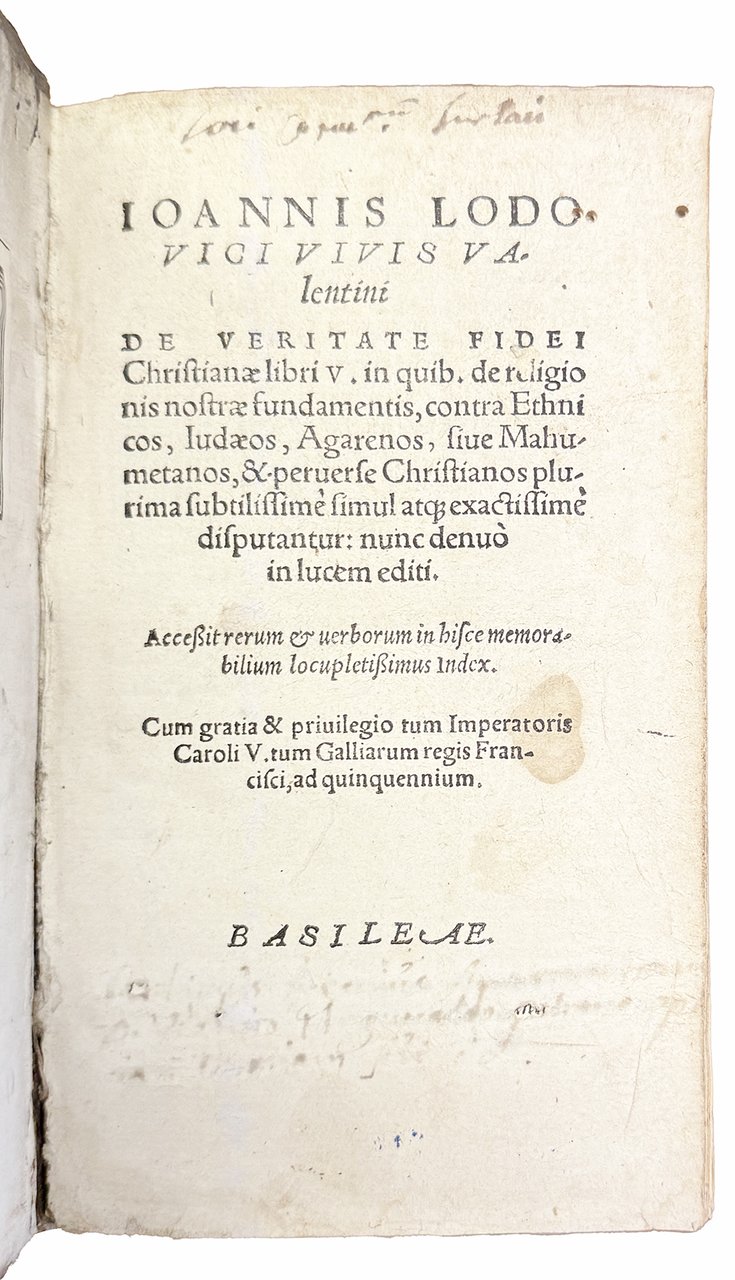
De veritate fidei Christianae libri V. in quib. de religionis nostrae fundamentis, contra Ethnicos, Iudaeos, Agarenos, sive Mahumetanos, & perverse Christianos plurima subtilissimè simul atq[u]e exactissimèdisputantur: nunc denuo in lucem editi
Mode de Paiement
- PayPal
- Carte bancaire
- Virement bancaire
- Pubblica amministrazione
- Carta del Docente
Détails
- Année
- 1544 (June)
- Lieu d'édition
- Basel
- Auteur
- VIVES, Juan Luis (1492-1540)
- Éditeurs
- Johannes Oporin
- Thème
- Quattro-Cinquecento
- Etat de conservation
- En bonne condition
- Langues
- Italien
- Reliure
- Couverture rigide
- Condition
- Ancien
Description
WITH A DIALOGUE BETWEEN A CHRISTIAN, A JEW AND A MUSLIM
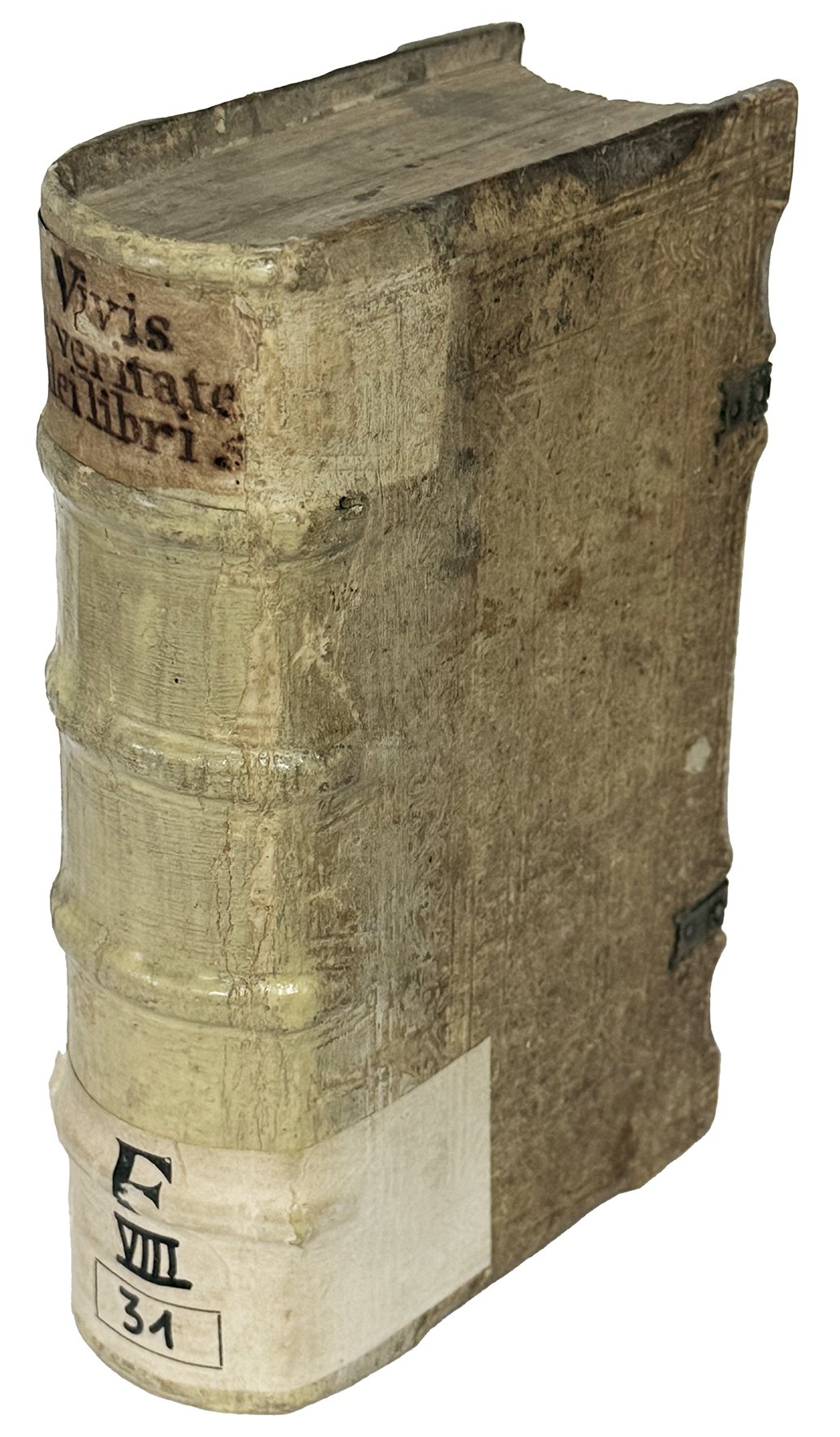
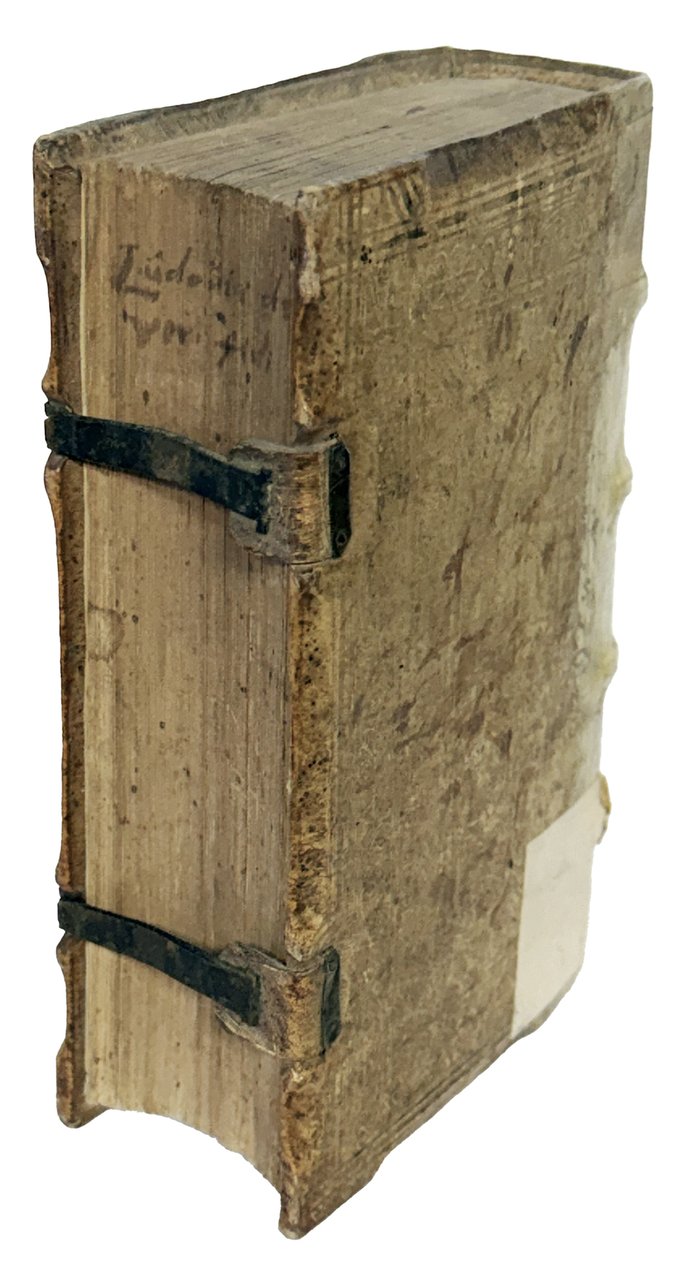
8vo (161x92 mm). [28] leaves, 701, [1] pp., [1] leaf. Collation: α8 β8 γ8 δ4 A-Xx8. Contemporary blind-stamped pigskin, two clasps, tinted back with manuscript title-label, small stamp and ex-libris on the inner front panel, old entries of ownership on the title-page (one erased), a few light spots, but a very attractive copy.
First octavo edition. The De veritate fidei Christianae, the last and longest of Vives' works, first appeared posthumously in January 1553. His longtime friend Frans van Craneveldt (1485-1564) saw it through the presses in cooperation with Vives' widow Margaret Valdaura. She kept her promise to her husband to see the work dedicated to the reigning Pope Paul III.
“To describe the contents of the De veritate fidei Christianae with oversimplified brevity: Book One covers the true end of humanity, the nature of mankind and God, the universe, divine providence, and the soul's immortality, arriving at most of its conclusions from reason and restoring to revelation mainly toward the end. Book Two takes up revealed sources, discussing the life of Christ, the trinity, the origins of the New Testament, the history of the church, the end of the world, and the day of judgement. The next two books shift suddenly from expository discourse to dialogue, in which a Christian engages a Jew in Book Three and a Muslim in Book Four. Book Five reverts to ordinary explication, recapitulating the superiority of Christianism over Judaism, Islam, or any other persuasion” (E.V. George, Author, Adversary, and Reader: A View of the ‘De veritate fidei Christianae', in: “A Companion to Juan Luis Vives”, Ch. Fantazzi, ed., Leiden, 2008, p. 318; see also M.L. Colish, The ‘De veritate fidei Christianae' of Juan Luis Vives, in: “Christian Humanism. Essays in Honour of Arjo Vanderjagt”, A.A. MacDonald, R.W.M. von Martels & J.R. Veenstra, eds., Leiden, 2009, pp. 173-197).
The present edition has a new dedicatory letter from the printer Oporin to his uncle, the theologian and humanist Ludwig Bär (1479-1554), who had followed Erasmus to Freiburg i.Br., when the Catholic service was prohibited in Basel in 1529 (see item no. 18 for his entry of ownership). In this important letter Oporin manifests his close relation with Vives and the genesis of the present work: “Die lateinische Erstausgabe des De veritate fidei christiana hatte Oporin im Januar 1543 im gleichen Format ‘augustiori charactere et forma' wie seine Koranausgabe gedruckt, da er das werk offenbar als Teil eines mehrbändigen Corpus von Schriften über den Islam betrachtete. Auf den Wunsch vieler Leser druckte er jedoch das Buch 1544 in kleinem Format (‘enchiridii forma') wieder, um es handlicher zu machen: ‘quo commodius omnium manibus feri gestarique in sinu posset'. Neu in dieser Ausgabe war ein bis heute anscheinend wenig beachteter Widmungsbrief an den katholischen Theologen und Erasmusfreund Ludwig Bär, in welchem sich der Basler Drucker über seine Beziehung zu Vives und über die Entstehung des Werkes eingehend aüsserte” (C. Gilly, Spanien und der Basler Buchdruck, Basel & Frankfurt/M., 1985, p. 183).
Juan Luis Vives, one of the greatest humanists of sixteenth century Europe, was born at Valencia. In 1509 he travelled to Paris, where he studied scholastic philosophy at the Collège de Montaigu. In 1512 he left for Bruges, which became his permanent home and the center of his activities. Here he met Erasmus, who was impressed with the young humanist. Vives then taught for some years humanities at Louvain and he accepted an offer from Cardinal Thomas Wolsey to lecture in Greek at Oxford. In England he enjoyed the patronage of Henry VIII and cultivated friendships with Thomas More, John Fisher, Thomas Linacre. He also versed as tutor to princess Mary. In 1528, however, he lost the favour of Henry VIII by siding with Catherine of Aragon in the matter of the divorce. In the last decade of his life, the most productive from
