Livres anciens et modernes
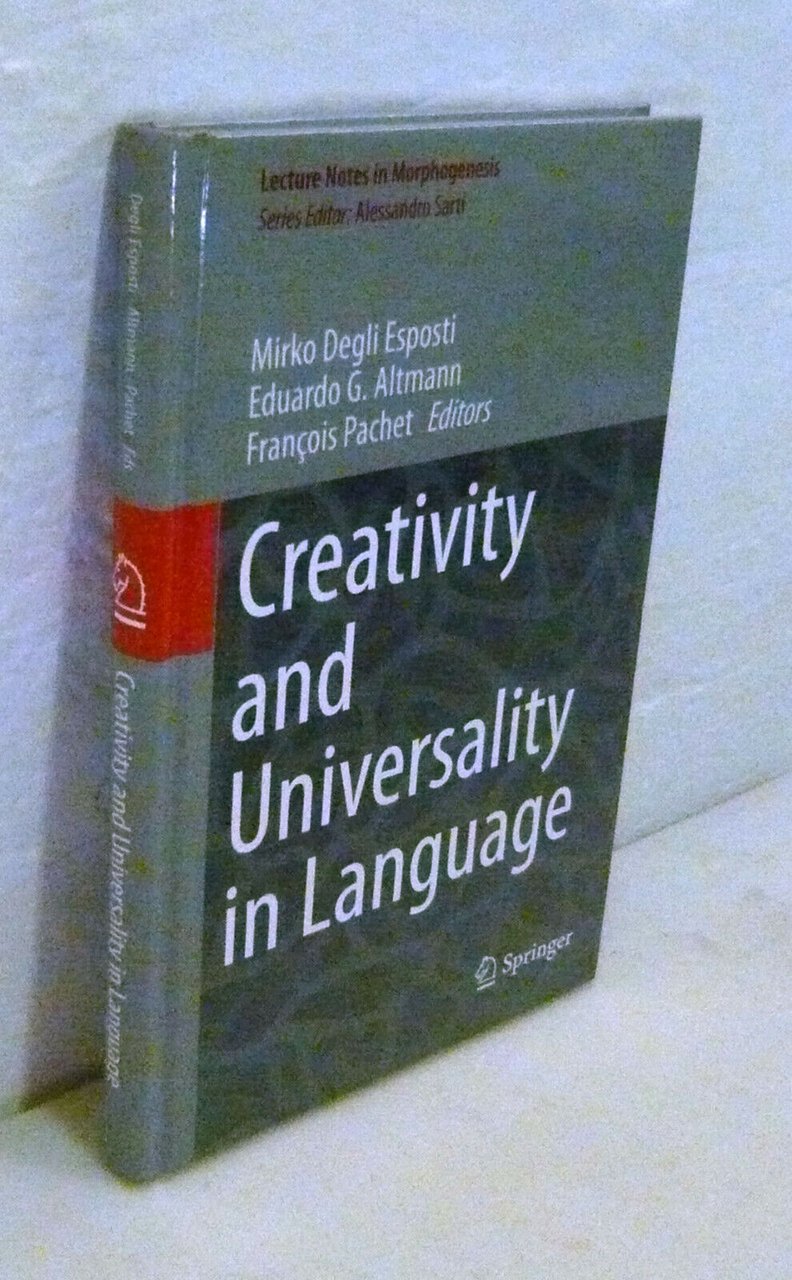
Degli Esposti,CREATIVITY AND UNIVERSALITY IN LANGUAGE,2016 Springer[linguistica
69,90 €
Modo Infoshop
(Bologna, Italie)
Les frais d'expédition corrects sont calculés une fois que l'adresse de livraison a été indiquée lors de la création de la commande. Un ou plusieurs modes de livraison sont disponibles à la discrétion du vendeur : standard, express, economy, in store pick-up.
Conditions d'expédition de la Librairie:
Pour les articles dont le prix est supérieur à 300 euros, il est possible de demander un plan de paiement échelonné à Maremagnum. Le paiement peut être effectué avec Carta del Docente, Carta della cultura giovani e del merito, Public Administration.
Les délais de livraison sont estimés en fonction du temps d'expédition de la librairie et de la livraison par le transporteur. En cas de retenue douanière, des retards de livraison peuvent survenir. Les frais de douane éventuels sont à la charge du destinataire.
Pour plus d'informationsMode de Paiement
- PayPal
- Carte bancaire
- Virement bancaire
-
-
 Découvrez comment utiliser
votre Carta del Docente -
 Découvrez comment utiliser
votre Carta della cultura giovani e del merito
Détails
Description
Mirko Degli Esposti, Eduardo G. Altman,
François Pachet (editors),
CREATIVITY AND UNIVERSALITY IN LANGUAGE.
Springer, 2016,
copertina rigida, 24x15,8 cm., pp.208,
Collana “Lecture Notes in Morphogenesis”,
testo in inglese,
peso: g.482
cod.5121
CONDIZIONI DEL LIBRO: ottime, come nuovo
dalle note editoriali:
This book collects research contributions concerning quantitative approaches
to characterize originality and universality in language.
The target audience comprises researchers and experts in the field but the
book may also be beneficial for graduate students.
Creativity might be considered as a morphogenetic process combining universal
features with originality.
While quantitative methods applied to text and music reveal universal features
of language and music, originality is a highly appreciated feature of authors,
composers, and performers.
In this framework, the different methods of traditional problems of authorship
attribution and document classification provide important insights on how to
quantify the unique features of authors, composers, and styles.
Such unique features contrast, and are restricted by, universal signatures,
such as scaling laws in word-frequency distribution, entropy measures, long-range
correlations, among others.
This interplay between innovation and universality is also an essential ingredient
of methods for automatic text generation.
Innovation in language becomes relevant when it is imitated and spread to other
speakers and musicians.
Modern digital databases provide new opportunities to characterize and model
the creation and evolution of linguistic innovations on historical time scales,
a particularly important example of the more general problem of spreading of
innovations in complex social systems.
This multidisciplinary book combines scientists from various different backgrounds
interested in quantitative analysis of variations (synchronic and diachronic) in
language and music.
The aim is to obtain a deeper understanding of how originality emerges, can
be quantified, and propagates.
Contents
Introduction to the Volume................................................... 1
Mirko Degli Esposti, Eduardo G. Altmann and François Pachet
Statistical Laws in Linguistics.............................................. 7
Eduardo G. Altmann and Martin Gerlach
Complexity and Universality in the Long-Range Order
of Words.................................................................... 27
Marcelo A. Montemurro and Damián H. Zanette
Symmetry and Universality in Language Change................................ 43
Richard A. Blythe
Dynamics on Expanding Spaces: Modeling the Emergence
of Novelties................................................................ 59
Vittorio Loreto, Vito D.P. Servedio, Steven H. Strogatz and Francesca Tria
Generating Non-plagiaristic Markov Sequences with Max
Order Sampling.............................................................. 85
Alexandre Papadopoulos, François Pachet and Pierre Roy
Integrating Purpose and Revision into a Computational
Model of Literary Generation............................................... 105
Pablo Gervás and Carlos León
Detection of Computer-Generated Papers in Scientific Literature.......... 123
Cyril Labbé, Dominique Labbé and François Portet
Universality of Stylistic Traits in Texts.................................. 143
Efstathios Stamatatos
Dynamics of Style and the Case of the Diario Postumo
by Eugenio Montale: A Quantitative Approach................................ 157
Dario Benedetto and Mirko Degli Esposti
Universality and Creativity: The Usage of Language
in Gender and Irony...................................................... 177
Paolo Rosso, Delia Irazú Hernández Farias and Francisco Rangel
Computational Approaches to the Analysis of Human Creativity............ 187
Fabio Celli
Meaning and Creativity in Language.................................... 197
Luc Steels
