Duellum epistolare: Gallie & Italiæ antiquitates summatis complectens. Trophaeum Christianissimi galliarum regis Francisci huius nominis primi. Item complures illustrium virorum epistolae ad dominu[m] Symphorianu[m] Camperiu[m]
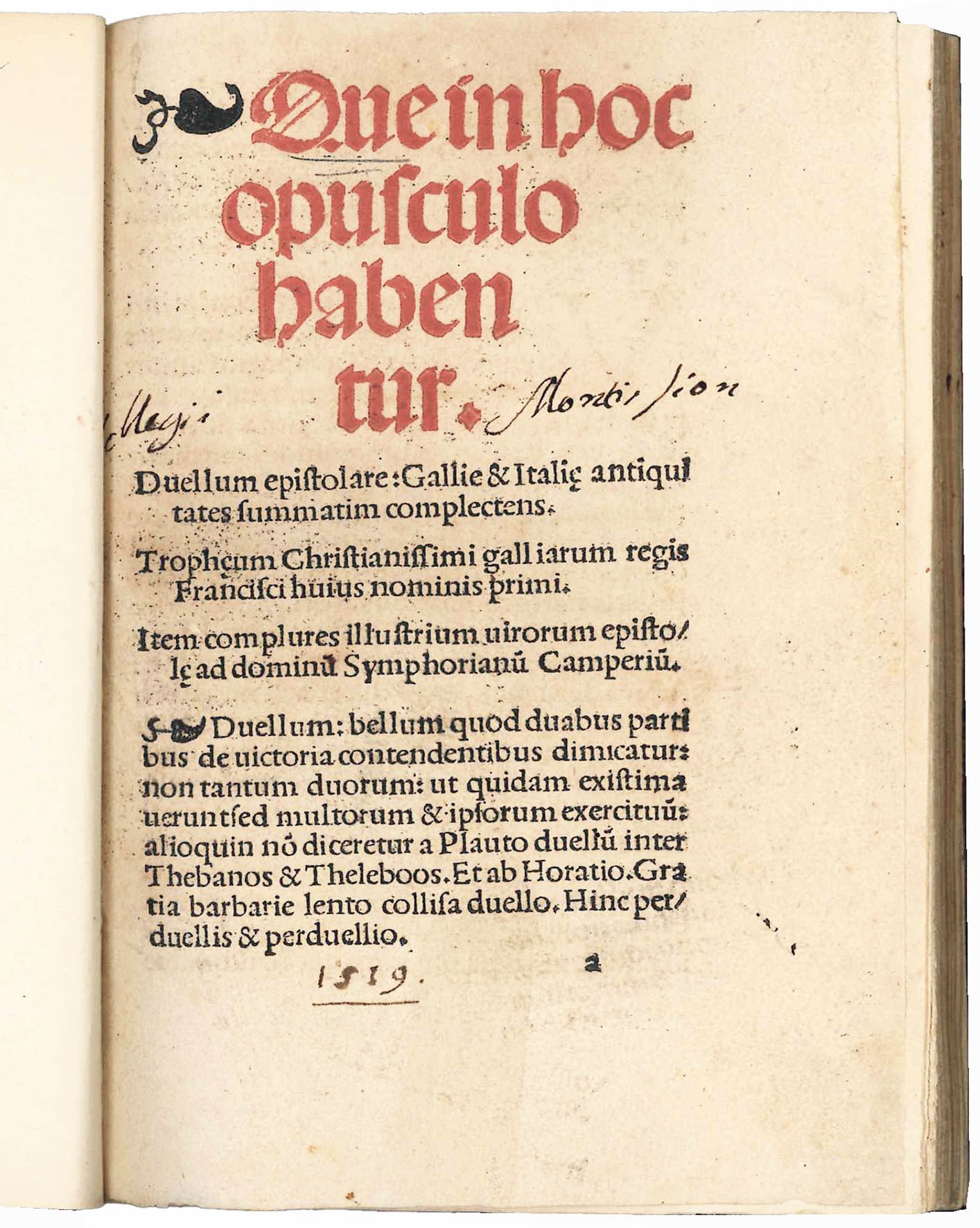

Duellum epistolare: Gallie & Italiæ antiquitates summatis complectens. Trophaeum Christianissimi galliarum regis Francisci huius nominis primi. Item complures illustrium virorum epistolae ad dominu[m] Symphorianu[m] Camperiu[m]
Mode de Paiement
- PayPal
- Carte bancaire
- Virement bancaire
- Pubblica amministrazione
- Carta del Docente
Détails
- Année
- 10 October 1519
- Lieu d'édition
- [Lyon]
- Auteur
- CHAMPIER, Symphorien (ca. 1474-1539)
- Éditeurs
- Jean Phiroben & Jean Divineur for Jacques François Giunta
- Thème
- Quattro-Cinquecento
- Etat de conservation
- En bonne condition
- Langues
- Italien
- Reliure
- Couverture rigide
- Condition
- Ancien
Description
WITH AN AN EARLY BIBLIOGRAPHY OF CHAMPIER'S WORKS
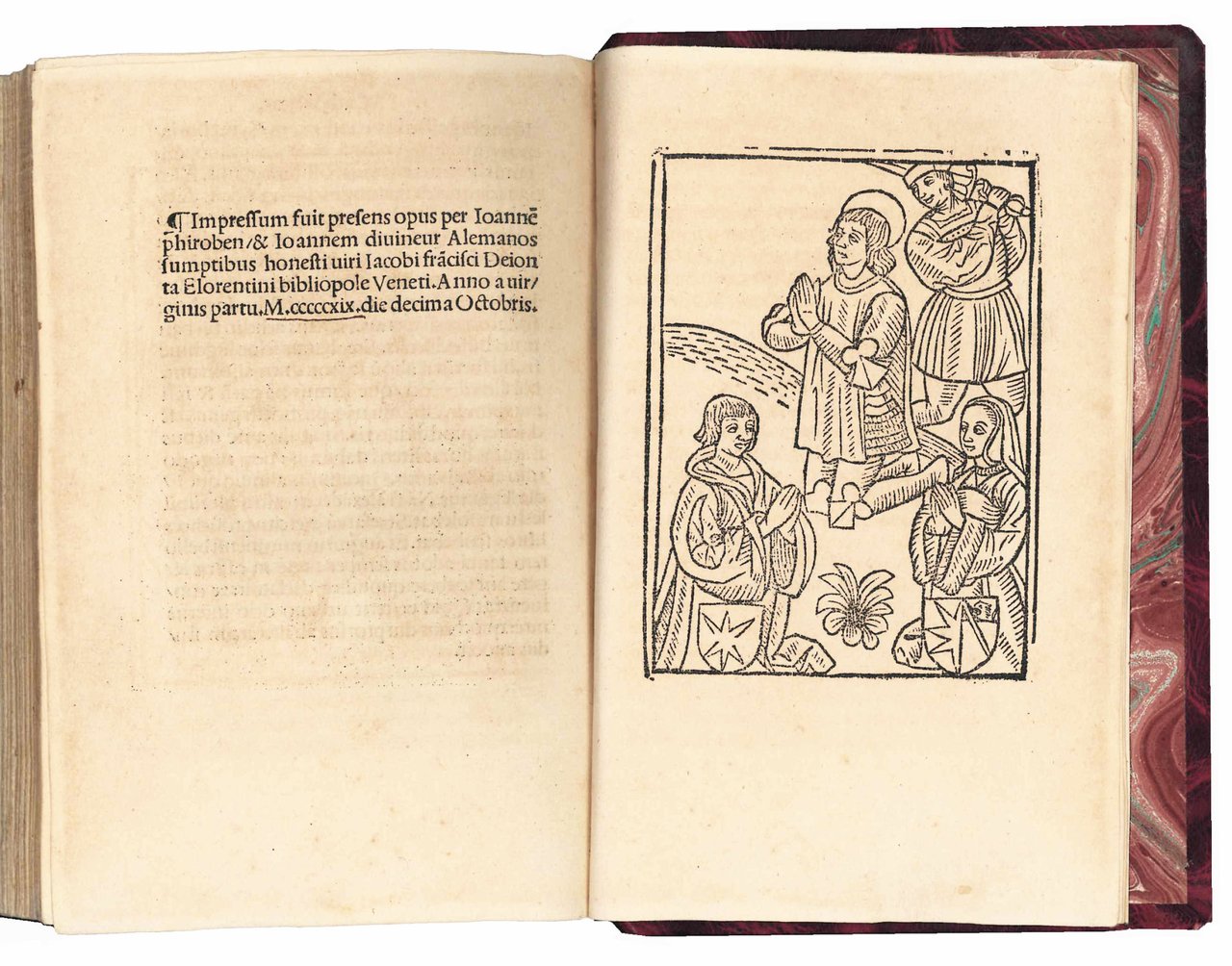
8vo (157x105 mm). [96] leaves. Collation: a-m8. Title printed in red and black and a full-page woodcut at the end showing the author with his patron and his wife kneeling in prayer. 20th-century gilt calf, marbled endleaves. Skilfully repaired worm track to the outer margin of several leaves not affecting the text, small repaired hole to l. e8 with loss of some text (the missing text has been supplied by hand), uniformly browned, still a good copy.
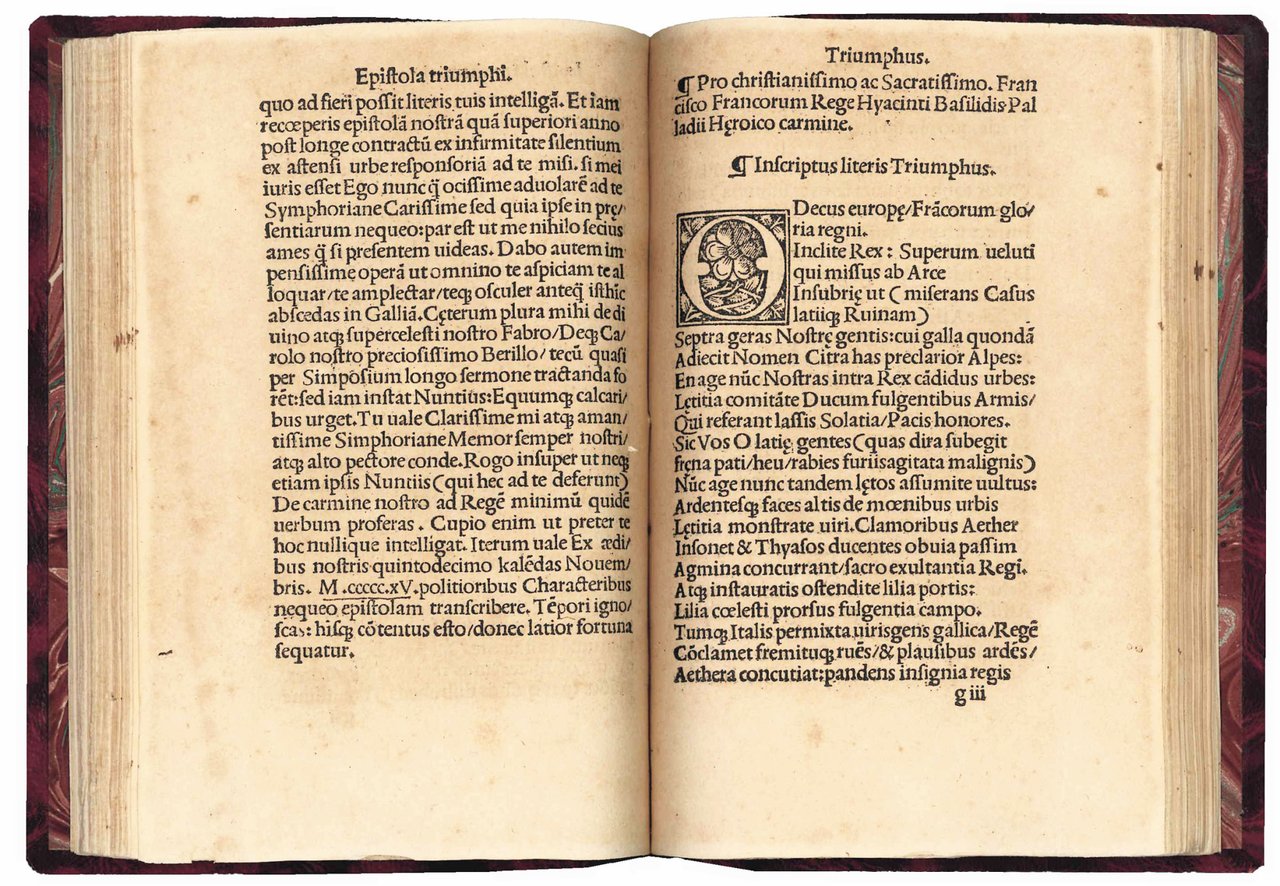
Rare first edition of Champier's most interesting work, a significant document for the development of cultural nationalism among Renaissance intellectuals. Champier was in Italy three times: in 1506, in 1509 and in 1515. During his last travel he spent some time at Pavia, where he was admitted to the ‘collegium artistarum et medicorum'. The speech by Pietro Antonio Rustico, lecturer on logic and medicine, held on that occasion and printed toward the end of the volume, shows how proud Champier was about this honor. Rustico also alludes to Champier's family ties in Italy, which he sees in the Campeggi families of Bologna and Pavia. At the end of the speech Rustico enumerates and praises the hitherto books published by Champier, important as an early bibliography. The main part of the volume though consists of a ‘epistolary duel' with Girolamo da Pavia, an Augustinian monk from Asti, with whom Champier had for five years an intensive correspondence through the Lyonese publisher Balthazar de Gabiano (cf. P. Jodogne, La correspondence de Symphorien Champier avec Jérôme de Pavie dans le ‘Duellum epistolare', in: “The Late Middle Ages and the Dawn of Humanism Outside of Italy”, G. Verneke & J. Ijsewijn, eds., Den Haag, 1972, pp. 44-56).
In the Duellum Champier defends the French culture against the pretended superiority of the Italian claimed by some scholars, namely Sabellico, Foresti and Battista Mantovano. He also sees in many Italian writers detractors moved only by jealousy and malice and mentions Valla, Merula, Poggio, Pico and Girolamo Balbo. Fierce of his Lyonnais origins he praises the antique origins of his native city on the authority of Berosus, which however was rightly questioned by Girolamo da Pavia and Raphael Maffei of Volterra. Even though Champier was not familiar with Annius of Viterbo's Antiquities (1498), in which the Berosus tradition made its first appearance, Champier contributed to the Gallican, anti-Italian Italia mendax narrative based on Berosus' assertions about the origin of the names “Gallia” and “Lugdunum” (cf. R. Cooper, Symphorien Champier et l'Italie, in: “L'Aube de la Renaissance”, Genève, 1991, pp. 233-246; see also W. Stephens, Giants in Those Days, Lincoln, 1989, pp. 171-174).
The volume contains furthermore various letters by Champier to others, e.g. a letter to Erasmus (Ep. 680a), in which Champier intervenes in his favor in the latter's dispute with Lefèvre d'Etaples over Psalm 8; a letter to Lefèvre d'Etaples followed by Champier's commentary on the Definitiones Asclepii (first published with Lazzarelli's translation in 1507), expressing his attitude to the Hermetic writings. But the book also contains letters addressed to Champier, mainly from other scholars and physicians, among them Alessandro Benedetti and Robert Cockburn, bishop of Ross (cf. A. Broadie, James Liddell on Concepts and Signs, in: “The Renaissance in Scotland: studies in literature, religion, history and culture”, A.A. MacDonald, et al. eds., Leiden, 1994, p. 82; see also J. Durkan, Robert Cockburn, bishop of Ross and French humanism, in: “Innes Review”, IV, 1953, pp. 121-2.).
The volume closes with Catalogus preceptorum, patronorum, familarium et auditorum, in which Champier lists his teachers, patrons, friends and students.
Though some scholars believe the work to be printed either at Basel or at Venice, it was in fact printed at Lyon, where the two printers Johann Froben and Jean Divineur were active for several Lyonese pu
