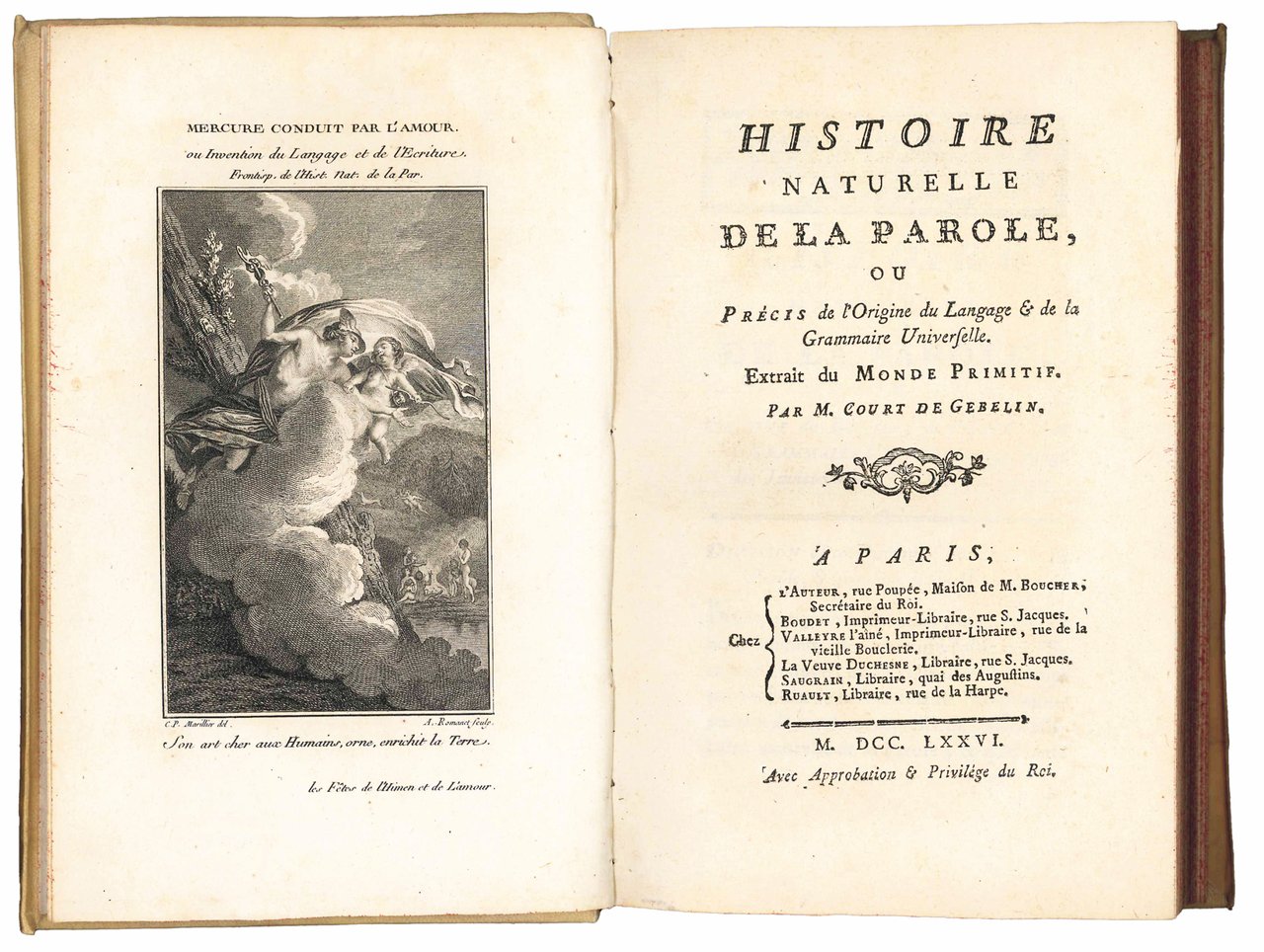
Histoire naturelle de la parole ou Précis de l'Origine du Language & de la Grammaire Universelle. Extrait du Monde Primitif par M. Court de Gebelin
Histoire naturelle de la parole ou Précis de l'Origine du Language & de la Grammaire Universelle. Extrait du Monde Primitif par M. Court de Gebelin
Mode de Paiement
- PayPal
- Carte bancaire
- Virement bancaire
- Pubblica amministrazione
- Carta del Docente
Détails
- Année
- 1776
- Lieu d'édition
- Paris
- Auteur
- COURT DE GÉBELIN, Antoine (1725-1784)
- Thème
- settecento
- Etat de conservation
- En bonne condition
- Langues
- Italien
- Reliure
- Couverture rigide
- Condition
- Ancien
Description
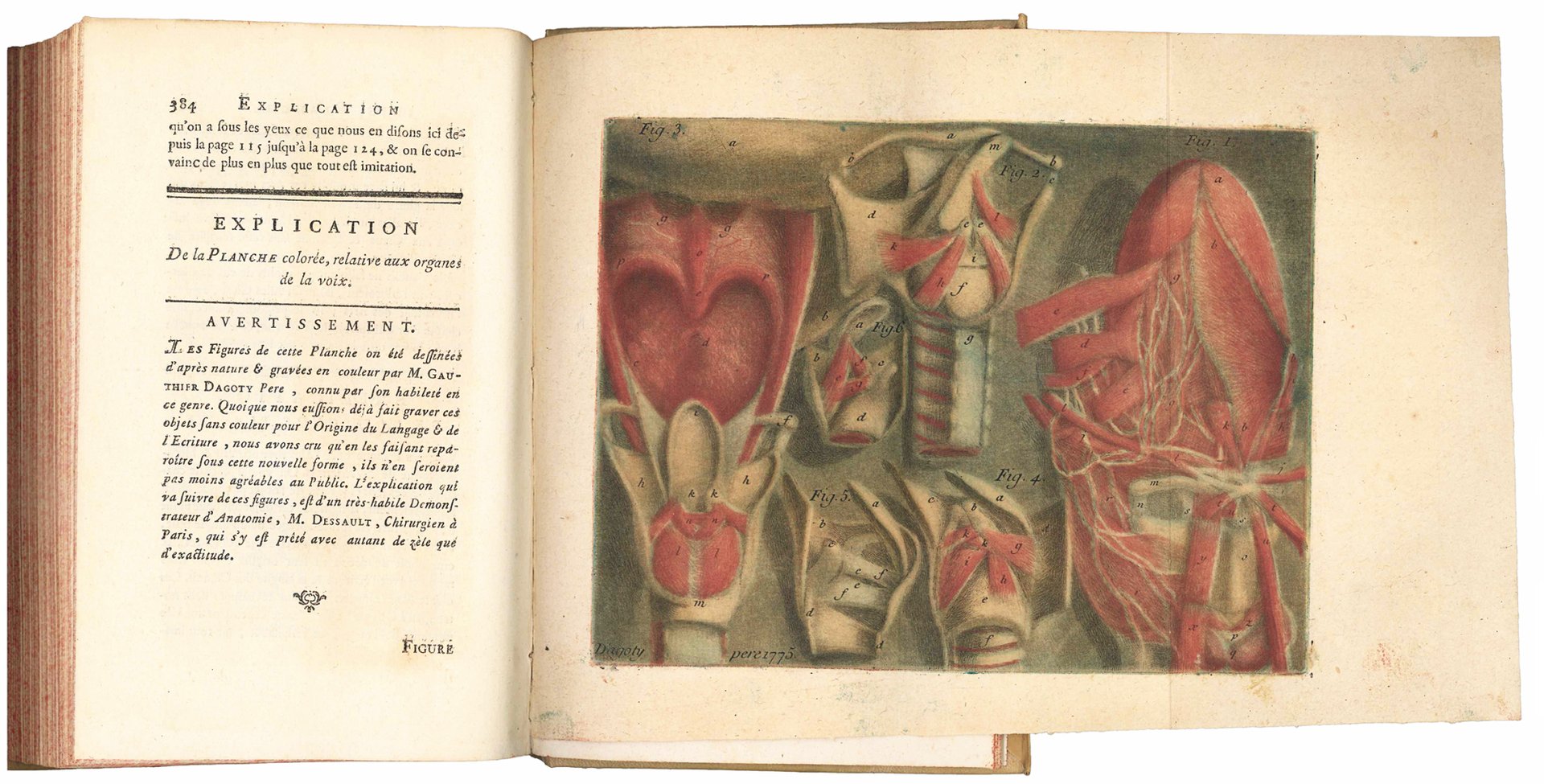
WITH A COLOUR-PRINTED PLATE OF THE SPEECH ORGANS BY JACQUES-FABIEN GAUTHIER DAGOTY
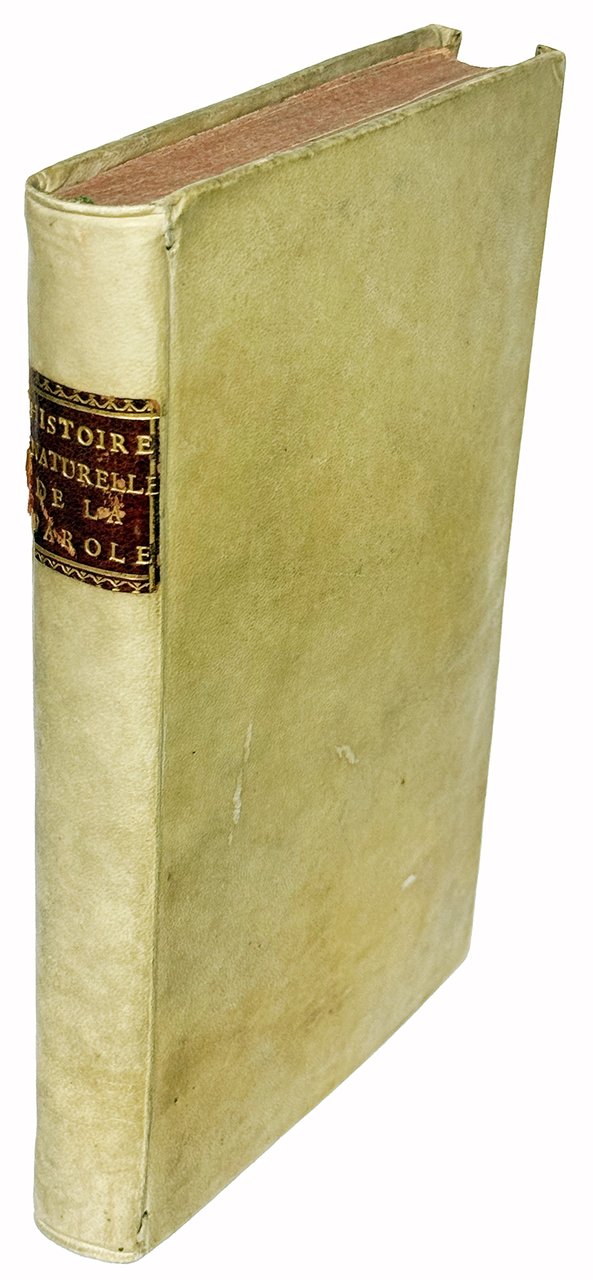
8vo (201x127 mm). [4], 400 pp. With an engraved frontispiece (“Mercure conduit par l'Amour ou Invention du Langage et de l'Écriture) by A.L. Romanet after C.P. Marillier, a folding table with the “Alphabet Primitif”, and a folding colour-printed plate (195x15 mm) of tongue, larynx and speech organs by Jacques-Fabien Gauthier Dagoty, “connu par son habilité en ce genre”, as stated by the publishers in a special “avertissement” (see the Explication on p. 384). Contemporary stiff vellum with ovelapping edges, lettering piece on spine, red sprinkled edges, green silk bookmark. Book plates Fratelli Salimbeni and “G.P.C.” with winged horse and motto ‘nec adversa retorquent'. Some light browning, a good, fresh copy.
First separate edition of this early theoretical treatise on the universal origins of speech and language. The color plate is among the last plates Gauthier Dagoty realized: it was printed from separate mezzotint plates, one for each primary colour and one for black. The text is an extract of the third volume of Le monde primitif, a vast work in nine volumes published by Court de Gébelin between 1773 and 1782. Court de Gébelin developed the idea that the relationship between specific articulations and certain notions was not arbitrary and that there was a biological basis for the tendency to associate certain sounds with certain notions.
“Since it is generally held that 17th and 18th century work in general grammar lost interest among 19th-century linguists, it may be worth asking whether the work of Humboldt does not reveal a definite influence of 18th-century linguistic theories, such as those expounded in the work of Antoine Court de Gébelin (1725-84) of whose Histoire naturelle de la parole, ou Précis de l'origine du langage et de la grammaire universelle (1776) the early 19th-century editor made the following observations: ‘La parole est née avec l'homme; elle lui a été donnée par la nature. Ainsi les règles qui en dirigent l'usage, ne sont point arbitraires; ce ne sont que des modifications de principes immuables. De cette grammaire générale ou universelle devaient découler les grammaires comparatives des différentes langues; en van de histore naturelle: Tout mot a eu sa raison prise dans sa nature. C'est sur cette base que Gébelin fonde l'art étymologique' (Jean Denis Comte Lanjuinais, Discours préliminaire to A. Court de Gébelin, Histore naturelle de la parole, second edition, Paris, 1816). It is true that many of Court de Gébelin's claims and linguistic practices have been rightly discarded by 19th-century philologists, but his assumptions underlying the program for a general grammar, which is much in line with the tradition of the grammaire générale of the 18th century (e.g. de Brosses, Beauzée), seem to have been influential at least up to the mid-19th century, as August Fredrich Pott's (1802-87) critique of 1863 suggests” (E.F.K. Koerner, European Structuralism: Early Beginnings, in: “History of Linguistics”, H. Aarsleff, R. Austerlitz & D. Hymes, eds., Berlin, 2021, vol. 2, p. 745).
Antoine Court de Gébelin was a pastor of the French Reformed church and a tolerant propagandist for Protestantism, as shown in his Les Lettres toulousaines (1763). With Benjamin Franklin and others he supported the independence of the American colonies in the Affaires de l'Angleterre et de l'Amérique (1776). His most important work of scholarship was the unfinished Le Monde primitif, analysé et comparé avec le monde moderne ( “The Primitive World, Analyzed and Compared with the Modern World”), which, among other things, offered a theory of allegory, a history of the calendar, a comparative grammar, and a universal theory of languages.
Cohen-De Ricci, pp. 261-262; Early Colour Printing, p. 51, IX; Blake, 101; Haag, IV, col. 821.
