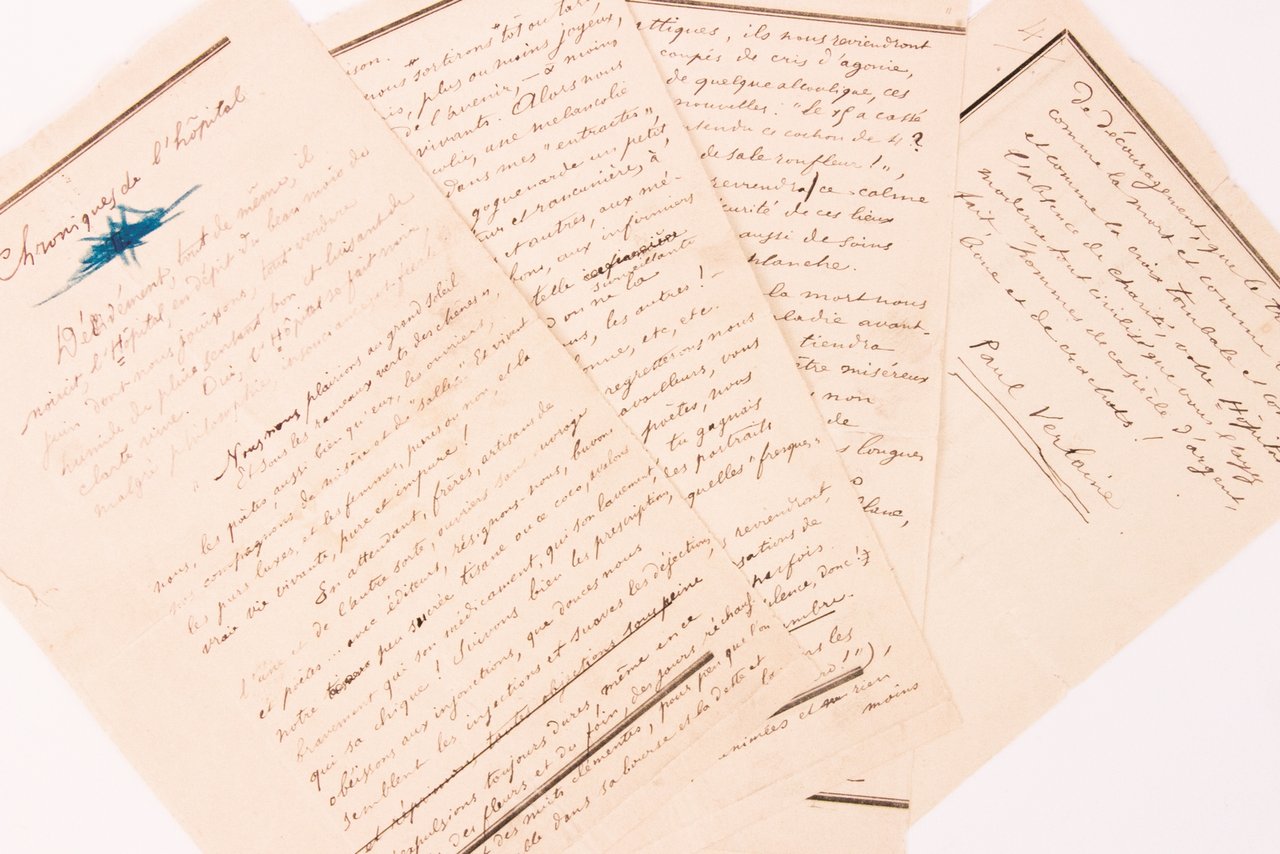
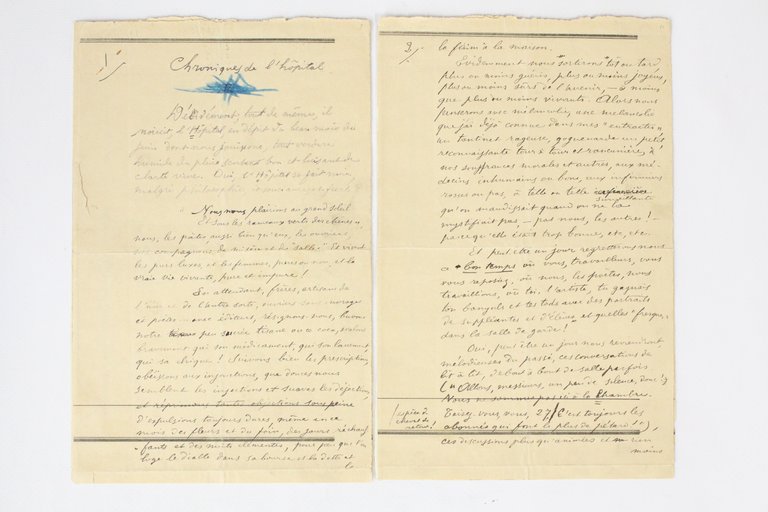
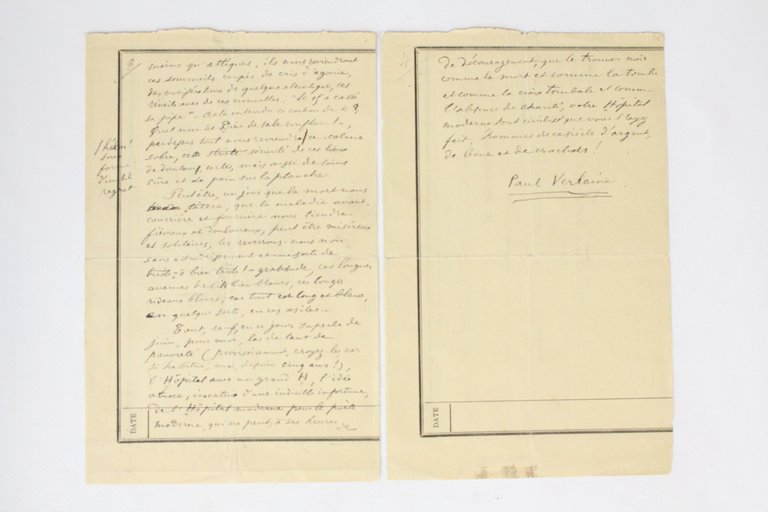
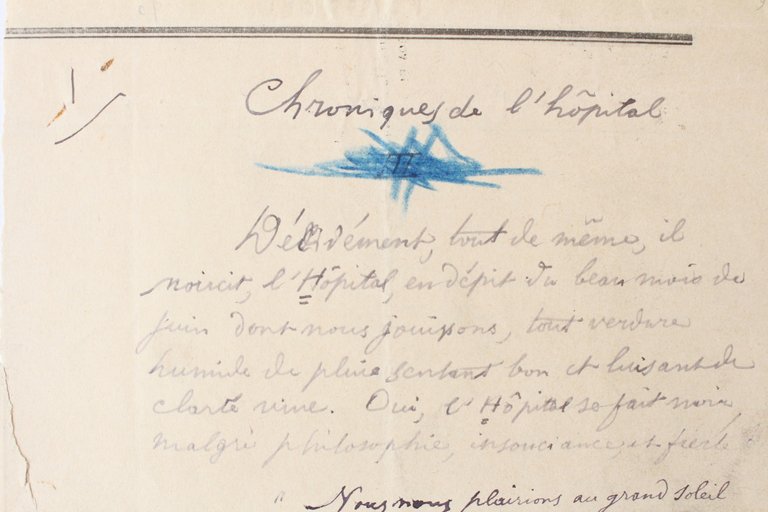
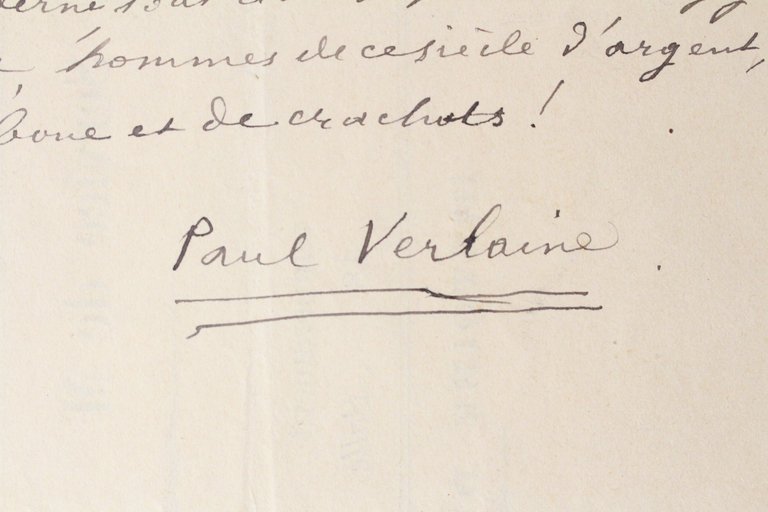
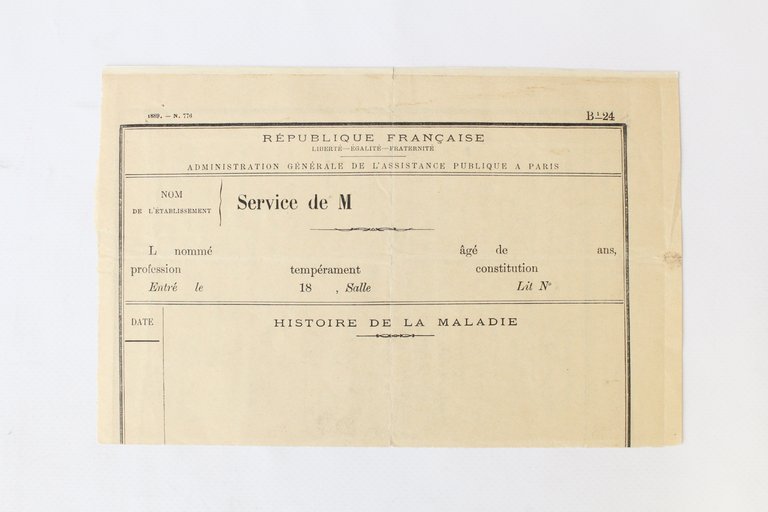
Paris s. d. [1890] | 21.30 x 14 cm | 3 pages in-8 au verso de 4 feuillets de l'Assistance publique de Paris | VERLAINE Paul Complete autograph manuscript signed by Paul Verlaine of one of his Hospital Chronicles: “We poets, as well as they, the workers, our companions in misery” Paris n. d. [1890], 213 x 140 mm (8 3/8 x 5 1/2 ”), 3 pages in-8 at the back of 4 leaves of the Assistance publique de Paris Complete autograph manuscript signed by Paul Verlaine of one of his Hospital Chronicles, 90 close lines in black ink on the verso of paper from the Assistance publique de Paris. The chronicle of one of Verlaine’s stays in hospital between September 1889 and February 1890. The note “III” has been crossed out in blue printer’s pencil. In the definitive collection, this text is, in fact, second. In the version published by Le Chat noir on 5 July 1890, there appear to be no variations with the text of this manuscript. This is thus the final state of the text, the one sent to the printer. Jacques Borel dates the writing of this chronicle to a hospital stay in Cochin in June 1890. Verlaine spent many days in hospital during his life, especially in this period. During these stays, he wrote Hospital Chronicles, prose poems in eight parts. Here, he mixed anecdotes, observations of the lives of the patients, and a delicate poetical analysis of the world of the hospital. Verlaine starts off with a troubling and tired observation: “But certainly, all the same, the Hospital darkens, despite the fine June weather.Yes, the Hospital is dark despite philosophy, insouciance, and pride.” Despite the fine weather, the inflexibility of the system, the misery and the sickness give the poet a gloomy take on things: “let us punish all objections under pain of expulsion, still severe, even in this month of flowers and hay, of warming days and clement nights, if you have the devil at your back and debt and hunger at home.” Discharge, whether by way of being thrown out or getting cured, and life outside did not offer more comfort than the stay itself: “Clearly, we’ll all get out sooner or later, more or less well, more or less happy, more or less sure of the future, at any rate more or less alive. So we will think sadly.of our suffering, emotional and otherwise, of the doctors, good or inhuman”. This was a feeling he had already experienced during what he called “my intervals”, the times when he was out of hospital. Life outside hospital was a miserable prospect, despite his established fame. Verlaine compares his misery to that of the working classes who share his stays in various hospitals. The poet calls for resignation from his “brothers, artisans of one sort or another, workers without a life’s-work and poets.and publishers too, let us accept our fate, let us drink up the cup of tea with (barely any sugar), or this little hot chocolate, and let us be brave whether it be with our medicine, or an enema, or chewing tobacco. Let us follow their prescriptions closely, let us obey all injunctions, so that injections and colonics will seem sweet to us, and let us reprimand all objections.”. And along with them, the poet wanted to take advantage of the beauties of June in quoting two verses from the Chanson sentimentale of Xavier Privas: “We are pleased with ourselves in the strong sun. And under the green branches of the oaks, we poets, as well as they, the workers, our companions in misery.”. Equal in the face of misfortune, whether active or passive, they might feel nostalgia once they were out: “And perhaps some day we will miss these good times where you workers, you could rest and where we, we poets, worked, and where you artists earned your wine and your cups .?” Despite this reverie, Verlaine was: “tired of so much poverty (provisionally, believe me, because I have been so used to it these last five years!)” and concludes bitterly with the observation of the lack of humanity in modern medicine: “Hospital with a capital H, an awful idea,
 Découvrez comment utiliser
 Découvrez comment utiliser