Le pistole vulgari
Le pistole vulgari | Livres anciens et modernes | FRANCO, Nicolò (1515-1570)

Le pistole vulgari
Le pistole vulgari | Livres anciens et modernes | FRANCO, Nicolò (1515-1570)
Mode de Paiement
- PayPal
- Carte bancaire
- Virement bancaire
- Pubblica amministrazione
- Carta del Docente
Détails
- Année
- [20 April 1539]
- Lieu d'édition
- [Venezia]
- Auteur
- FRANCO, Nicolò (1515-1570)
- Éditeurs
- [Antonio Gardane]
- Thème
- Quattro-Cinquecento
- Etat de conservation
- En bonne condition
- Langues
- Italien
- Reliure
- Couverture rigide
- Condition
- Ancien
Description
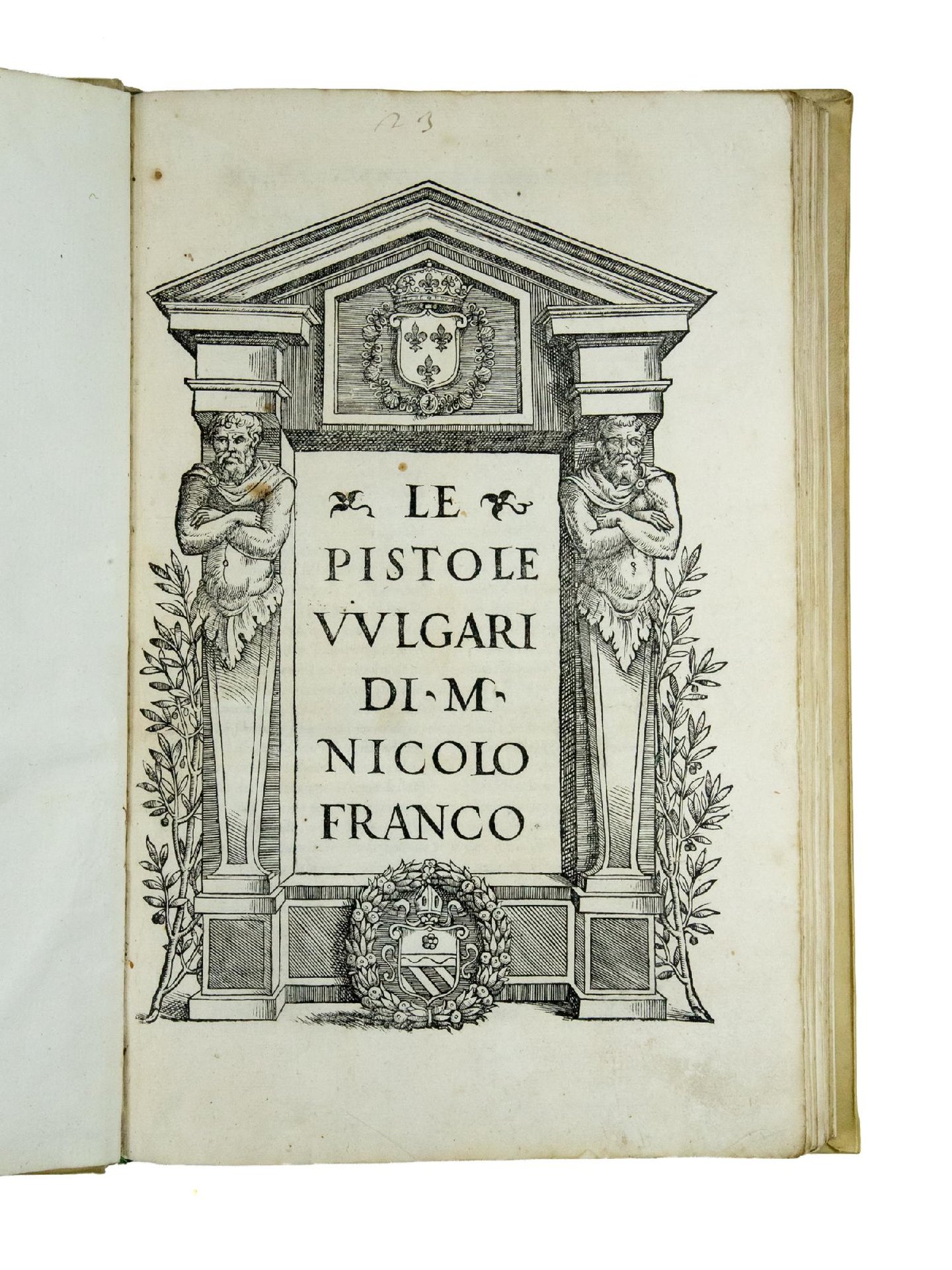
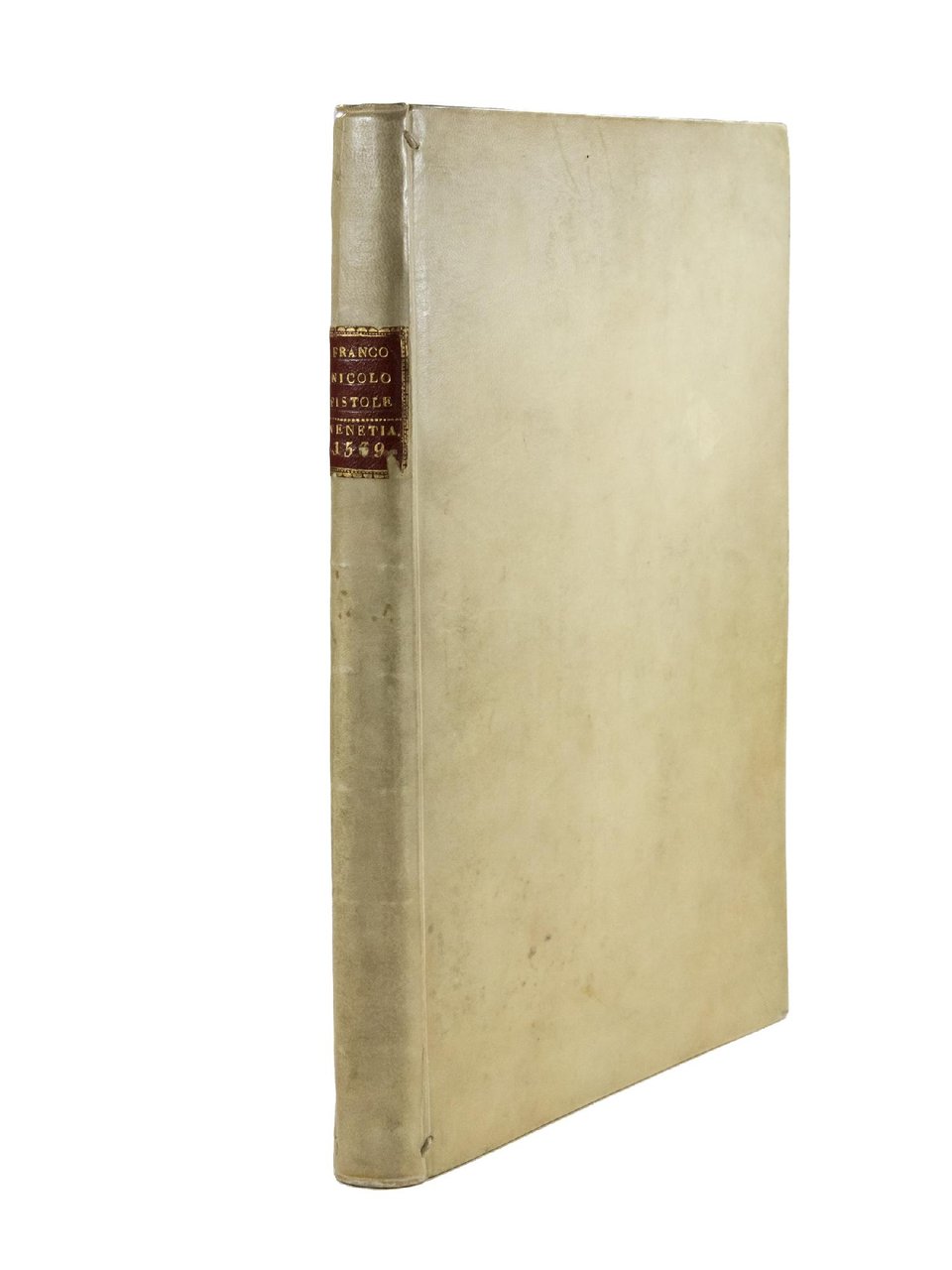
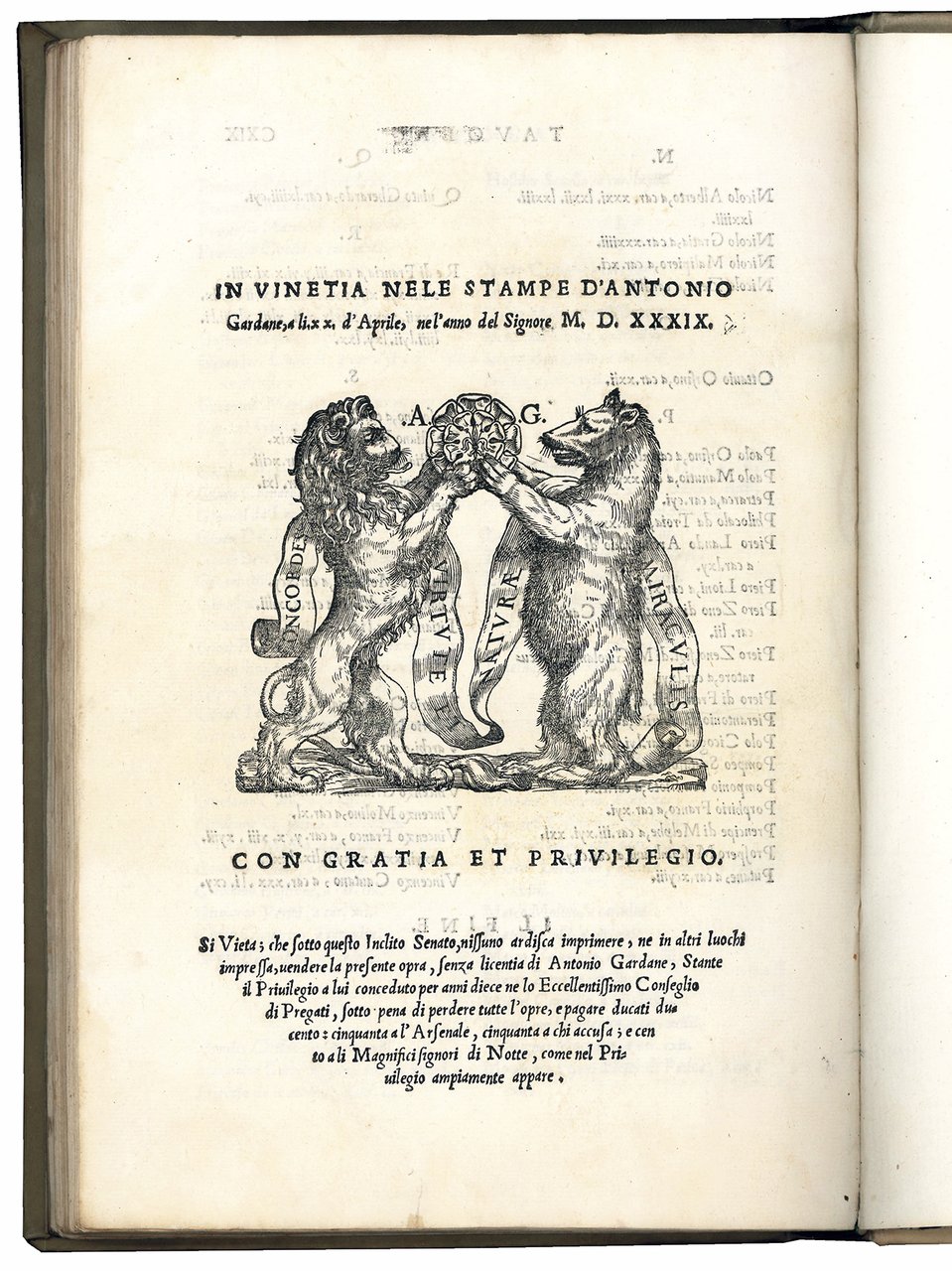
Folio (320x200 mm). CXIX [recte CXX] leaves. Collation: A-Z4, AA-GG4. With an architectural title-page and large typographical device on the verso of the last page. Late eighteenth-century vellum over boards, marbled endpapers, red morocco label on spine. With an interesting seven line manuscript note by Giulio Bernardino Tomitano (1761-1828) stating that the present copy was offered to the “Eccelso Consiglio dei X”, the rulers of Venice; and in fact there is a strip of paper pasted on the last endpaper with a two line dedication to the Consiglio dei X in a sixteenth-century hand possibly by Franco himself. A very fresh copy.
Adams, F-961; Basso, pp. 51-52; Edit 16, CNCE 19815; Quondam, p. 297; R.L. Bruni, Per una bibliografia delle opere di Nicolò Franco, in: “Studi e problemi di critica testuale”, XV, 1977, p. 84.
First edition, second issue with Gardane's address and his beautiful large typographical device. The first issue is dated November 1538 and bears neither address nor device. For this second issue the bi-folium GG1-GG4 was reset.
The book is dedicated to Leone Orsini (Venice, July 1, 1538), a member of the powerful roman family, and the founder of the Accademia degli Infiammati in Padua, who was made bishop of the diocese of Fréjus-Toulon in 1525 and, later on, agent to the king of France at the papal court. He was Franco's patron, and the latter dedicated two other works to him (cf. C. Schiavon, Una via d'accesso agli epistolari. Le dediche dei libri di lettere d'autore nel Cinquecento. Prima parte, in: “Margini. Giornale della dedica e altro”, 3, 2009, p. 21).
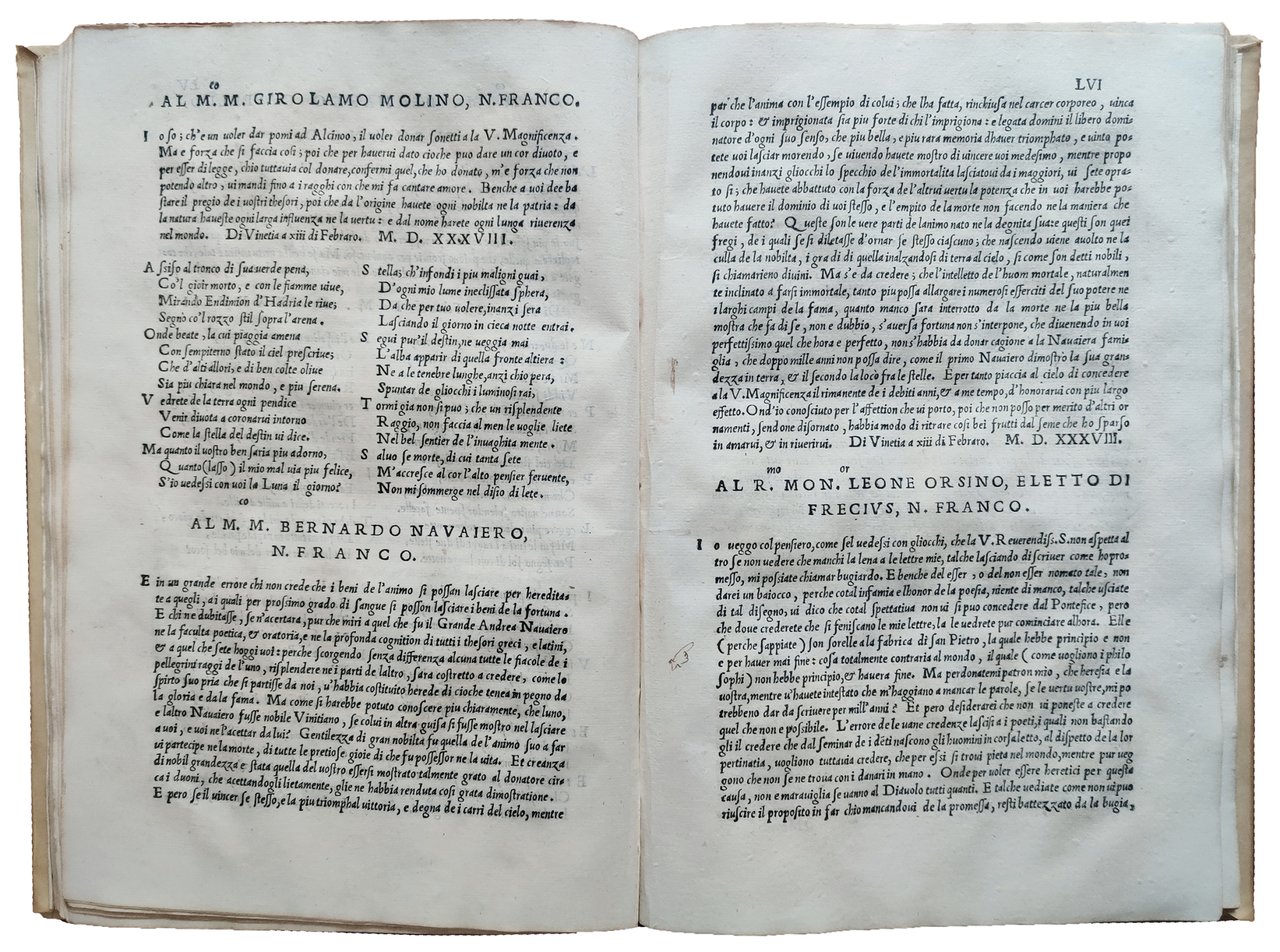
The collection contains 292 letters (all dated between 1531 and 1538) and many dedicatory sonnets. Although the imitation of Aretino as a model is immediately evident, even in the choice of the unusual folio format, the major difference between Aretino's De le lettere libro primo (Venice, 1538) and Franco's Pistole vulgari lies in the presence of many explicitly fictitious letters in the latter's collection, all gathered together in the third and final book. Besides that, the whole Franco's correspondence has raised doubts about its authenticity and historical veracity. In particular, the group of letters addressed to the king of France, Francis I, the first of which are dated 1531 when the author was only 16 years old, where questioned, even by Aretino. It is probable that they were written by Franco at a later date to win the favour of Francis I and to find a way to the court of France (cf. P. Grendler, Critics of the Italian World (1530-1560). Anton Francesco Doni, Nicolò Franco and Ortensio Lando, Madison-Milwaukee-London, 1969, p. 43).
Considering Franco's correspondents, some few homogeneous groups of recipients are easily recognizable: “accanto al gruppo composto da famosi uomini di governo capeggiati da Francesco I […], e a quello dei pochi ma molto amati amici beneventani (Cautano, Mansella Aquila), il nucleo più consistente è senz'altro rappresentato da interlocutori la cui prevalente ‘venezianità' mostra come per il Franco la mediazione aretiniana fosse stata fondamentale. Fra questi ultimi, inoltre, accanto ad uomini impegnati a vario titolo nel governo della repubblica (Donato, Da Legge, B. Navagero, G. Quirini, ecc.) o a intellettuali che tenevano cenacolo nella città (Grassi, Speroni, D. Venier, ecc.) emergono per numero soprattutto amici o discepoli dell'Aretino (Acquaviva, Ricchi, Spira, Marcolini, Venier, Degli Eusebi, Alunno, Sansovino, Tiziano, ecc.)” (F.R. De' Angelis, Introduzione, in: N. Franco, “Le pistole vulgari”, Sala Bolognese, 1986,p. XIX).
Among the fictitious letters of the third book is the famous Risposta della Lucerna (‘Lantern's answer'). It is in that lengthy letter that Franco launched his satirical and raucously attack on learning and announced his iconoclastic aims. “Lucerna wanders about at night in order to see if what men write corresponds to reality. Lucerna comments that many men write sonnets and canzoni in prai