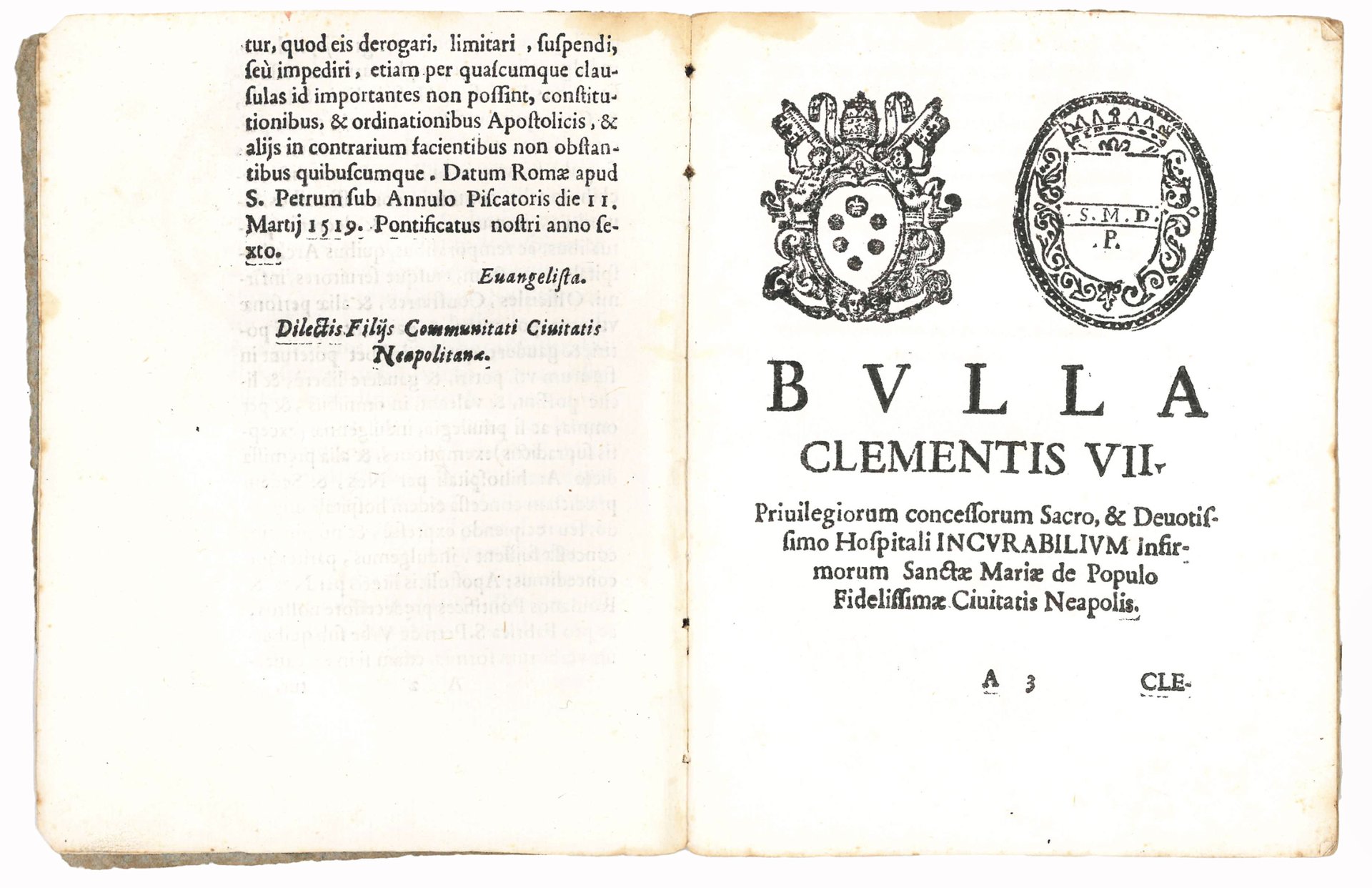
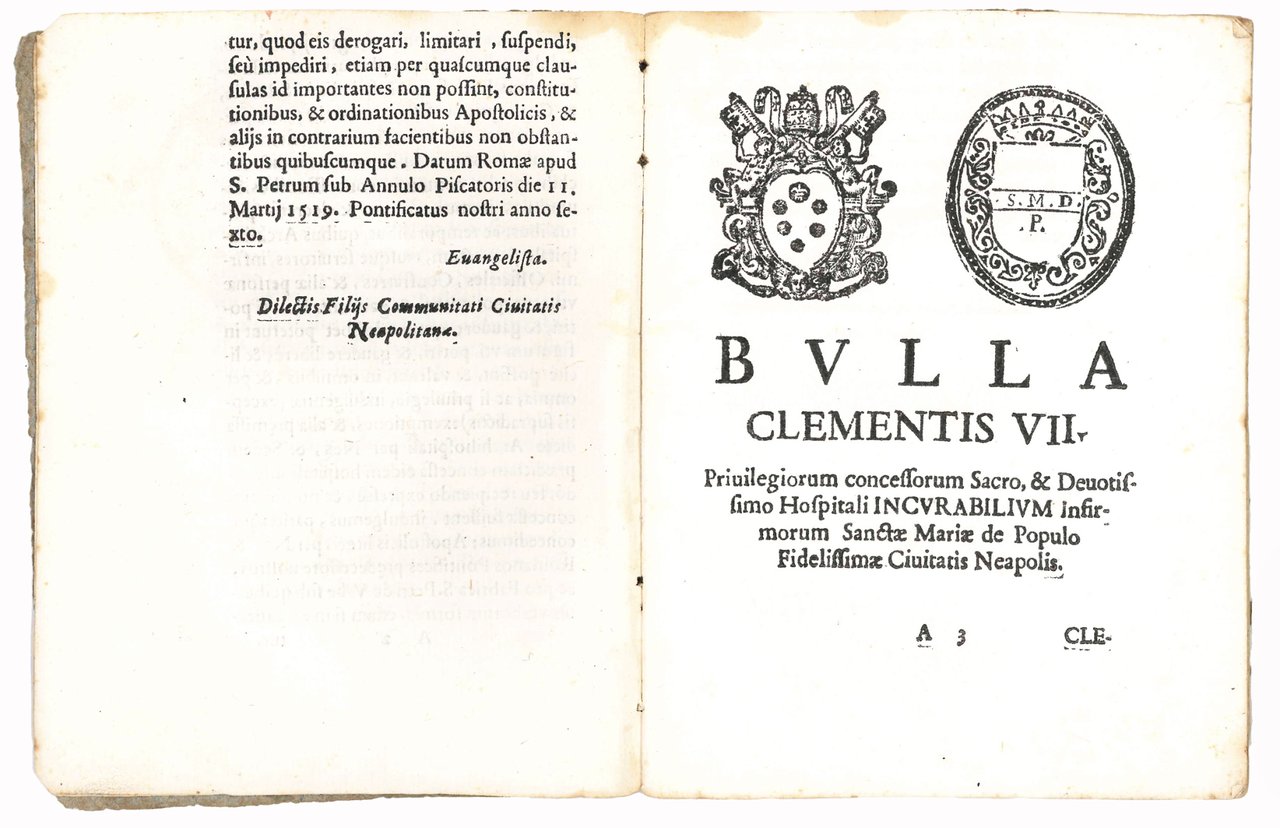
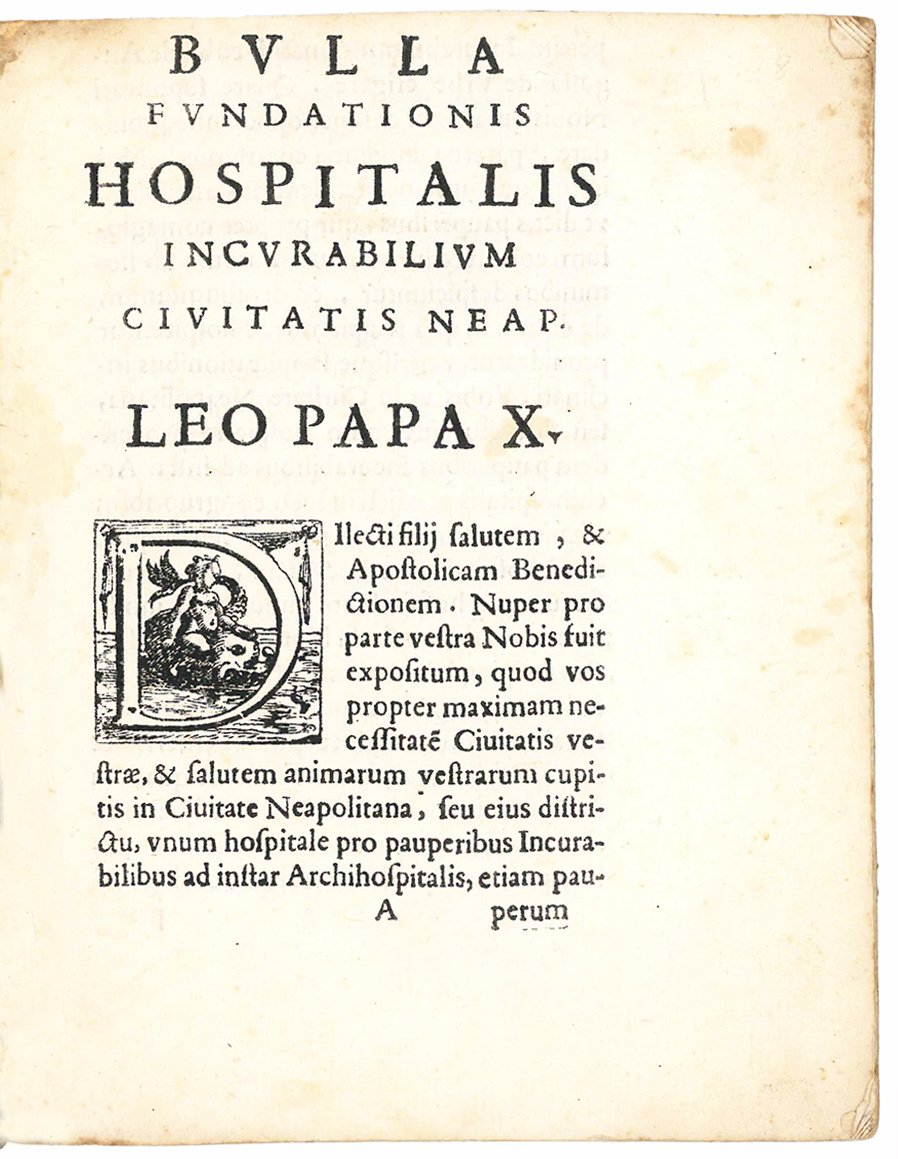
LEO X (Pope, 1513-1521). Bulla fundationis Hospitalis Incurabilium civitatis Neap. Leo Papa X. Incipit: "Nuper pro parte Vestra". Issued on March 11, 1519. [followed by:] CLEMENS VIII (Pope, 1523-1534). Bulla Clementis VII Privilegiorum concessorum Sacro, & Devotissimo Hospitali Incurabilium infirmorum Sanctae Mariae de Populo Fidelissimae Civitatis Neapolis. Incipit: "Ex supernae dispositionis arbitrio". Issued on December 11, 1523. N.pl., n.pr., n.d. [presumably Rome, 1523]
LEO X (Pope, 1513-1521). Bulla fundationis Hospitalis Incurabilium civitatis Neap. Leo Papa X. Incipit: "Nuper pro parte Vestra". Issued on March 11, 1519. [followed by:] CLEMENS VIII (Pope, 1523-1534). Bulla Clementis VII Privilegiorum concessorum Sacro, & Devotissimo Hospitali Incurabilium infirmorum Sanctae Mariae de Populo Fidelissimae Civitatis Neapolis. Incipit: "Ex supernae dispositionis arbitrio". Issued on December 11, 1523. N.pl., n.pr., n.d. [presumably Rome, 1523] | Livres anciens et modernes | THE HOSPITAL OF SANTA MARIA DEL POPOLO DEGLI INCURABILI IN NAP
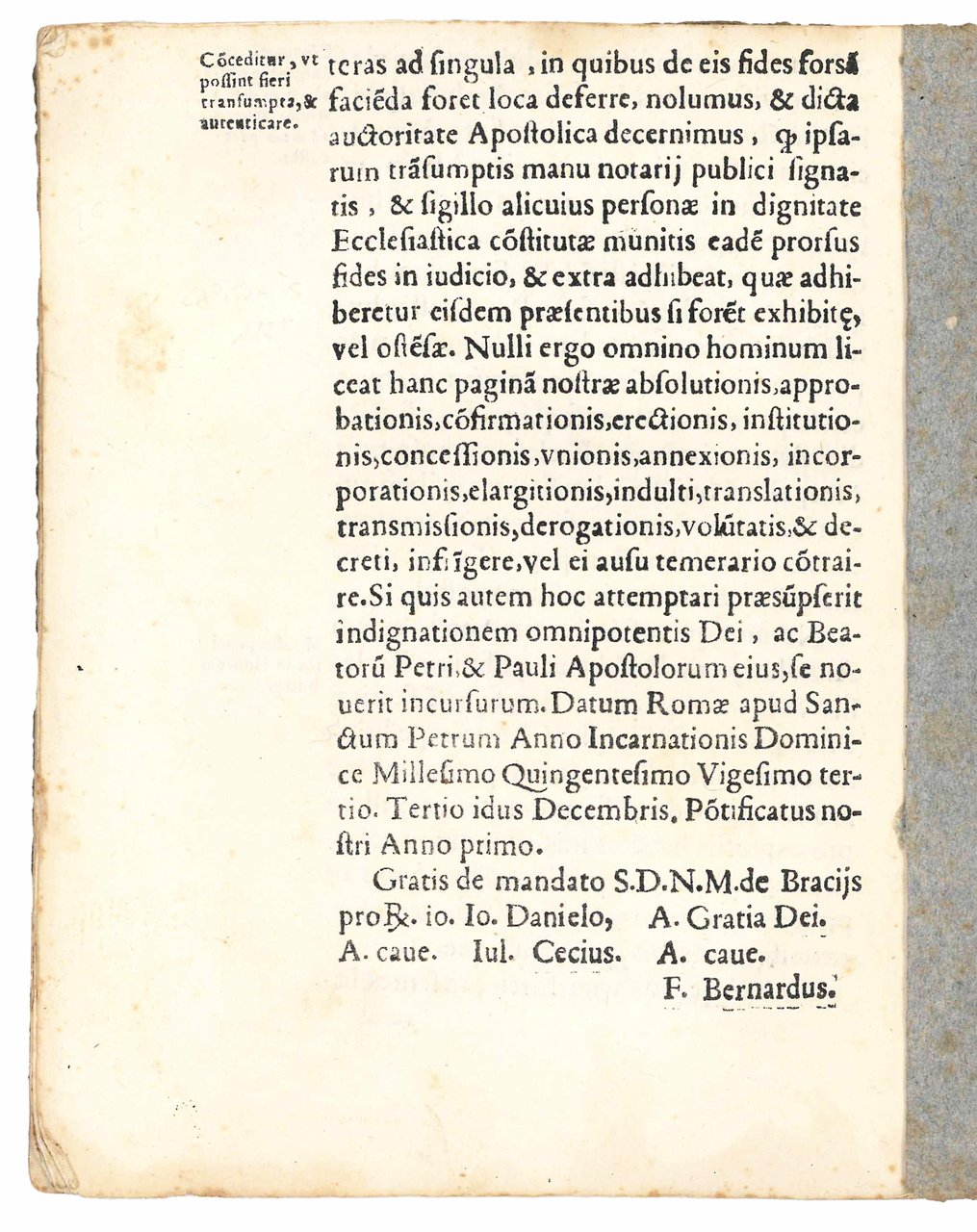
LEO X (Pope, 1513-1521). Bulla fundationis Hospitalis Incurabilium civitatis Neap. Leo Papa X. Incipit: "Nuper pro parte Vestra". Issued on March 11, 1519. [followed by:] CLEMENS VIII (Pope, 1523-1534). Bulla Clementis VII Privilegiorum concessorum Sacro, & Devotissimo Hospitali Incurabilium infirmorum Sanctae Mariae de Populo Fidelissimae Civitatis Neapolis. Incipit: "Ex supernae dispositionis arbitrio". Issued on December 11, 1523. N.pl., n.pr., n.d. [presumably Rome, 1523]
LEO X (Pope, 1513-1521). Bulla fundationis Hospitalis Incurabilium civitatis Neap. Leo Papa X. Incipit: "Nuper pro parte Vestra". Issued on March 11, 1519. [followed by:] CLEMENS VIII (Pope, 1523-1534). Bulla Clementis VII Privilegiorum concessorum Sacro, & Devotissimo Hospitali Incurabilium infirmorum Sanctae Mariae de Populo Fidelissimae Civitatis Neapolis. Incipit: "Ex supernae dispositionis arbitrio". Issued on December 11, 1523. N.pl., n.pr., n.d. [presumably Rome, 1523] | Livres anciens et modernes | THE HOSPITAL OF SANTA MARIA DEL POPOLO DEGLI INCURABILI IN NAP
Mode de Paiement
- PayPal
- Carte bancaire
- Virement bancaire
- Pubblica amministrazione
- Carta del Docente
Détails
- Auteur
- THE HOSPITAL OF SANTA MARIA DEL POPOLO DEGLI INCURABILI IN NAP
- Thème
- Quattro-Cinquecento
- Etat de conservation
- En bonne condition
- Langues
- Italien
- Reliure
- Couverture rigide
- Condition
- Ancien
Description
4to (193x146 mm). [14] leaves. Collation: A14. Large woodcut historiated initials on l. A1r and woodcut arms of Pope Clemens VII and of the Hospital of Santa Maria del Popolo degli Incurabili on l. A3r. Old blue wrappers (worn and rubbed). Some marginal foxing and staining, upper margin cut short, a good copy.
Apparently unrecorded edition of two papal bulls concerning the foundation, the privileges and constitution of the Hospital of Santa Maria del Popolo degli Incurabili in Naples. We were unable to find a copy of this edition or of any other edition of Pope Leo X's bull, and we found only one copy of a different issue of Pope Clement VII's bull (see Edit 16, CNCE78392).
On March 11, 1519, Pope Leo X issued the brief “Nuper pro parte Vestra,” which established the hospital of Santa Maria del Popolo degli Incurabili and placed it under the authority of the Roman hospital of S. Giacomo in Augusta, which in 1515 had been elevated by Leo himself to the rank of Arciospedale, or head of all hospitals of the same kind. In the brief, Leo X defined the “incurables” as patients who, unable to be cared for at home, were in need of hospitalization. And so, between March and September 1519, the hospital began its reception and clinical activities in some rooms of the old hospital of San Nicola al Molo, under the direction of Ettore Vernazza of Divino Amore and Maria Longo, who, after Vernazza's transfer to Rome, remained alone in charge of the hospital, to which she dedicated the rest of her life. The Incurabili healthcare complex took its name, Ospedale di Santa Maria del Popolo degli Incurabili, from the church and confraternity located within its perimeter. The first stone was laid by Viceroy Don Ramon di Cardona, a friend and relative of Longo, in April 1520 on the hill of Sant'Aniello, which rose near Porta San Gennaro and was certainly one of the healthiest places in the city. On 23 March 1522, Maria Longo transferred the patients from the old Hospital of San Nicola al Molo, which was being demolished to make way for the expansion of the Maschio Angioino. The church of Santa Maria del Popolo, the headquarters of the Compagnia dei Bianchi, the shelter of the “Pentite” and the Monastery of the “Riformate” were then built around the structure.
Maria Lorenza Longo (1463-1539), wife of Giovanni Lonc (Longo), Grand Chancellor of the Kingdom of Spain and later secretary to King Ferdinand the Catholic, was a Spanish noblewoman who spent all her wealth and devoted her entire life to caring for the sick. In 1510, after a pilgrimage to the Sanctuary of Loreto, from which she returned cured of a severe form of paralysis, she began to devote herself to works of charity. She thus began to visit the charitable institutions of Naples: the Hospital of St. James, the Fatebenefratelli (known as La Pace), the Pellegrini, and in particular the Hospital of San Nicola al Molo, where she worked tirelessly for seven years. During that period, she developed the idea of organizing a charity for the “incurable” sick together with Ettore Vernazza. Alongside Longo, other Neapolitan noblewomen of the time took up the cause, including Maria d'Ayerba, Duchess of Termoli and wife of Andrea di Capua, whose marble tomb, created by Giovanni da Nola, is located in the church of Santa Maria del Popolo.
With the bull “Ex supernae dispositionis arbitrio” of December 11, 1523, Pope Clement VII decreed the Apostolic Constitution of the Hospital and the establishment of the Confraternity of Santa Maria del Popolo, which was also open to women. He provided the first constitution of the Royal House of the Incurables, which was actually drafted by the Bishop of Chieti, Gian Pietro Carafa, and the magistrate Marcello Gazzella, and ratified the union between the Compagnia dei Bianchi and the Hospital. Clement VII's bull also established the election of a seven-member government that assumed the senior management of the hospital. Longo was appointed “Rector” or “Gubernatrix Vener