Manuale di economia politica con una introduzione alla scienza sociale (The copy of Giacomino Sarfatti)
Manuale di economia politica con una introduzione alla scienza sociale (The copy of Giacomino Sarfatti) | Livres anciens et modernes | PARETO, Vilfredo (1848-1923)
Manuale di economia politica con una introduzione alla scienza sociale (The copy of Giacomino Sarfatti)
Manuale di economia politica con una introduzione alla scienza sociale (The copy of Giacomino Sarfatti) | Livres anciens et modernes | PARETO, Vilfredo (1848-1923)
Mode de Paiement
- PayPal
- Carte bancaire
- Virement bancaire
- Pubblica amministrazione
- Carta del Docente
Détails
- Année
- 1905-1906
- Lieu d'édition
- Milano
- Auteur
- PARETO, Vilfredo (1848-1923)
- Éditeurs
- Società editrice libraria
- Thème
- Ottocento e Novecento
- Etat de conservation
- En bonne condition
- Langues
- Italien
- Reliure
- Couverture rigide
- Condition
- Ancien
Description
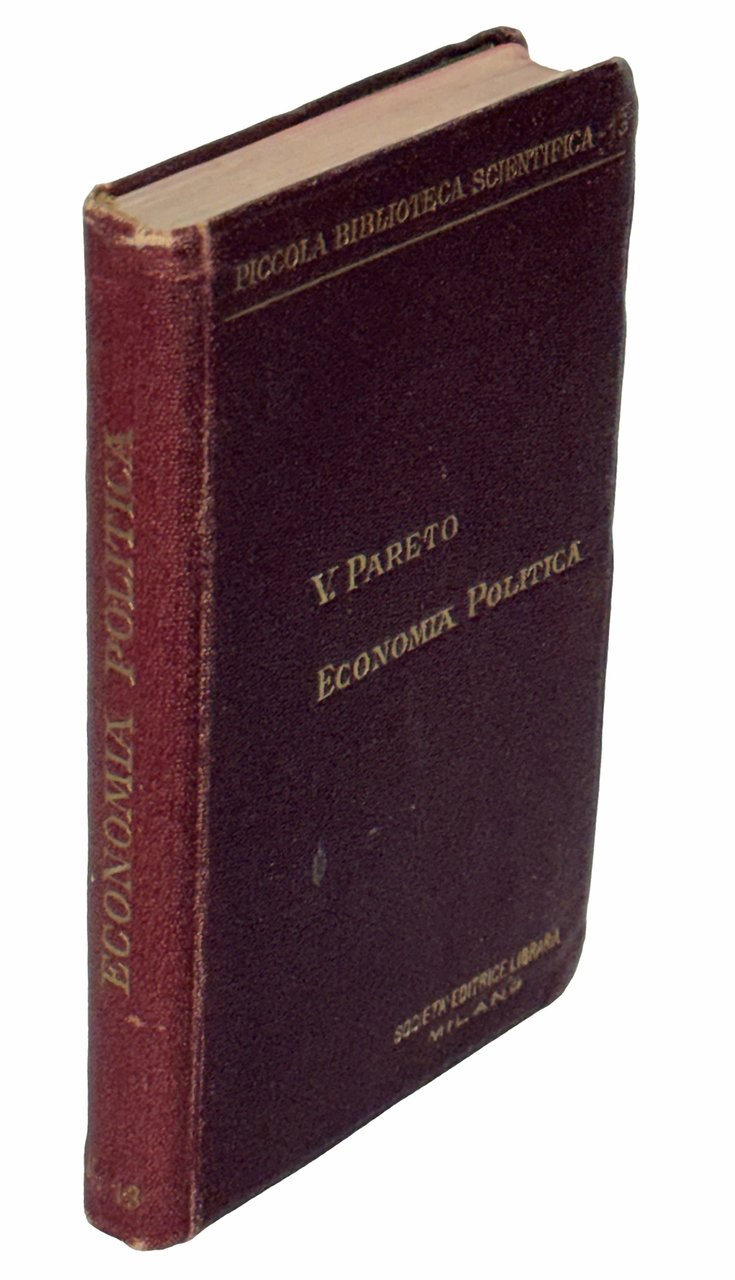
131x80 mm. XII, 579, [1 blank] pp. Editor's red cloth, spine and front board lettered in gilt, patterned endpapers, red edges. A very good copy.
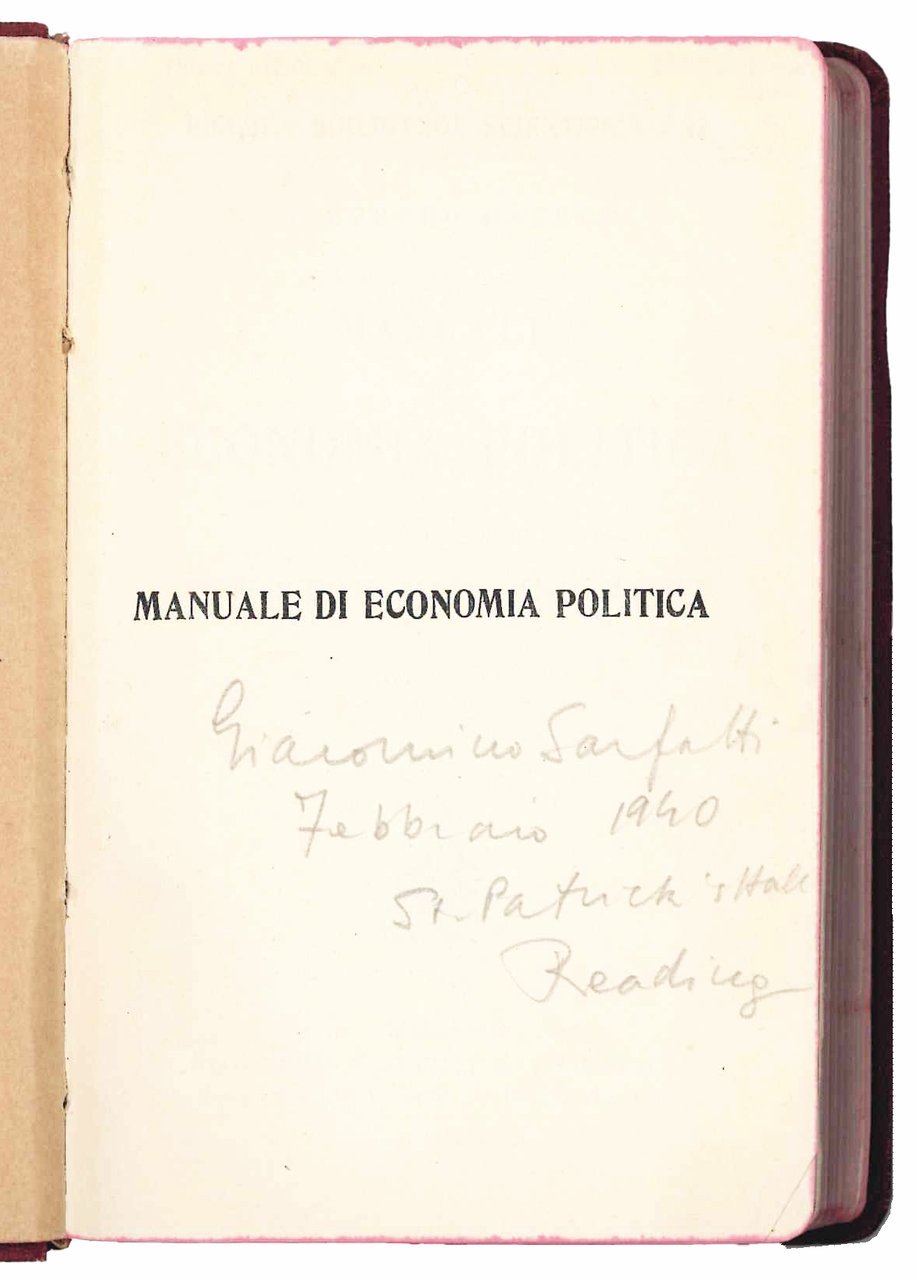
Provenance. On the half title penciled ownership entry: “Giacomino Sarfatti Febbraio 1940 St. Patrick's Hall Reading” (Giacomino Sarfatti was born in Florence in 1920. In 1938, after the introduction of racial laws, he emigrated to England where he found work on a farm. In 1939, he enrolled in agriculture at the University of Reading. When Italy entered World War II in June 1940, he was interned as an “enemy alien.” After enlisting as a volunteer in an auxiliary corps of the British army, in March 1941 he joined the Special Operations Executive, a secret corps tasked with sabotage. After completing an assignment in Malta, in 1942 he agreed to work in Italy, where he acted as a radio operator, collaborating with a British agent on the ground. After September 8, 1943, he took part in the liberation movement. In 1948, he graduated with a degree in agricultural sciences from the University of Florence. He served as assistant and professor of botany at the universities of Florence, Camerino, Siena, and Bari. Sarfatti died in Siena in 1985).
First edition of Pareto's masterpiece, issued as volume 13 of the series “Piccola Biblioteca Scientifica”. The Manuale “is better conceived and, more important, much better thought through than the Cours d'économie politique (1896-‘97). It is basically a work of synthesis in which Pareto presented a general theory of economic equilibrium which is considerably more refined than Walras's” (IESS). The treatise was published in French in 1909 in an expanded edition.
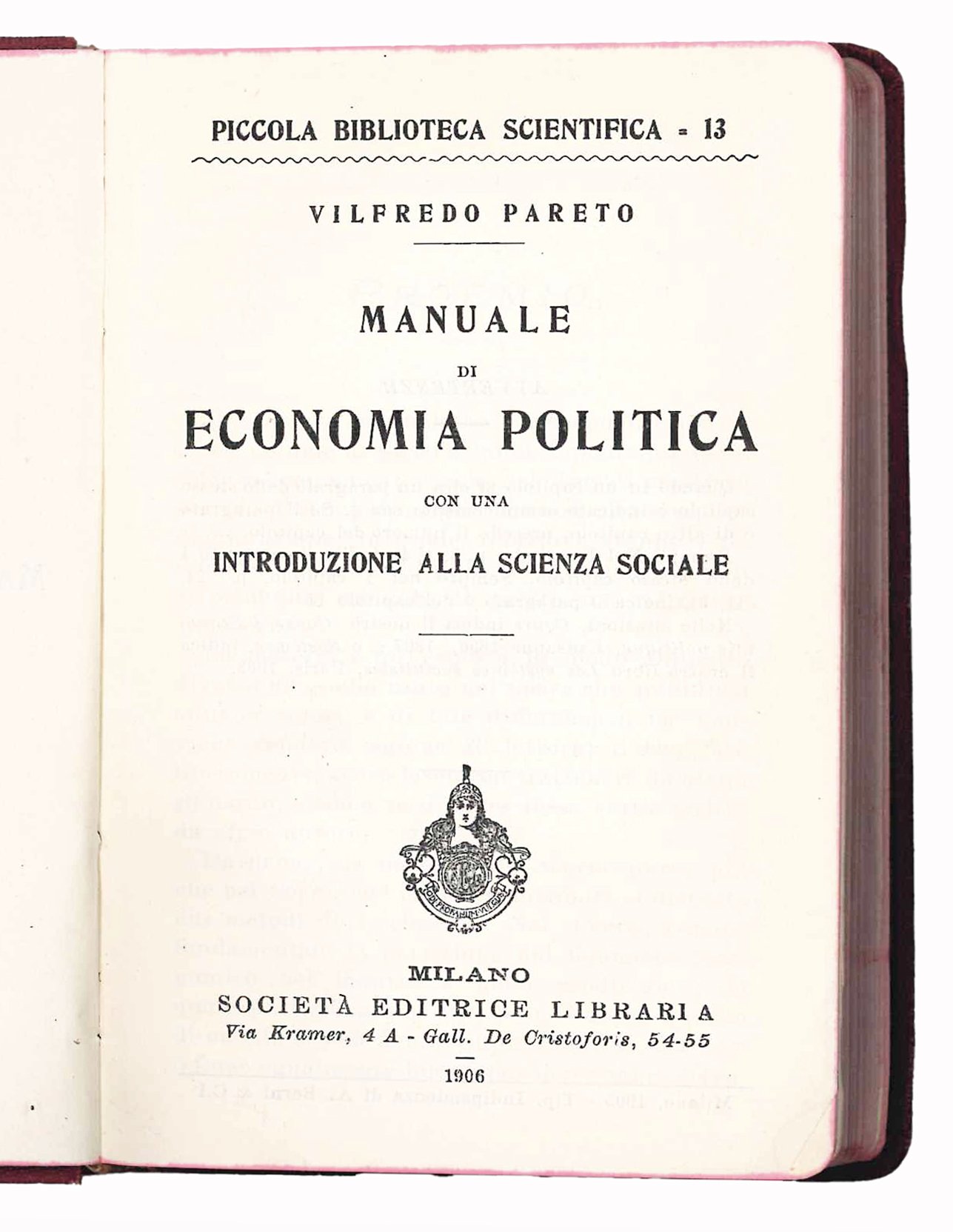
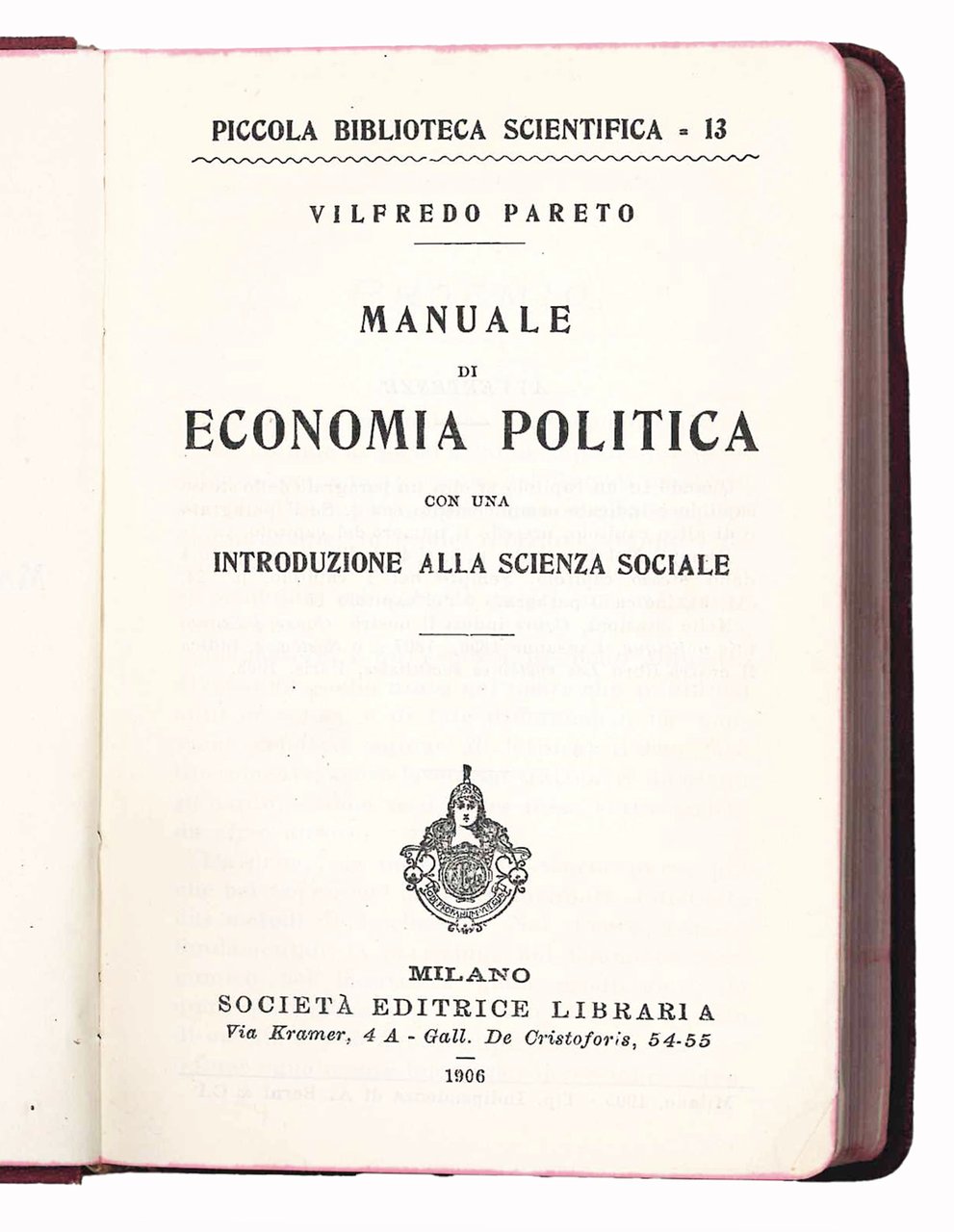
“The first edition of the Manuale di economia politica con una introduzione alla scienza sociale appeared in 1906 in Milan, published by the Società Editrice Libraria (via Kramer, 4A-Gall. De Cristoforis, 54-55) as issue No. 13 in the series “Piccola Biblioteca Scientifica” (‘Little Scientific Library'). The books from this series are so small (about 13x8 cm) that in the antique book market Pareto's Manuale was often called “il Paretino” -literally, ‘the little Pareto'. An indication at the bottom of p. IV -Milano, 1905, Tip. Indipendenza di A Berni & C.i.- reveals that the Manuale came out of the printing house in 1905. This date explains why some economists (A. Graziani and A. Loria, for instance) have indicated that they had already read the Manuale by the end of 1905 […] The first edition of the Manuale included a mathematical Appendix followed by three indices: an Index of Chapters, an Index of Subject, and an Authors' Names Index. The volume ended with an Errata corrige regarding also the mathematical formulae of the Appendix, and missing letters” (cf. A. Zanni, Editors' Introductory Note, in: V. Pareto, “Manual of Political Economy. A Critical and Variorum Edition”, A. Montesano, A. Zanni, L. Bruni, J.S. Chipman & M. McLure, eds., Oxford, 2014, p. XI).
Vilfredo Pareto was born in Paris in 1848 to a Mazzinian exile of Genoese origin. He completed his early studies in France, then graduated in engineering in Turin in 1869. In the following years, he worked in industry and contributed to various economics journals, distinguishing himself for his uncompromising and controversial style. Influenced by the writings of M. Pantaleoni and L. Walras, he became interested in theoretical economic research. In 1893, he succeeded Walras as professor of political economy at Lausanne. In 1896, he published the Cours d'économie politique, a work of capital importance in the history of economic thought. After abandoning his academic career in 1906, Pareto remained in Switzerland, leading a secluded life in his villa in Céligny, near Geneva. In his later years, he devoted himself to refining his economic thought and writing a treatise on sociology (Trattato di sociologia generale, Florence, 1916), while continuing to exert his liberal and anti-prohibitionist influence on the economic and political li