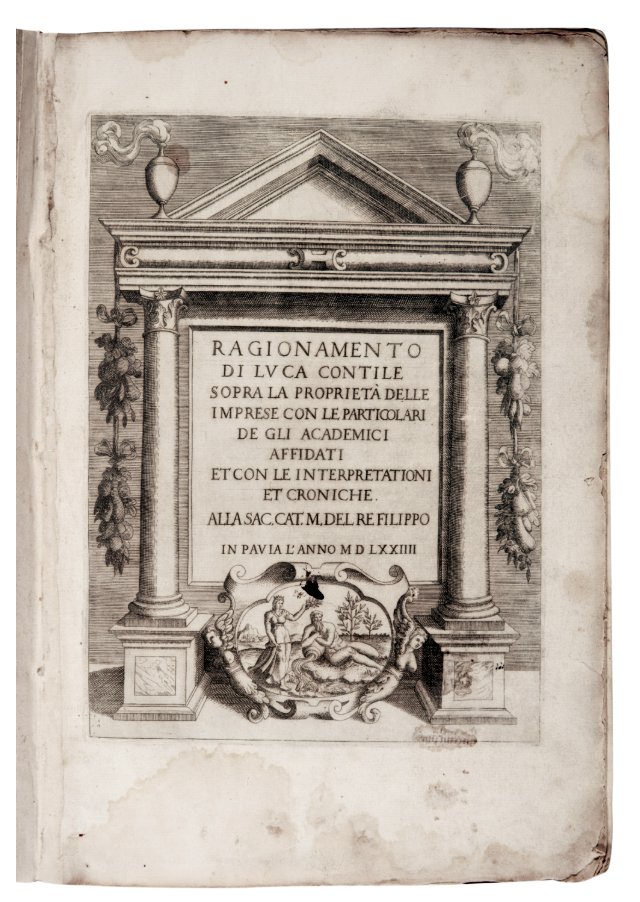
Ragionamento di Luca Contile sopra la proprietà delle imprese con le particolari de gli Academici Affidati et con le interpretationi et croniche
Ragionamento di Luca Contile sopra la proprietà delle imprese con le particolari de gli Academici Affidati et con le interpretationi et croniche
Mode de Paiement
- PayPal
- Carte bancaire
- Virement bancaire
- Pubblica amministrazione
- Carta del Docente
Détails
- Année
- 1574
- Lieu d'édition
- Pavia
- Auteur
- CONTILE, Luca (1505-1574)
- Éditeurs
- Girolamo Bartoli
- Thème
- Quattro-Cinquecento
- Etat de conservation
- En bonne condition
- Langues
- Italien
- Reliure
- Couverture rigide
- Condition
- Ancien
Description
ACCADEMIA DEGLI AFFIDATI-PAVIA
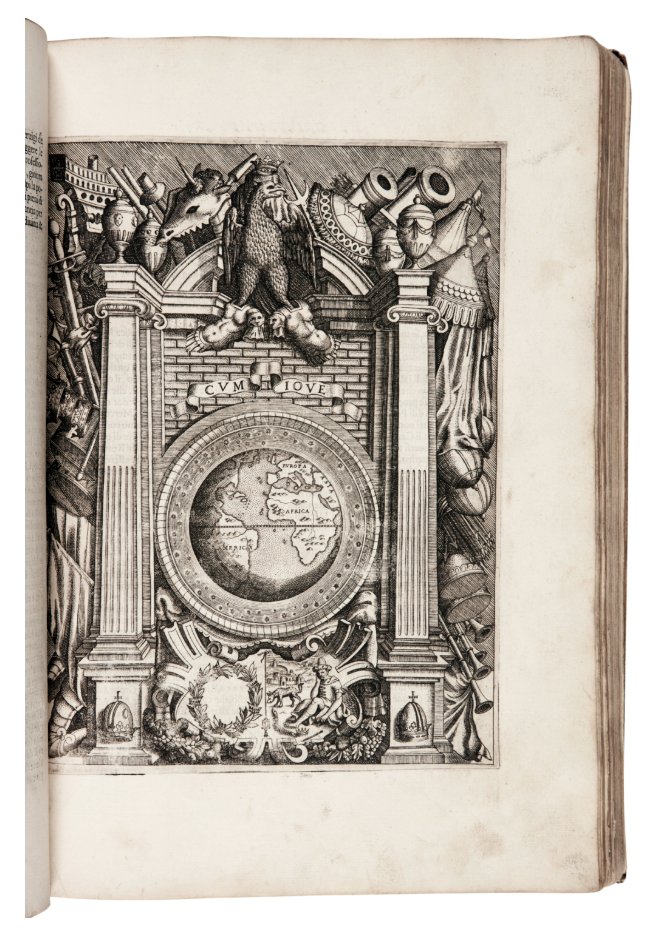
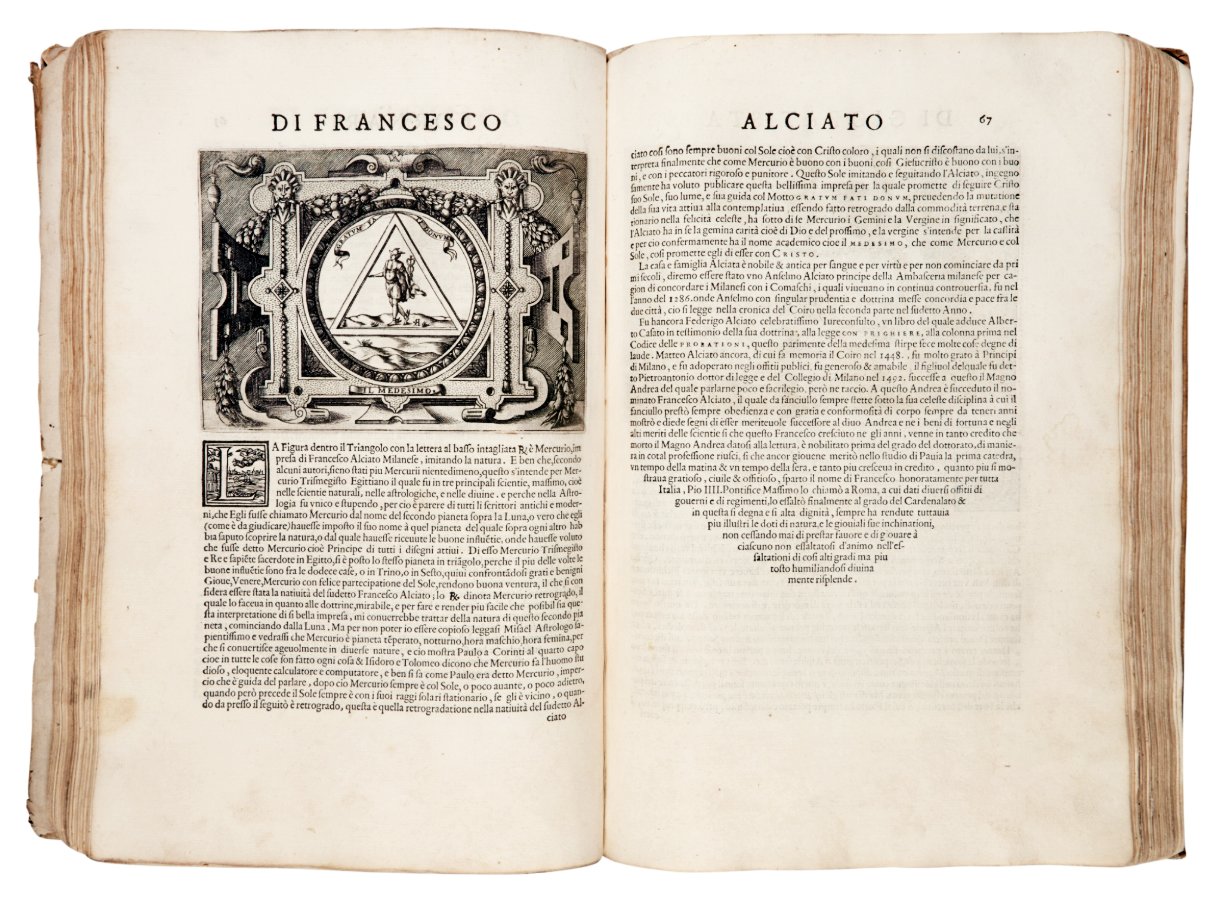
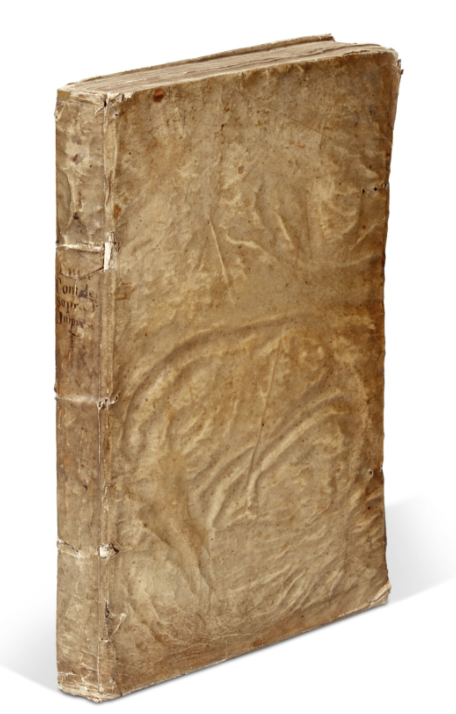
Folio (349x230 mm). [6], 1-43, [1], 44-161 [recte 162], [1]. Collation: *6 A-Z4 Aa-Pp4 Qq4(-Qq4) Rr8. The final quire was added later, so the previously final leaf Qq4 was excised, and its content (register, errata, and table) was reprinted on the recto and verso of leaves Rr1 and Rr8, respectively. A few other leaves were sometimes cancelled, in this copy leaves S1-2, Aa4, Bb3, Cc1, Hh4 and Mm4 appear to be cancels. Roman type, 54 lines plus headline. Engraved title page, woodcut initials, woodcut printer's device above colophon. With 116 engraved illustrations in the text, the first of which is full page and unnumbered, and depicts the device of Philip II of Spain, to whom the work is dedicated; the remaining half-page illustrations show the devices of the Accademia degli Affidati and its members. The illustrations are set within elaborate and elegant borders and bear both the motto and the academic name of the owner of the emblem. Contemporary vellum, modern buckram drop-backed box (traces of ties, binding crinkled and somewhat worn, spine slightly torn with old repairs at ends, front hinge repaired). Title-page somewhat soiled, occasional staining throughout, quire Gg browned, occasional offsetting, repaired tear in Cc1, a few small wormholes towards end. A tall copy with some deckle edges.
Provenance: W.D. Worthington, bookplate; Kerr & Richardson, Glasgow, bookseller's label at end; T. Kimball Brooker (Bibliotheca Brookeriana, VIII, lot 95).
Original edition of this lavishly printed emblem book divided into two parts. The first part (ll. 1-43), after briefly discussing medals and hieroglyphics, deals with devices from a theoretical point of view by raising specific questions. The author, who demonstrates to be well aware of his predecessors' writings on the subject (citing, among others, Paradin, Giovio, Domenichi, Ruscelli, Ammirato, and Arnigio), distinguishes between crests, coat-of-arms, hieroglyphics, emblems, and devices, seeking to define how the latter differ from the former: the device, which in his opinion is “componimento di figura e di motto rappresentando vertuoso e magnanimo disegno” (‘a composition of figure and motto representing a virtuous and magnanimous design'), is only suitable for virtuous characters and not for “li tinti d'infamia et i professori dell'arti meccaniche, eccettuati gl'ingegneri che stanno a' servigi de' principi, i pittori eccellenti e gli statuarii famosi” (‘those tainted with infamy and those practicing mechanical arts, except for engineers who are in the service of princes, excellent painters, and famous sculptors'). The second part, on the other hand, is a veritable tribute to the members of the Accademia degli Affidati, whose devices are extensively commented on and enriched with numerous biographical details. The devices include that of Contile himself (l. 83), in which he provides valuable information about his life, and that of San Carlo Borromeo (l. 86).
Towards the end of April 1574, the printing of Contile's Ragionamento was finally completed, and on August 23, he sent a copy of the newly printed book to the Duke of Parma, informing him that the edition had been ready for four months and, complaining about the quality of the printing, he was hoping for a second edition, which, however, never appeared. The publication had also been delayed by discussions arose among the members of the Accademia degli Affidati regarding its authorship, with some wanting the Ragionamento to be printed in the name of the Accademia, and others wanting it to be published solely under the name of its compiler; the latter party prevailed. Contile's treatise is considered the most accomplished, and certainly the most useful for the history of the genre. Furthermore, the second part is quite significant as a collection of biographical and genealogical information on the various members of the academy, almost all of which was diligently obtained by Contile through di
