Rime
Rime
Mode de Paiement
- PayPal
- Carte bancaire
- Virement bancaire
- Pubblica amministrazione
- Carta del Docente
Détails
- Année
- 1564
- Lieu d'édition
- Parma
- Auteur
- MARMITTA, Giacomo (1504-1561)
- Éditeurs
- Seth Viotti
- Thème
- Quattro-Cinquecento
- Etat de conservation
- En bonne condition
- Langues
- Italien
- Reliure
- Couverture rigide
- Condition
- Ancien
Description
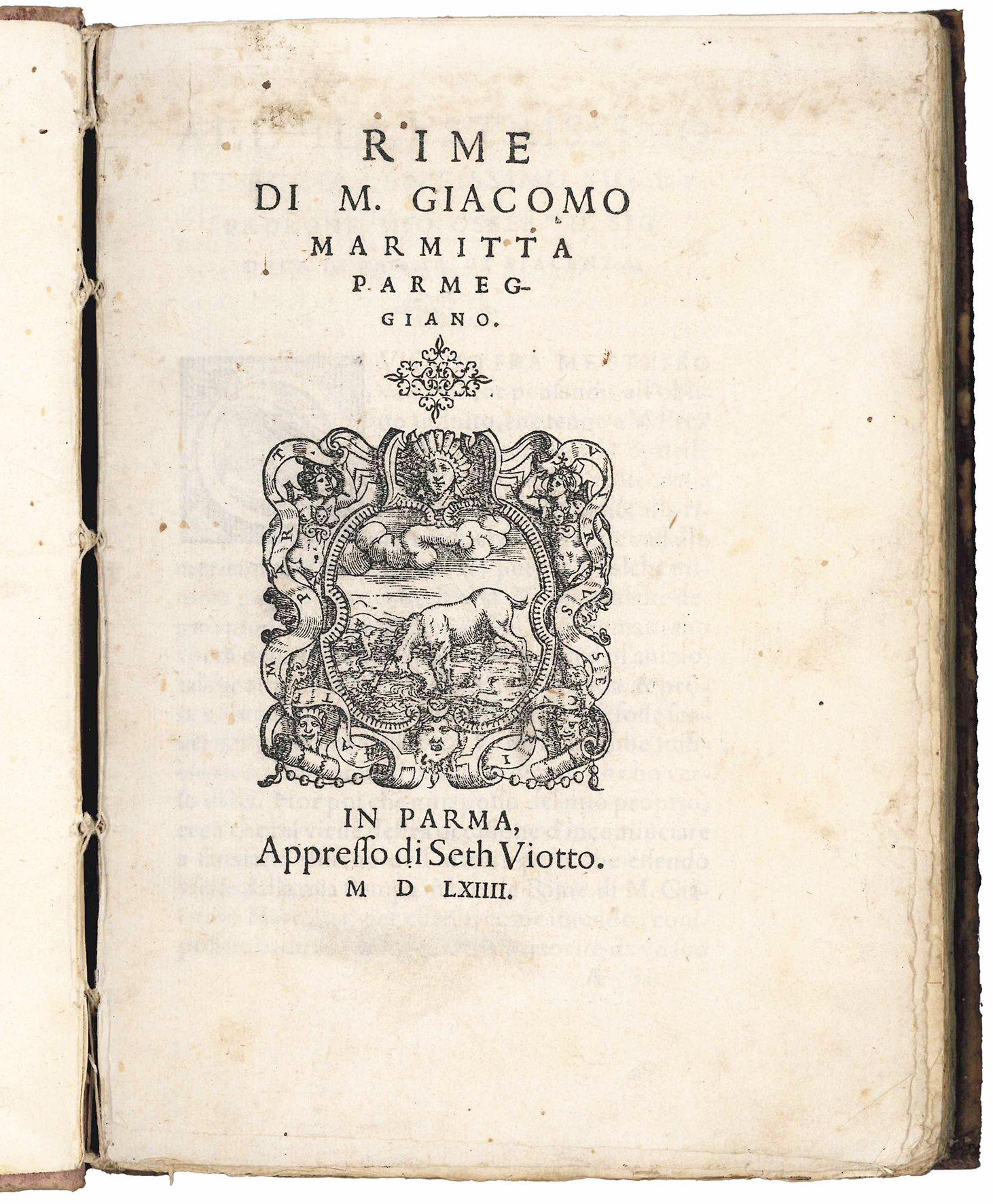
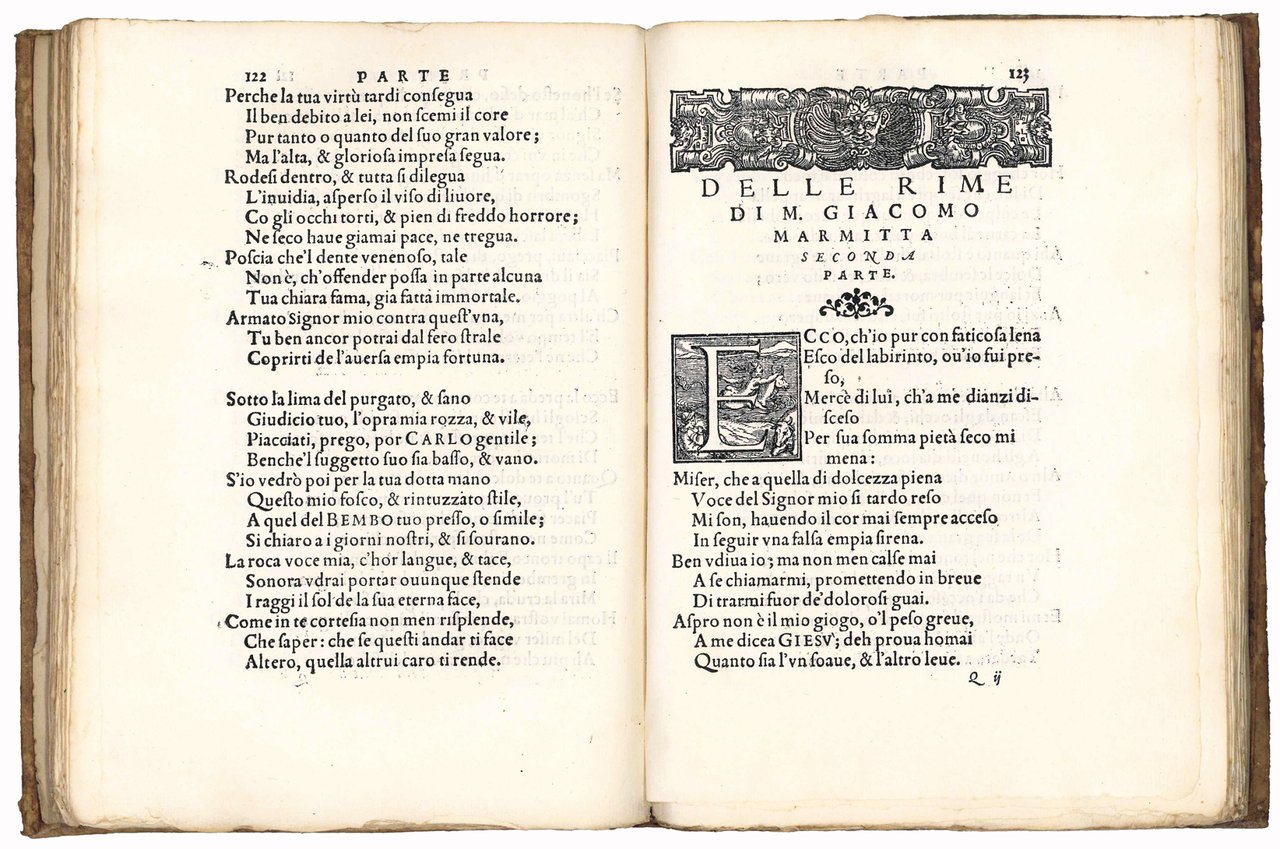
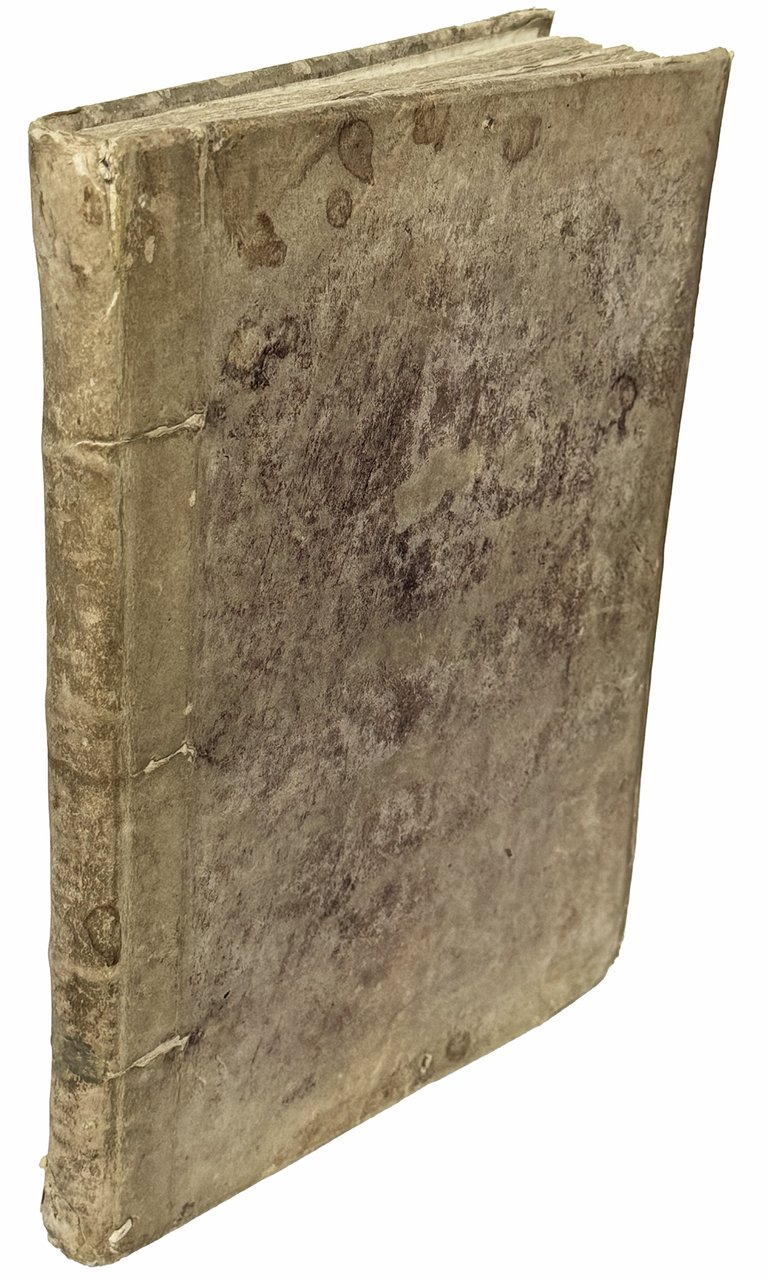
4to (221x160 mm). [8], 198, [10] pp. Collation: A4, 1A-Z4 a-c4. Woodcut printer's device on the title page representing a unicorn surrounded by a grotesque border (Z810). Decorated woodcut initials throughout the text. Contemporary purple vellum over boards, spine later reinforced (faded and worn). Pale stain to the upper margin of the title page and its correspondent leaf, some occasional light staining, lower margin of the title page cut a bit shorter, worm hole to the gutter of a few leaves at the end of the volume not affecting the text, all in all a good, full-margined copy with traces of deckle edges.
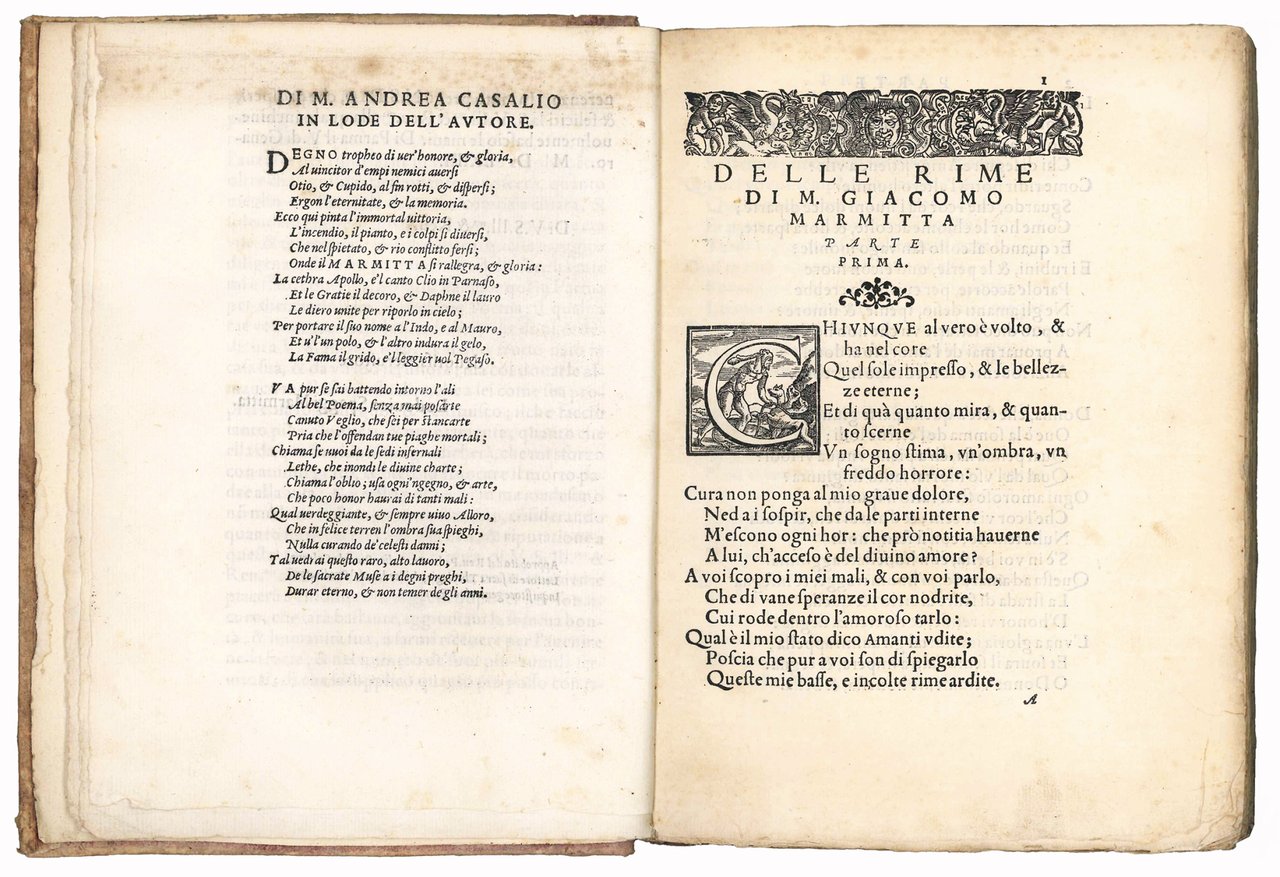
First and only edition, published after the author's death, of the poem collection by Giacomo Marmitta. The edition is dedicated by the printer to the Duke of Parma and Piacenza, and by Marmitta's adopted son to Cardinal Ricci of Montepulciano, the poet's life-long patron. The preliminary leaves contain also two sonnets written by Andrea Casalio in memory of the author. The poems, described by the printer as “dotte e leggiadre” (‘learned and graceful'), range from the love topics of Marmitta's early life to the religious topics with which he was more concerned after his meeting with Filippo Neri.
Marmitta's Rime “rappresentano uno dei raggiungimenti più sicuri del bembismo maturo, per la notevole capacità di rivitalizzare i topoi più consunti in una assidua, tenace, preziosa ricostruzione in filigrana di un discorso amoroso perpetuamente inquieto, in un'assillante meditazione sugli affetti (con pointes esplicitamente autobiografiche) notomizzati con sfumature e intagli densi, in un classicismo superbo della propria salda presa sulla materia” (Storia letteraria d'Italia. Il Cinquecento, G. da Pozzo, ed., Milan, 2006, pp. 983-84).
Giacomo Marmitta was born in Parma in 1504. At the age of twenty he moved to Venice, where he met P. Bembo, P. Aretino, B. Cappello, and L. Dolce. After spending some time at the service of the Patriarch of Aquileia Marino Grimani, in 1538 he was appointed secretary to the future cardinal Giovanni Ricci da Montepulciano. In Venice he also became a member of the Accademia della Fama, founded by Federico Badoer, and a close friend of Giovanni Della Casa.
In 1544 Ricci was sent as apostolic nuncio to Portugal. Marmitta followed his patron and reached Lisbon on January 1546. He describes the fatigues of the journey in two sonnets. He came back to Rome after Paul III's death in 1549. Two years later Ricci was appointed cardinal by the new Pope Julius III.
Very important in Marmitta's life was the meeting in 1556 with Filippo Neri, who led him towards a more retired life. His poetry turned in this period from secular to spiritual. In his last years Marmitta was afflicted by a disease that brought him to death on December 1561 in Rome, assisted until the end by Filippo Neri (cf. P. Cosentino, Marmitta, Giacomo, in: “Dizionario Biografico degli Italiani”, vol. 70, Rom, 2008, s.v.).
Marmitta never published his poems probably because of his late conversion. A few rhymes had appeared before his death in collective anthologies edited by Giolito, Giaccarello, Pietrasanta, and other printers. It was only after his death that Dionigi Atanagi included fifteen of his sonnets in De le rime di diversi eccellentissimi autori thoscani (Venice, 1565), and his adopted son, Ludovico Spaggi, gathered in a manuscript all his poetical production (Ms. Parmense 864). The printed edition is based on this manuscript and is divided into two parts: the first contains 186 poems (among which 177 are sonnets), while the second part includes 96 compositions, of which 94 are sonnets. At the end is an appendix (pp. 188-198) with sonnets by others in response to the author. Among the dedicatees of Marmitta's poems are Pope Paul III, D. Atanagi, P. Barbato, P. Bembo, B. Cappello, Stefano and Vittoria Colonna, G.F. Commendone, G. Cenci, G. Della Casa, L. Dolce, F.M. Molza, and B. Varchi (cf. B. Basile, Petrarchismo e manierismo nei lirici
