Opyt geomtrii o chetyrekh izmereniakh. Geometriia sinteticheskaia ("An Essay on the Geometry of Four Dimensions. Synthetic Geometry")
Opyt geomtrii o chetyrekh izmereniakh. Geometriia sinteticheskaia ("An Essay on the Geometry of Four Dimensions. Synthetic Geometry") | Livres anciens et modernes | HULAK, Mykola Ivanovich (1821-1899)
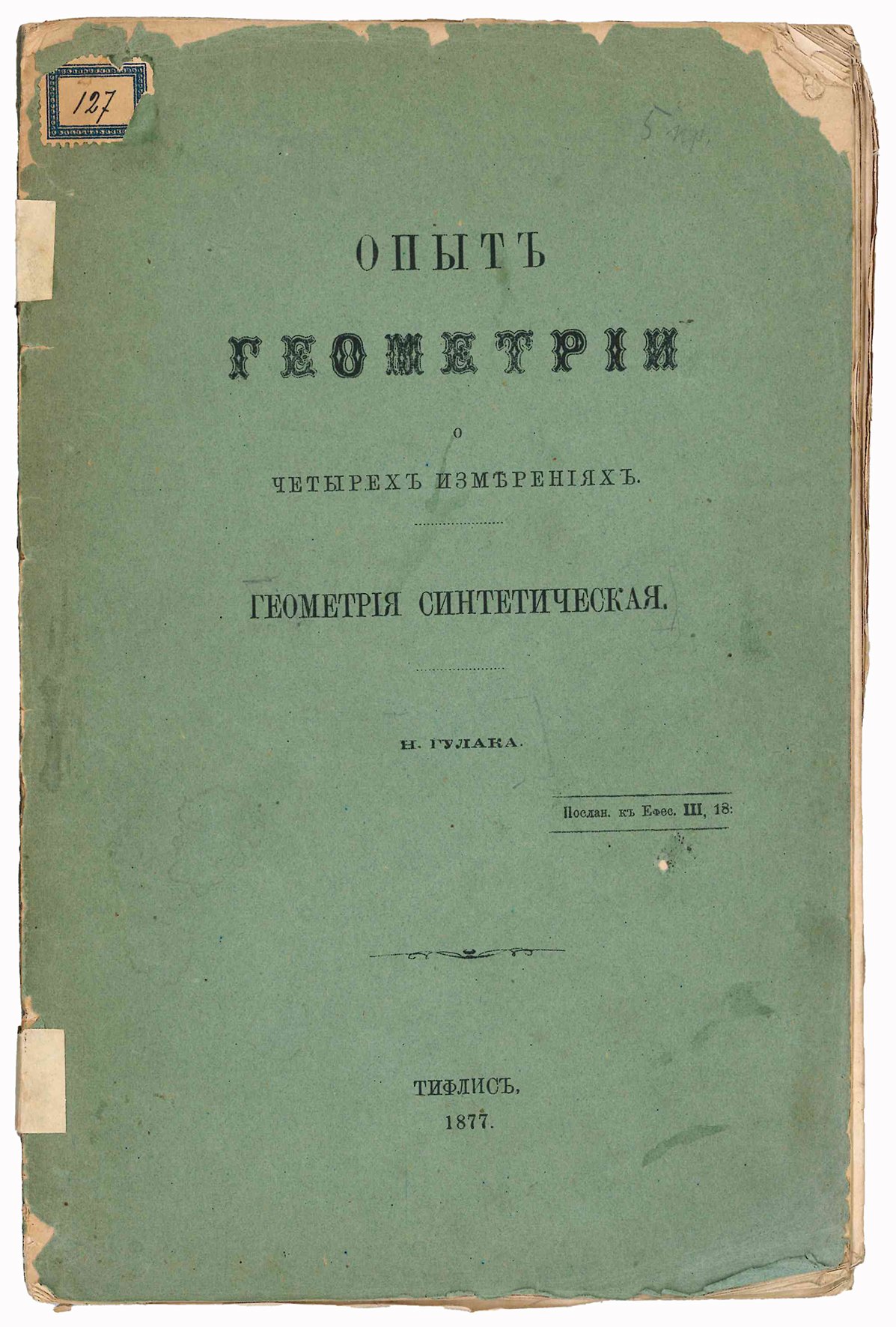
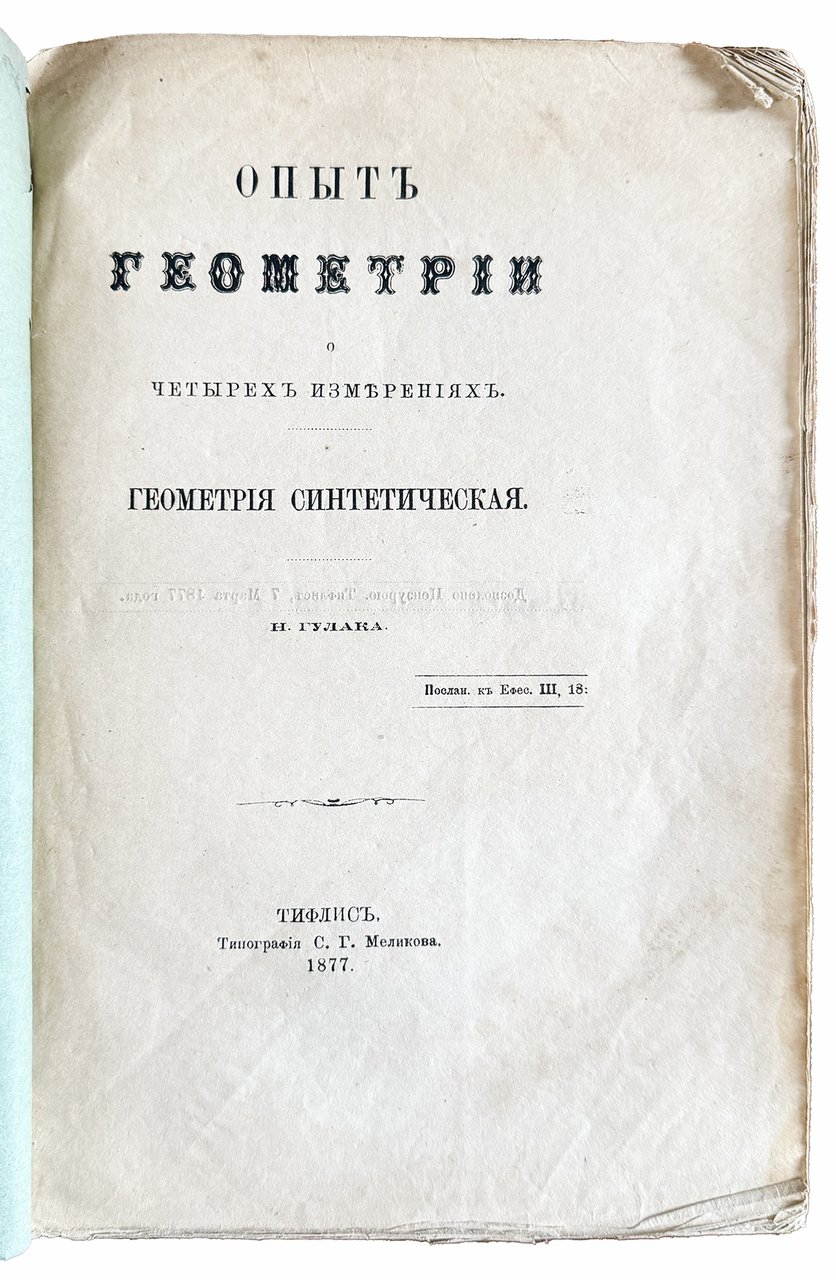
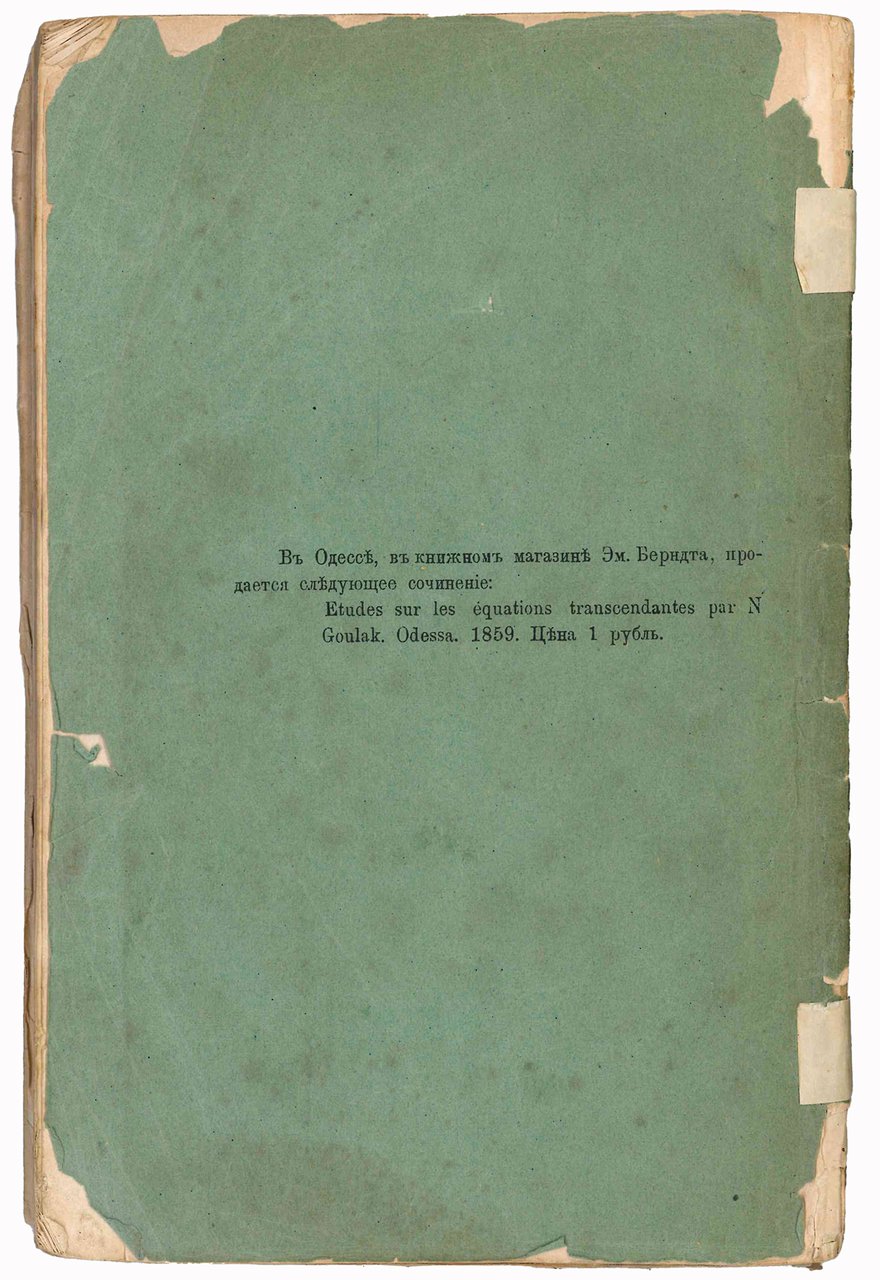
Opyt geomtrii o chetyrekh izmereniakh. Geometriia sinteticheskaia ("An Essay on the Geometry of Four Dimensions. Synthetic Geometry")
Opyt geomtrii o chetyrekh izmereniakh. Geometriia sinteticheskaia ("An Essay on the Geometry of Four Dimensions. Synthetic Geometry") | Livres anciens et modernes | HULAK, Mykola Ivanovich (1821-1899)
Mode de Paiement
- PayPal
- Carte bancaire
- Virement bancaire
- Pubblica amministrazione
- Carta del Docente
Détails
- Année
- 1877
- Lieu d'édition
- Tiflis (Tbilisi)
- Auteur
- HULAK, Mykola Ivanovich (1821-1899)
- Éditeurs
- Tipographia S.G. Melikova
- Thème
- Ottocento e Novecento
- Etat de conservation
- En bonne condition
- Langues
- Italien
- Reliure
- Couverture rigide
- Condition
- Ancien
Description
A FORGOTTEN WORK ON FOUR-DIMENSIONAL GEOMETRY BY AN UKRAINIAN HERO
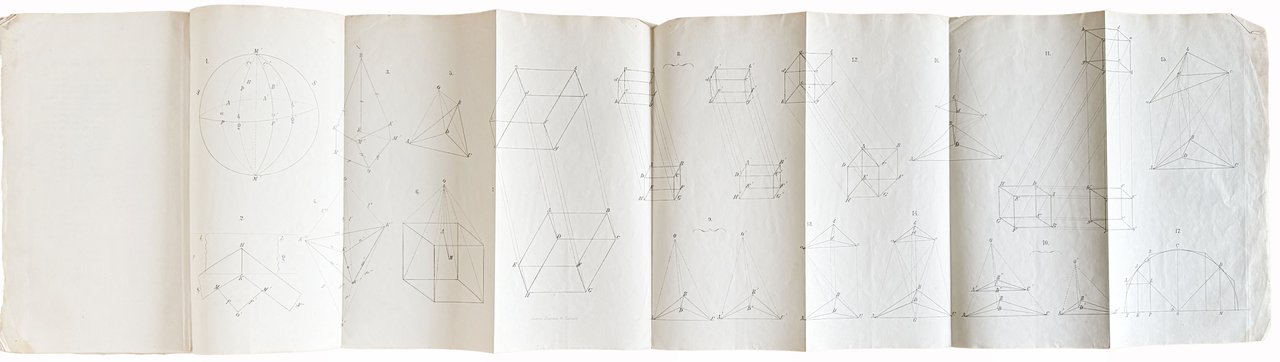
8vo (250x165 mm). [6], 150, [4] pp. and one large folding plate with geometrical figures. Editor's printed wrappers (worn, marginal paper loss, spine broken and roughly repaired). Some quires loose. A genuine copy preserved in a cloth box.
Incredibly rare first and only edition of this pioneristic work on four-dimensional geometry.
Mykola Ivanovich Hulak (or Nikolai Ivanovich Gulak or Goulak) was born in Warsaw in 1821 into a noble, but poor family from the Zolotonish district of the Poltava province. He spent his childhood and youth in the village of Mykolaivka, in the Kherson region. After graduating from the local gymnasium, he studied law at the University of Tartu in Estonia, graduating in 1844. From 1845 he served the Kiev governor-general as a translator and archaeographer.
Hulak played an active part in the founding of the Cyril and Methodius Brotherhood (cf. P.S. Goncharuk, The harbinger of friendship and cooperation of peoples: to the 180th anniversary of the birth of Cyril and Methodius M.I. Hulak, Kyiv, 2002). He belonged to the radical wing of the organization, which defended national-democratic ideals and the idea of a peasant revolution. He advocated the elimination of autocracy and serfdom, the abolition of estates, universal education, and the unification of Slavic people. In January 1847 he moved to St. Petersburg, where he was arrested in March for his political activism. During interrogation, he refused to testify or name any of the brotherhood's members. He spent three years in the Shlisselburg Fortress, after which he was exiled to Perm. It was only 12 years later that he returned to Ukraine and began teaching. He taught geography and mathematics at the Russian-language lyceum in Odessa (1859-1861), history at the Kushnikov Women's Institute in Kerch (1861-1862), mathematics at the Stavropol gymnasium (1862-1863), physics and cosmography at the Kutaisi Gymnasium (1863-1867), and mathematics, physics, Latin and Greek at the Tiflis Gymnasium (1867-1886). After retiring, he moved to the Azerbaijani city of Yelizavetpol (later Kirovabad, today Ganja), where he died. A street in that city is named after him.
Hulak had been interested in mathematics even before the Brotherhood was founded. While in prison, he studied the subject and later carried out research primarily related to non-Euclidean geometries and four-dimensional space. In 1859, he published “Studies on Transcendental Equations” in Odessa, and in 1877, he published the present work in Tbilisi (cf. M. Briefly & O. Antonyuk, Mikola Gulak as a mathematician: Monograph, Lutsk, 2004).
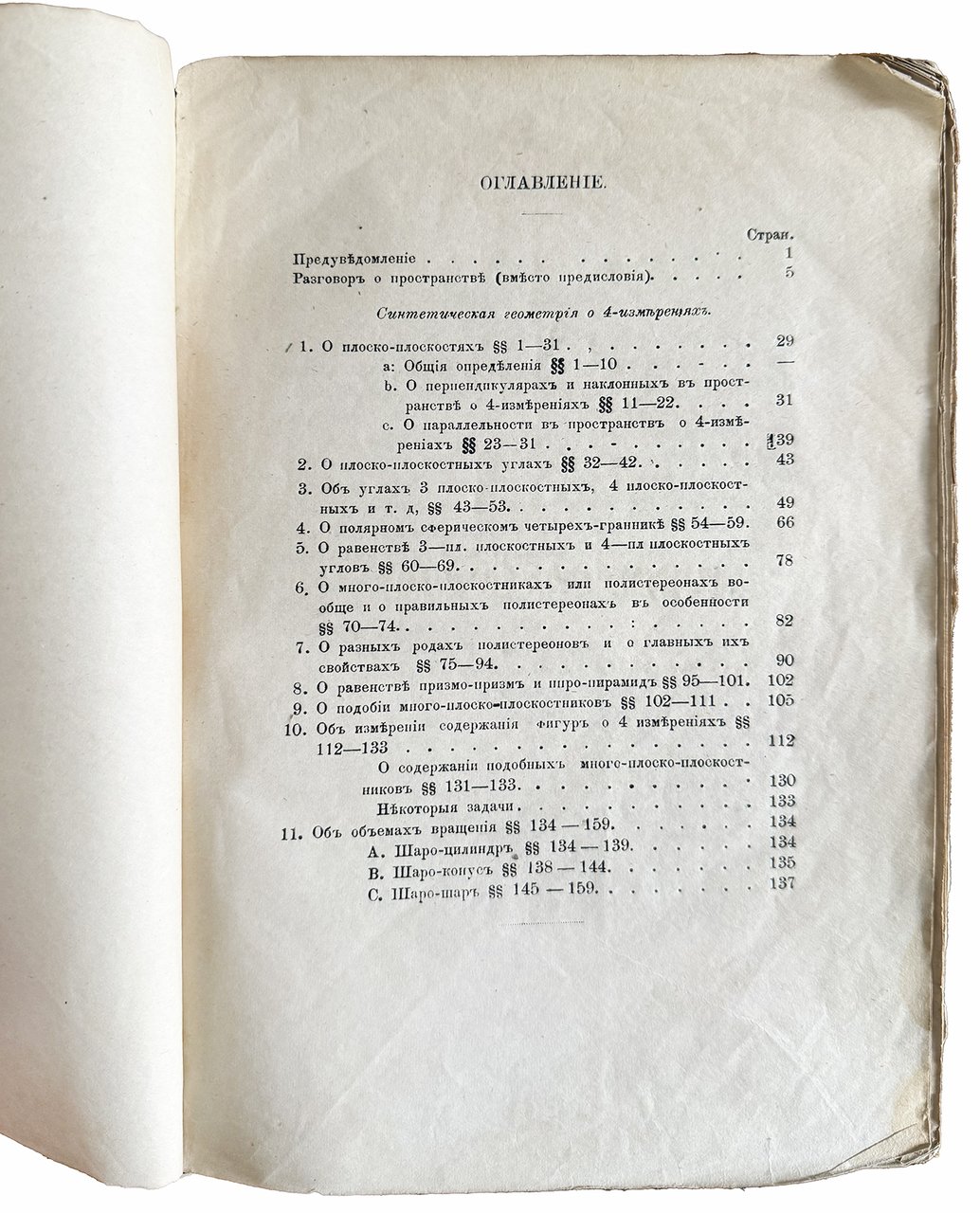
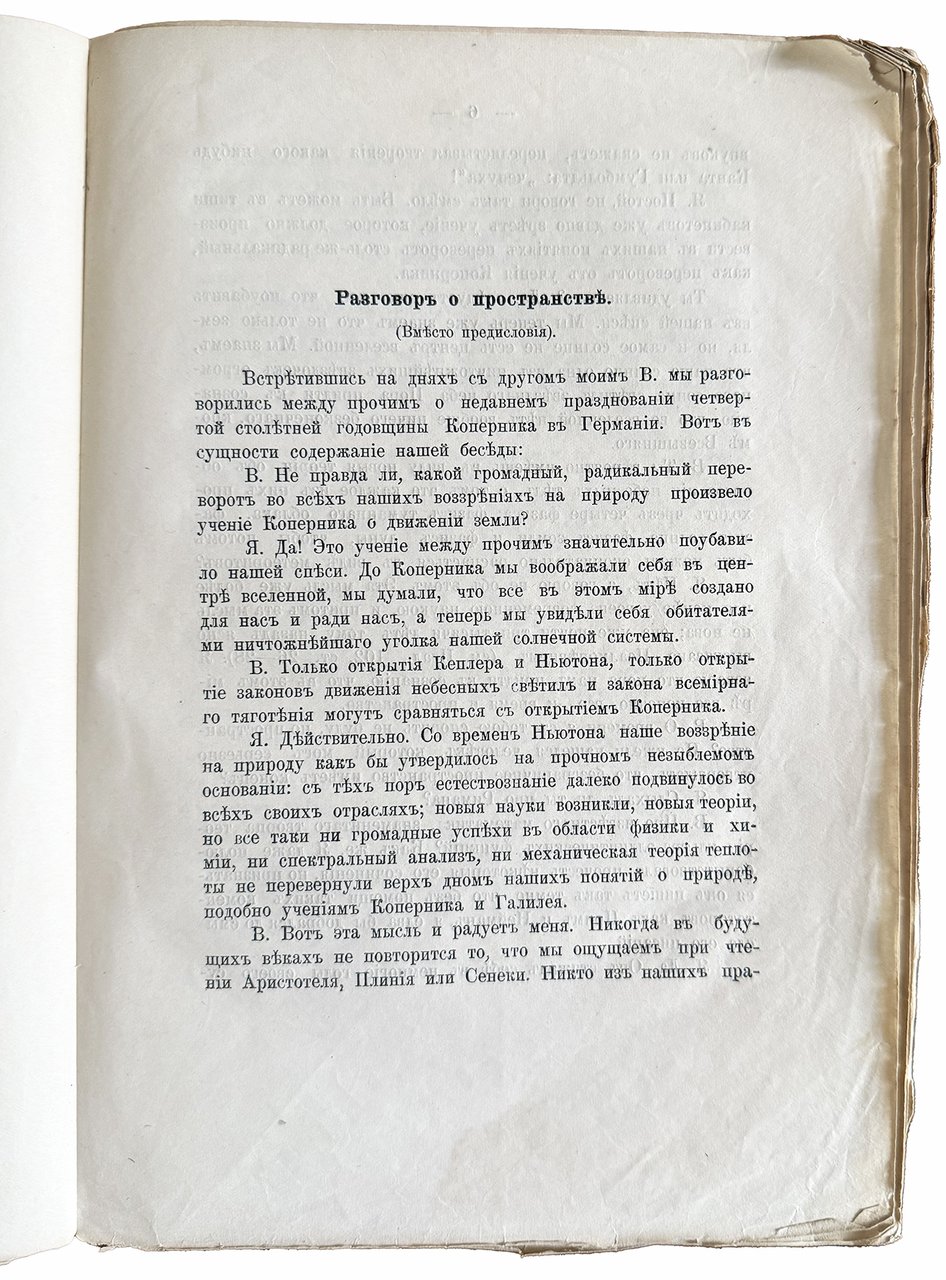
In particolar, Hulak's second book aroused great interest. He published it with a dedication “To the memory of Lobachevsky”. He considered Lobachevsky's discoveries in non-Euclidean geometry to be of revolutionary importance. The introduction to the book is titled “A Conversation about Space”. Written in the form of a dialogue between the author and his friend “V”, it contains an exchange of thoughts about the theories of Nicolaus Copernicus and Nikolai Lobachevsky. The book, one of the first ever published in this field, deals with synthetic geometry and explores the properties of figures in a four-dimensional space. Hulak invented neologisms for the new concepts he was explaining (such as ‘sphero-sphere', ‘plano-planes', ‘prismo-prisms', ‘pyro-pyramides', so forth), and was one of the first to systematically treat four-dimensional geometry in a synthetic way, anticipating by decades some of the best-known developments in the West (even though his works remained little known outside certain circles). Hulak also wrote a continuation to the “Attempt at Four-Dimensional Geometry” entitled “Analytical Geometry with Four Dimensions and with Spherical Tetrahedronometry”, but this work remained unpublished. The original manuscript ended up in the collection of Professor I.K. Andronov (cf. I.K. Omelchenko, Gula