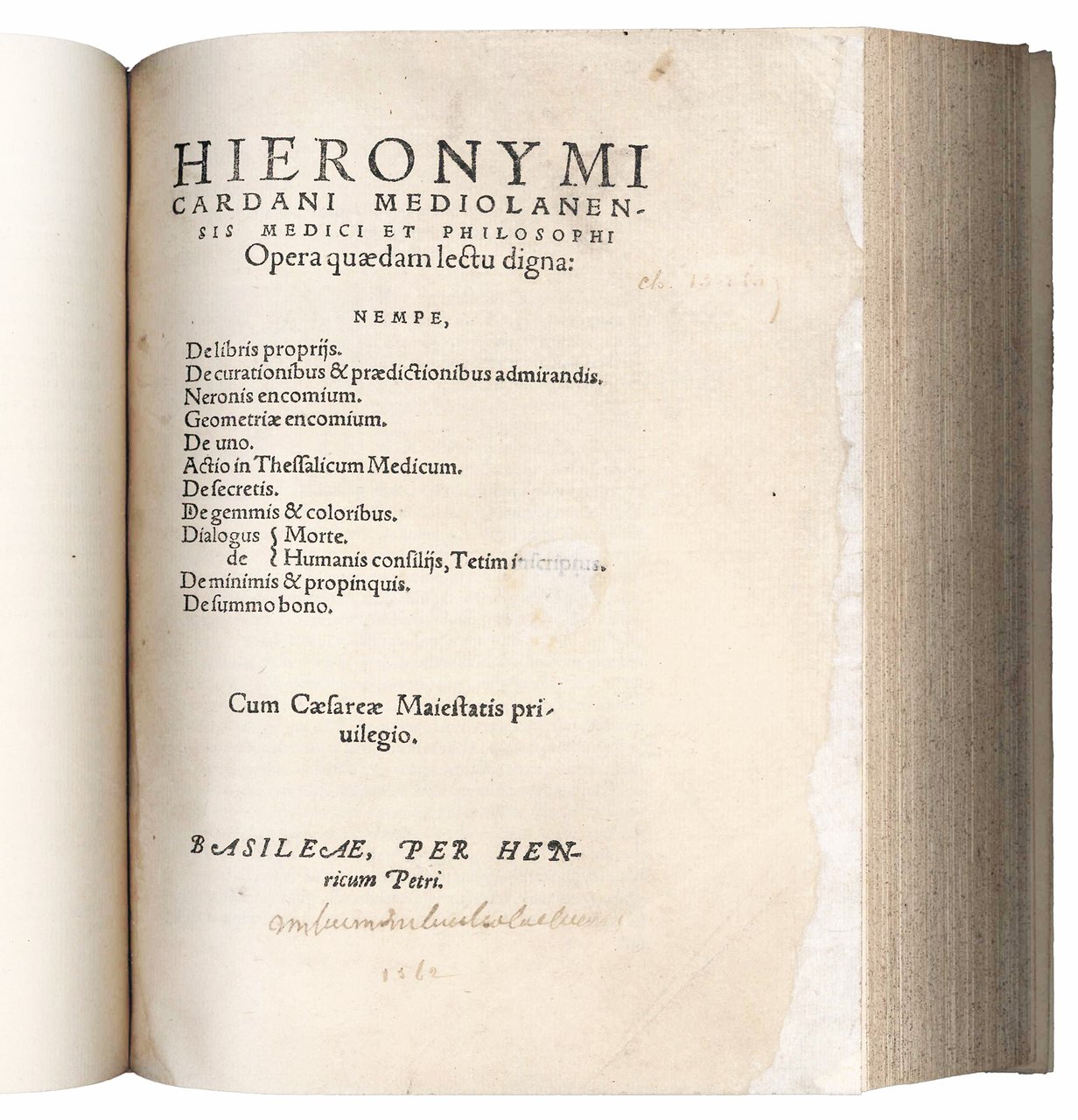
Somniorum synesiorum, omnis generis insomnia explicantes, libri IIII. Per Hieronymum Cardanum Mediolanensem medicum ac philosophum. Quibus accedunt, eiusdem haec etiam: De libris proprijs. De curationibus & prædictionibus admirandis. Neronis encomium. Geometriae encomium. De uno. Actio in Thessalicum medicum. De secretis. De gemmis & coloribus. Dialogus de Morte/Humanis consilijs, Tetim inscriptus. Item ad Somniorum libros pertinentia: De minimis & propinquis. De summo bono
Somniorum synesiorum, omnis generis insomnia explicantes, libri IIII. Per Hieronymum Cardanum Mediolanensem medicum ac philosophum. Quibus accedunt, eiusdem haec etiam: De libris proprijs. De curationibus & prædictionibus admirandis. Neronis encomium. Geometriae encomium. De uno. Actio in Thessalicum medicum. De secretis. De gemmis & coloribus. Dialogus de Morte/Humanis consilijs, Tetim inscriptus. Item ad Somniorum libros pertinentia: De minimis & propinquis. De summo bono | Livres anciens et modernes | CARDANO, Girolamo (1501-1576)
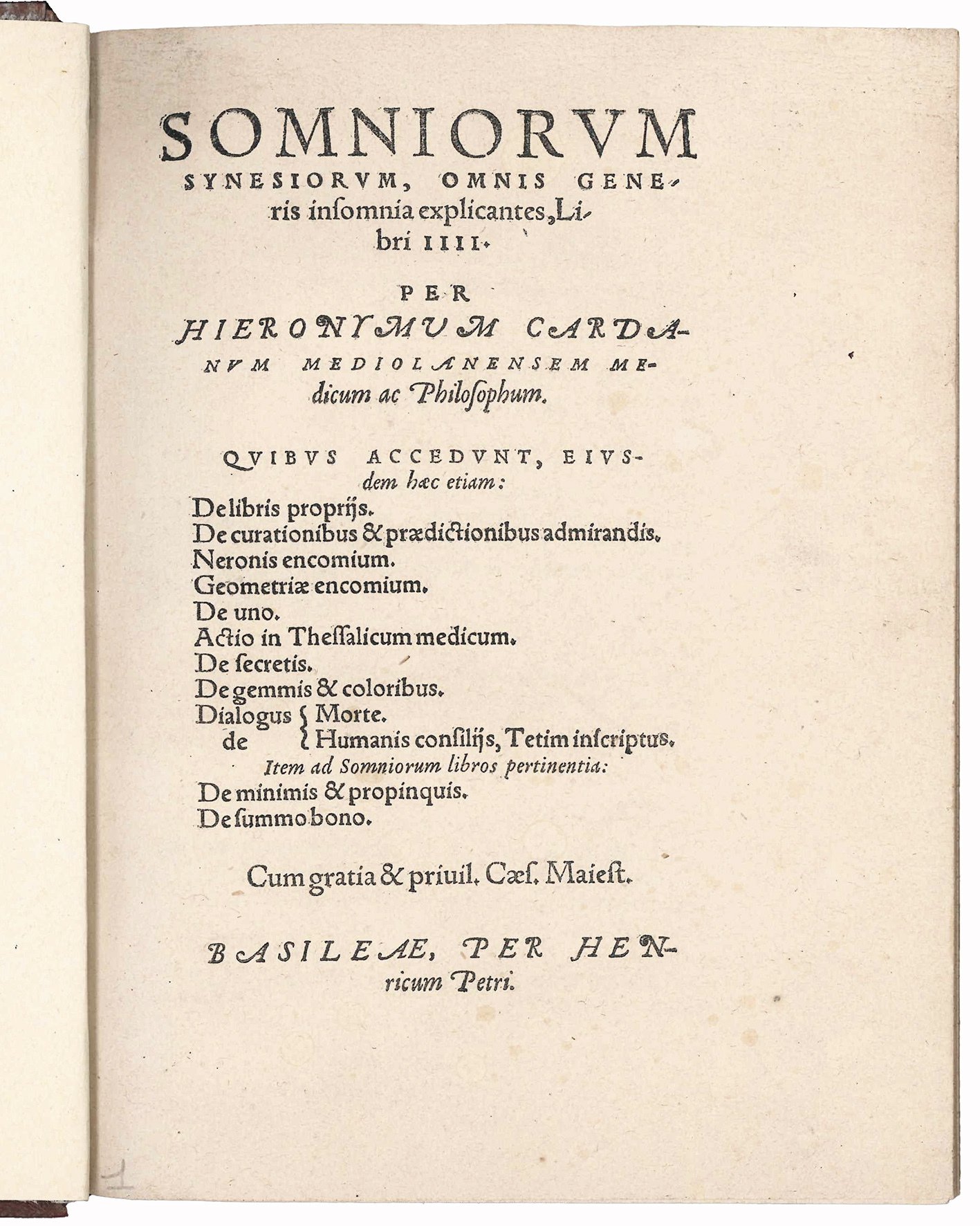

Somniorum synesiorum, omnis generis insomnia explicantes, libri IIII. Per Hieronymum Cardanum Mediolanensem medicum ac philosophum. Quibus accedunt, eiusdem haec etiam: De libris proprijs. De curationibus & prædictionibus admirandis. Neronis encomium. Geometriae encomium. De uno. Actio in Thessalicum medicum. De secretis. De gemmis & coloribus. Dialogus de Morte/Humanis consilijs, Tetim inscriptus. Item ad Somniorum libros pertinentia: De minimis & propinquis. De summo bono
Somniorum synesiorum, omnis generis insomnia explicantes, libri IIII. Per Hieronymum Cardanum Mediolanensem medicum ac philosophum. Quibus accedunt, eiusdem haec etiam: De libris proprijs. De curationibus & prædictionibus admirandis. Neronis encomium. Geometriae encomium. De uno. Actio in Thessalicum medicum. De secretis. De gemmis & coloribus. Dialogus de Morte/Humanis consilijs, Tetim inscriptus. Item ad Somniorum libros pertinentia: De minimis & propinquis. De summo bono | Livres anciens et modernes | CARDANO, Girolamo (1501-1576)
Mode de Paiement
- PayPal
- Carte bancaire
- Virement bancaire
- Pubblica amministrazione
- Carta del Docente
Détails
- Année
- September 1562
- Lieu d'édition
- Basel
- Auteur
- CARDANO, Girolamo (1501-1576)
- Éditeurs
- Heinrich Petri
- Thème
- Quattro-Cinquecento
- Etat de conservation
- En bonne condition
- Langues
- Italien
- Reliure
- Couverture rigide
- Condition
- Ancien
Description
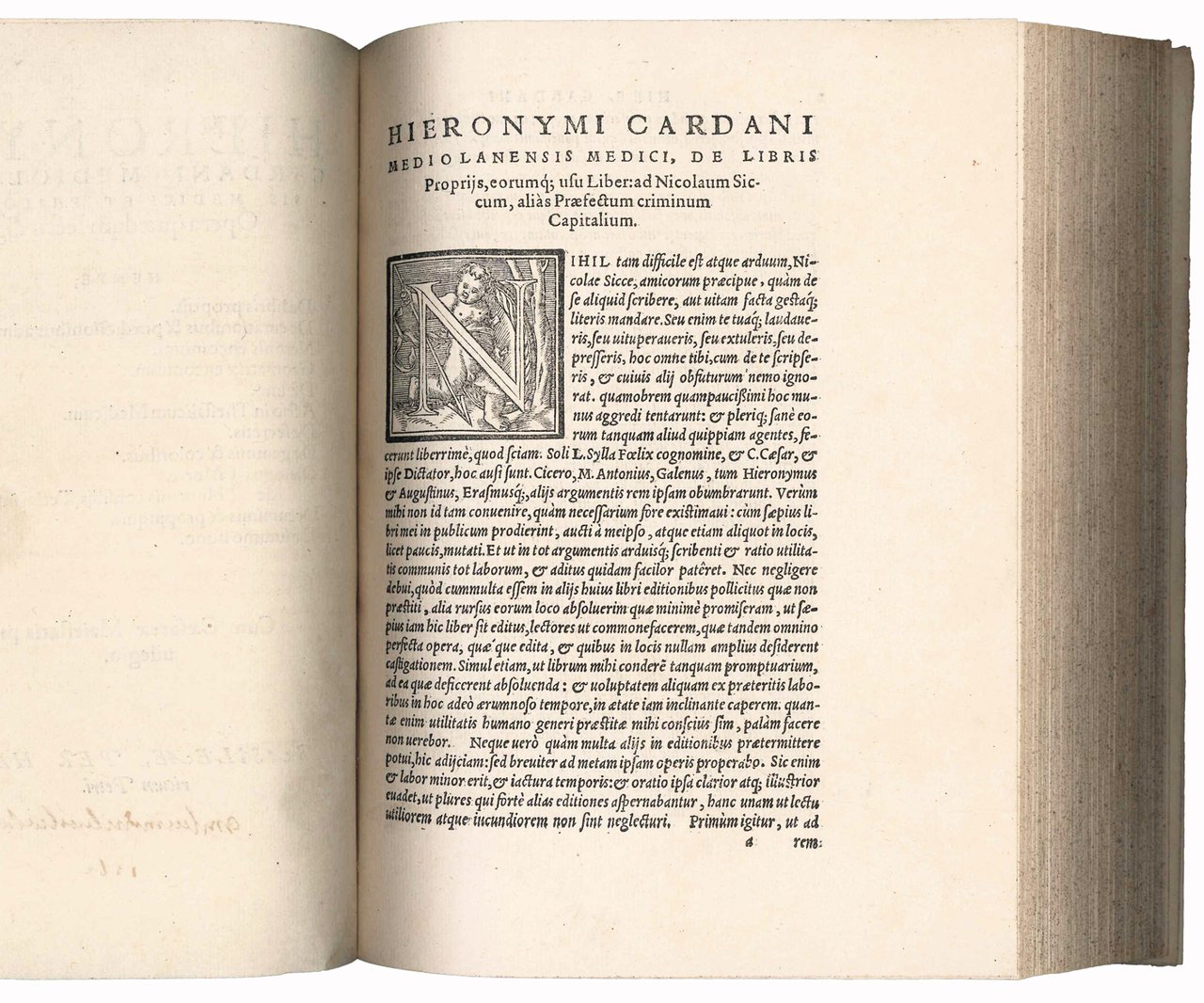
Two parts in one volume, 4to (210x160 mm). [44], 278, [2]; [36], 413, [3] pp. Collation: α-δ4 ε6 AA-ZZ4 AAa-MMm4; α-γ4 δ6 a-z4 A-Z4 aa-ff4. Leaves ε6 and MMm4 are blank. Leaf α1 in part two bound after δ6. Colophon on l. ff3v. Printer's device on l. ff4v. The second part opens with a section title. With two woodcut diagrams in text. Roman and italic types. Woodcut initials. Modern full leather, spine with five raised bands and gilt title. Repair to the outer of the title page of part two. Copy skillfully washed bearing a few marginal annotations and reading signs in two different old hands.
First edition (reprinted by Petri in 1585) of this collection of texts by Girolamo Cardano, which includes the first appearance of his work on dream interpretation and the final version of his bibliographical study on his own works.
Like astrology, the art of interpreting dreams occupied Cardano for a long time. As early as 1543, while writing his first, elaborate autobiography, he emphasized the role dreams played in his intellectual life. His work in mathematics during the 1530s and 1540s, for example, was based in part on his skill and diligence, but also in part on luck, “for through my dreams I made many discoveries. Moreover, they encouraged me to continue seeking solutions, which in this case never eluded me.” Another dream from the same period encouraged Cardano to continue writing, in such an imperious manner that “its image continues to trouble me.” Yet another led Cardano to write about the life of Christ and terrified him to such an extent that he did not dare to publish the text. Another convinced him to learn Greek. The idea that knowledge obtained through dreams could supplement the experience acquired while awake was corroborated in Cardano's eyes by authoritative sources. Galen had affirmed this. A whole series of dream interpretation manuals also assured him that from a careful and systematic study of dreams, one could derive the principles for interpreting them, generally viewing them as clues to the immediate future rather than, as they would be for Freud, keys to understanding the dreamer's past mental states. Thus, early in his career, Cardano set out to develop dream interpretation into a well-structured predictive art. In Somnia Synesia, which remained unpublished until 1562, he recounted a long series of his own dreams in a detailed, meticulous, and often fascinating manner. He also devised an elaborate and plausible explanation for the predictive power of dreams. Recognizing that dreams took various forms and had many different levels of clarity and obscurity, Cardano emphasized that both the cause and the object of a vision must be clearly determined for a dream to become truly clear. Only when the stars inspired a vision of a person or object already known to the dreamer could the interpretation achieve certainty. Cardano celebrated the powers of this art with the utmost enthusiasm, while at the same time warning against its abuse by the incompetent. Like astrology, Cardano's art of dream interpretation required of its practitioners knowledge derived from experience, profound wisdom, and a sense of personal honor. Unlike astrology, however, dream interpretation was not always based on a well-articulated and coherent set of technical principles. Cardano did not believe that dreams were always caused by the predictable movements of the stars and planets. Instead, he tended to explain these fleeting and unpredictable glimpses of the future by attributing them to inspiration from supernatural beings. Like his astrology, Cardano's belief in other channels of communication with divine beings was at least partly inherited. His father, Fazio, for whom he had great respect, had believed he possessed the power to enter into direct contact with God and his angels (cf. A. Grafton, Cardano's Cosmos, Cambridge MA-London, 1999, pp. 165-166).
“Girolamo Cardano conceived and outlined his four books on dreams according to Synesius