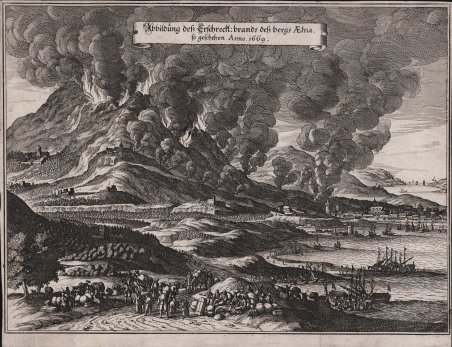
Rappresentazione drammatica dell’attività eruttiva dell’Etna del 1669; sul lato sinistro della stampa in evidenza il vulcano che emette fuoco e fumo, da cui la lava scorre verso la costa. Sul lato destro la città di Catania con il porto, gravemente danneggiata dalla devastante eruzione, e dietro di essa lo Stretto di Messina. In primo piano si vedono numerose persone in fuga e sulla destra diverse imbarcazioni arrivate in soccorso. In alto al centro il titolo in tedesco. Acquaforte, circa 1677, priva di firma ed indicazioni editoriali. Tavola tratta dal celebre Theatrum Europaeum. Beschreibung aller Geschichten so sich 1617[-1718] zugetragen haben. Beschrieben durch J. P. Abelin [et al.]. Famosa cronaca del secolo, illustrata da Matthaeus Merian e dai suoi successori, acclamata come la prima e più completa fonte per l'epoca di Luigi XIV e della Guerra dei Trent'anni. Ebbe un lunghissimo periodo di pubblicazione, quasi 100 anni; le numerose mappe, vedute, ritratti e illustrazioni di eventi storici e battaglie conferiscono all'opera un valore storico e culturale. Il numero e la disposizione delle incisioni varia nelle varie edizioni; Wüthrich indica un inventario massimo di 693 tavole diverse con 722 illustrazioni. Matthaeus Merian il Vecchio incise lui stesso circa 140 delle tavole del Theatrum. Questa incisione viene attribuita a Caspar Merian (1627-1686), figlio ed allievo dell’incisore Matthäus Merian. L'eruzione dell'Etna ebbe l'11 marzo del 1669; sarà la più grande eruzione laterale dell'Etna avvenuta negli ultimi quattro secoli sia dal punto di vista vulcanologico che storico. Per questo, il 1669 fu definito dalla popolazione interessata dall'evento vulcanico l'anno della grande "ruina" (rovina). Durante tale fenomeno dalla bocca principale, localizzata a 800 m di quota presso Nicolosi, furono eruttati circa 600 milioni di m3 di lava che generarono un vasto campo lavico lungo 17 km, interessando una grande parte di quello che oggi è il territorio dell'area metropolitana di Catania ed in particolare i comuni di Belpasso, Camporotondo Etneo, Catania, Gravina di Catania, Mascalucia, Misterbianco, Nicolosi, Pedara e San Pietro Clarenza. L'eruzione si concluse quattro mesi dopo, l'11 Luglio, dopo aver generato la più grossa emergenza vulcanica mai avvenuta sull'Etna, raggiungendo il mare e spostando con "nuove terre" la linea di costa di poco meno di un chilometro. Un evento drammatico e allo stesso tempo straordinario, documentato da numerose cronache del tempo, da viaggiatori italiani e stranieri, da numerose iconografie e preziosi oggetti devozionali. Caspar Merian è stato uno dei più importanti incisori ed editori topografici del periodo barocco. Proveniva dal ramo francofortese della famiglia Merian di Basilea. Caspar era figlio e allievo dell'incisore Matthäus Merian il Vecchio (1593-1650) e di sua moglie Maria Magdalena, nata de Bry. Lavorò come assistente del padre per un certo periodo a Parigi e a Norimberga. Dopo la morte del padre, diresse la casa editrice di Francoforte insieme al fratello Matthäus il Giovane, continuando a pubblicare le opere principali iniziate dal padre, la Topographia Germaniae e il Theatrum Europaeum, e realizzando per esse numerose altre incisioni. Bell’esemplare, rifilato al rame, in buono stato di conservazione. Dramatic depiction of Mount Etna's 1669 eruptive activity; on the left side of the print highlighting the volcano emitting fire and smoke, from which lava flows toward the coast. On the right side is the city of Catania with its harbor, severely damaged by the devastating eruption, and behind it the Strait of Messina. In the foreground can be seen numerous people fleeing and on the right several boats arrived to help. In the upper center is the title in German. Etching, ca. 1677, unsigned and without editorial indications. Plate from the famous Theatrum Europaeum. Beschreibung aller Geschichten so sich 1617[-1718] zugetragen haben. Beschrieben durch J. P. Abelin [et al.]. Famous chronicle of the century, illustrated by Matthaeus Merian and his successors, acclaimed as the first and most complete source for the time of Louis XIV and the Thirty Years' War. It had a very long period of publication, nearly 100 years; the numerous maps, views, portraits and illustrations of historical events and battles give the work historical and cultural value. The number and arrangement of engravings varies in the various editions; Wüthrich indicates a maximum inventory of 693 different plates with 722 illustrations. Matthaeus Merian the Elder himself engraved about 140 of the plates in the Theatrum. This engraving is attributed to Caspar Merian (1627-1686), son and pupil of Matthäus Merian. The eruption of Etna took place on March 11, 1669; it was to be the largest lateral eruption of Etna to occur in the last four centuries both volcanologically and historically. Therefore, 1669 was called by the people affected by the volcanic event the year of the great "ruina" (ruin). During that phenomenon from the main mouth, located 800 m above sea level near Nicolosi, about 600 million m3 of lava were erupted, generating a vast lava field 17 km long, affecting a large part of what today is the territory of the metropolitan area of Catania and in particular the municipalities of Belpasso, Camporotondo Etneo, Catania, Gravina di Catania, Mascalucia, Misterbianco, Nicolosi, Pedara and San Pietro Clarenza. The eruption ended four months later, on July 11, after generating the largest volcanic emergency ever on Etna, reaching the sea and displacing with "new land" the coastline by just under a kilometer. A dramatic and at the same time extraordinary event, documented by numerous chronicles of the time, Italian and foreign travelers, numerous iconographies and precious devotional objects. Caspar Merian (1627 -1686) was one of the most important engravers and topographical editors of the Baroque period. He came from the Frankfurt branch of the Merian family of Basel. Caspar was the son and pupil of engraver Matthäus Merian the Elder (1593-1650) and his wife Maria Magdalena, née de Bry. He worked as his father's assistant for a time in Paris and Nuremberg. After his father's death, he ran the Frankfurt publishing house together with his brother Matthäus the Younger, continuing to publish the major works begun by his father, the Topographia Germaniae and the Theatrum Europaeum, and producing numerous other engravings for them. Fine example, trimmed to copperplate, in good condition. Cfr.
 Découvrez comment utiliser
 Découvrez comment utiliser