Arch of Traian. This monument is situated at Beneventum in the Kingdom of Naples
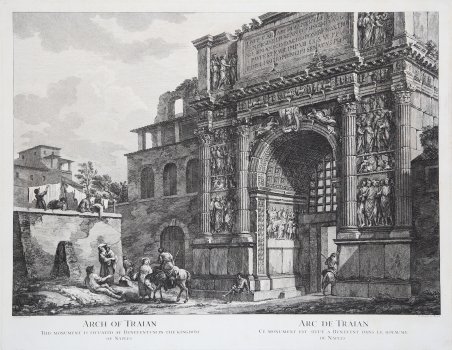
Arch of Traian. This monument is situated at Beneventum in the Kingdom of Naples
Mode de Paiement
- PayPal
- Carte bancaire
- Virement bancaire
- Pubblica amministrazione
- Carta del Docente
Détails
- Année
- 1760
- Lieu d'édition
- Roma
- Format
- 605 X 465
- Graveurs
- CUNEGO Domenico
Description
L'arco di Traiano a Benevento, da un dipinto di Charles Louis Clérisseau; alcune figure si vedono stendere il bucato su una terrazza in primo piano a sinistra, mentre in basso altre parlano tra di loro. Acquaforte, 1760/65 circa, con titolo seguito da 'this monument is situated at Beneventum in the Kingdom of Naples', in inglese e francese, seguito dai dati di produzione: 'C. Clerisseau p. / D. Cunego sc. Romae". Dalla serie Views of Antique Buildings and Famous Ruins in Italy. Charles-Louis Clérisseau (28 agosto 1721 - 9 gennaio 1820) fu un architetto, disegnatore, antiquario e artista francese che divenne una delle massime autorità in materia di architettura romana antica e di rovine romane in Italia e in Francia. Con la sua influenza che si estendeva alla Russia, all'Inghilterra e agli Stati Uniti, e con clienti come Caterina la Grande e Thomas Jefferson, Clérisseau giocò un ruolo chiave nella genesi dell'architettura neoclassica della seconda metà del XVIII secolo. Clérisseau creò opere su carta utilizzando una varietà di mezzi, spesso in combinazione tra loro, tra cui matita, gesso, inchiostro, acquerello e gouache. Molte delle sue opere sono state tradotte a stampa da incisori come Domenico Cunego (la serie delle Views of Antique Buildings and Famous Ruins in Italy), Francesco Bartolozzi, Francesco Zucchi e Paolo Santini. Per l’incisore Domenico Cunego (Verona 1727 - Roma, 1803) fu centrale l'incontro nel 1760 con James Adam, che fermatosi a Verona dal 9 al 20 ottobre circa in compagnia di Clérisseau, dell'abate Farsetti e di uno dei fratelli Zucchi, assunse a suo servizio un disegnatore, Giuseppe Sacco, e, come incisore, il Cunego, che pare gli fosse stato presentato dal conte Girolamo Dal Pozzo. ' Le Views of Antique Buildings and Famous Ruins in Italy si riferiscono ad un più ampio progetto di Antiquities of Sicily and Graecia Major, lungamente discusso col Clérisseau ed impostato fra il settembre e il dicembre 1761 durante un viaggio nel Napoletano cui non risulta che il Cunego abbia partecipato di persona. Ottima impressione, su carta vergata coeva, con piccoli margini, tracce di colla al verso, altrimenti in buono stato di conservazione. Rara. Bibliografia Gian Luca Kannès, Domenico Cunego, in “Dizionario Biografico degli Italiani” - Volume 31 (1985). The arch of Trajan at Benevento, after Charles Louis Clérisseau, with some figures seen hanging the laundry on a terrace in the left foreground, and below some figures chatting. Etching, circa 1760/65, lettered with title followed by 'this monument is situated at Beneventum in the Kingdom of Naples', in English and French, and production details: 'C. Clerisseau p. / D. Cunego sc. Romae'. From the series Views of Antique Buildings and Famous Ruins in Italy. Charles-Louis Clérisseau (28 August 1721 – 9 January 1820) was a French architect, draughtsman, antiquary, and artist who became a leading authority on ancient Roman architecture and Roman ruins in Italy and France. With his influence extending to Russia, England, and the United States, and clients including Catherine the Great and Thomas Jefferson, Clérisseau played a key role in the genesis of neoclassical architecture during the second half of the 18th century. Clérisseau created works on paper using a variety of media, often in combination, including pencil, chalk, ink, watercolor, and gouache. Many of his works were reproduced as etchings by engravers including Domenico Cunego (the series Views of Antique Buildings and Famous Ruins in Italy), Francesco Bartolozzi, Francesco Zucchi and Paolo Santini. Central to the engraver Domenico Cunego (Verona 1727 - Rome, 1803) was his meeting in 1760 with James Adam, who stopped in Verona from about October 9 to 20 in the company of Clérisseau, Abbot Farsetti and one of the Zucchi brothers, and hired a draughtsman, Giuseppe Sacco, as his servant and, as engraver, Cunego, who apparently had been introduced to him by Count Girolamo Dal Pozzo. ' The Views of Antique Buildings and Famous Ruins in Italy refer to a larger project of Antiquities of Sicily and Graecia Major, discussed at length with Clérisseau and set up between September and December 1761 during a trip to the Naples area in which Cunego does not appear to have participated in person. A very good impression, on contemporary laid paper, with small margins, trace of glue on verso, otherwise in good condition. Rare. Bibliografia Gian Luca Kannès, Domenico Cunego, in “Dizionario Biografico degli Italiani” - Volume 31 (1985). Cfr.
