Ascensione della Vergine
Ascensione della Vergine | Gravures | SCHUT I Cornelis
Ascensione della Vergine
Ascensione della Vergine | Gravures | SCHUT I Cornelis
Mode de Paiement
- PayPal
- Carte bancaire
- Virement bancaire
- Pubblica amministrazione
- Carta del Docente
Détails
- Année
- 1640
- Format
- 200 X 160
- Graveurs
- SCHUT I Cornelis
Description
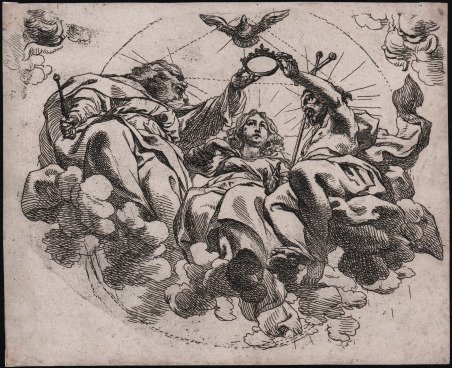
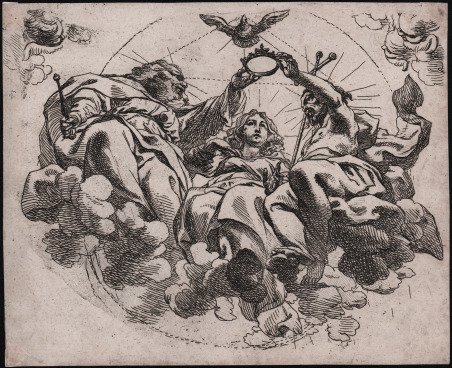
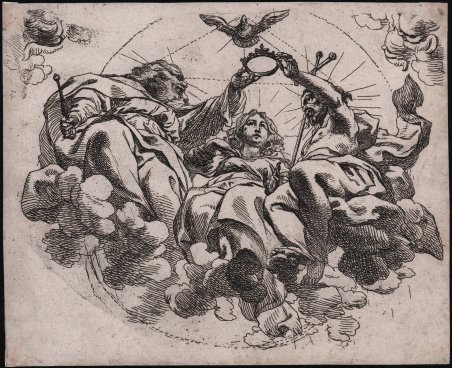
Acquaforte, 1640 circa, impressa su carta vergata contemporanea, in ottimo stato di conservazione. L’incisione raffigura l'incoronazione della Vergine, seduta sulle nuvole tra Dio a sinistra e Cristo a destra; lo Spirito Santo, sotto forma di colomba, vola sopra di lei. Cornelis Schut nacque ad Anversa come figlio di Willem Schut e Suzanna Schernilla. Non ci sono documenti sulla sua formazione artistica. Viene menzionato per la prima volta come allievo di Peter Paul Rubens dallo storico del XVIII secolo Jacob Campo Weyerman. Divenne un maestro della Gilda di San Luca di Anversa nel 1618; poco dopo il 1618. Mentre era a Roma, fu un membro fondatore dei Bentvueghels, un'associazione di artisti principalmente olandesi e fiamminghi che lavoravano a Roma. Divenne consuetudine per i Bentvueghels adottare un soprannome accattivante, il cosiddetto 'nome piegato'. Schut prese il soprannome Broodzak (borsa del pane). ' Dal 13 gennaio 1627 lavorò agli affreschi nella villa "Casino Pescatore" situata a Frascati, di proprietà di Giorgio Pescatori (alias Pieter de Vischere), un ricco banchiere e mecenate italiano di origine fiamminga. Un altro importante mecenate a Roma fu l'aristocratico banchiere italiano e collezionista d'arte Vincenzo Giustiniani che gli commissionò due grandi composizioni religiose (ora nell'Abbazia di Sainte-Trinité, Caen). Questo mecenatismo dimostra chiaramente la stima di cui Schut godeva a Roma. Egli attirò anche l'attenzione del giovane Poussin che allora risiedeva a Roma nella residenza dello scultore fiammingo François Duquesnoy. Le prime opere di Poussin presero in prestito alcuni motivi dalle opere di Schut realizzate per Vincenzo Giustiniani. I piani di Schut a Roma furono interrotti quando il 16 settembre 1627 fu imprigionato per l'uccisione di un collega artista di nome Giusto. Il suo periodo in carcere fu breve, poiché il 2 ottobre fu già rilasciato grazie all'intervento dell'Accademia di San Luca, l'associazione degli artisti di Roma. Lasciò quindi Roma e fu segnalato nel 1627-28 a Firenze. È noto per aver disegnato arazzi per l'Arazzeria Medicea, la più importante fabbrica di arazzi d'Italia fondata nel 1546 a Firenze dal granduca Medici Cosimo I. I suoi movimenti dopo questo periodo non sono chiari. Schut godette di successo artistico al suo ritorno ad Anversa, dove produsse principalmente pale d'altare per le chiese locali. Dipinse nello stile alto-barocco che era diventato popolare nelle Fiandre in quel periodo. Schut ebbe un ruolo di primo piano nel progetto decorativo in occasione dell'Ingresso Reale del Cardinale-Infante Ferdinando nel 1635 sia ad Anversa (dove Rubens fu incaricato del progetto artistico generale) che a Gand. Su questi progetti collaborò con Gaspard de Crayer, Nicolas Roose, Jan Stadius e Theodoor Rombouts. Il magistrato di Gand incaricò Schut di disegnare e incidere tutte le decorazioni che erano state fatte per l'entrata reale di Gand. Schut fornì più di 100 incisioni per questa commissione. Schut morì ad Anversa il 29 aprile 1655. Fu sepolto nella chiesa di San Willibrord ad Anversa in una tomba condivisa con la sua seconda moglie. La tomba e il suo cenotafio di marmo sono ancora presenti nella chiesa. Schut fu il maestro di Ambrosius (II) Gast, Jan Baptist van den Kerckhoven, Philippe Vleughels, Hans Witdoeck e suo cugino Cornelis Schut III. Bibliografia Hollstein, ' Dutch and Flemish etchings., n. 89; ' Nagler 1858-79 / Die Monogrammisten (XVI, 88, 11). Etching, 1640 circa. Printed on contemporary laid paper, in good condition. The Coronation of the Virgin, sitting on the clouds between God at left and Christ at right, two heads of angels above right, one head on the left. The Holy Spirit, in the form of a dove, flies above her. Cornelis Schut was a Flemish painter, draughtsman, engraver and tapestry designer who specialized in religious and mythological scenes. Presumed to have trained under Rubens, he treated Counter-Reformation subjects in a High-Baroque style. After a stay in Italy, he worked mainly in Antwerp where he was one of the leading history painters in the first half of the 17th century. There are no records about his artistic training. He is first mentioned as a pupil of Peter Paul Rubens by the 18th century historian Jacob Campo Weyerman. Although the scientific relevance of Weyerman's sources is questioned, it is still assumed that Schut was a pupil of Rubens since Rubens was exempted from registering his pupils with the Antwerp Guild of St Luke. Because Schut's early works are closer to the style of the leading Antwerp history painter Abraham Janssens, some connection with the workshop of Abraham Janssens may have existed although it does not prove he was Janssens' pupil. Schut became a master of the Antwerp Guild of St Luke in 1618. Schut left for Italy shortly after 1618. While in Rome, he was a founding member of the Bentvueghels, an association of mainly Dutch and Flemish artists working in Rome. It became customary for the Bentvueghels to adopt an appealing nickname, the so-called 'bent name'. Schut took the nickname Broodzak (bread bag). From 13 January 1627 he worked on frescoes in the villa "Casino Pescatore" located in Frascati, owned by Giorgio Pescatori (aka Pieter de Vischere), a wealthy Italian banker and patron of Flemish descent. Another important patron in Rome was the aristocratic Italian banker and art collector Vincenzo Giustiniani who commissioned two large religious compositions from him (now in the Abbey of Sainte-Trinité, Caen). This patronage clearly demonstrated the esteem which Schut enjoyed in Rome. He also attracted the attention of the young Poussin then residing in Rome in the residence of the Flemish sculptor François Duquesnoy. Poussin's early works borrowed some motifs from Schut's works made for Vincenzo Giustiniani. Schut's plans in Rome were disrupted when on 16 September 1627 he was imprisoned for the killing of a fellow artist by the name of Giusto. His jail time was short as on 2 October he was already released thanks to the intervention of the Accademia di San Luca, the association of artists in Rome. He then left Rome and was reported in 1627-28 in Florence. He is known to have designed tapestries for the Arazzeria Medicea, the most important tapestry factory in Italy founded in 1546 in Florence by the Medici grand duke Cosimo I. His movements after this time are unclear. Schut enjoyed artistic success upon his return to Antwerp where he produced mainly altarpieces for the local churches. He painted in the High-Baroque style that had become popular in Flanders by that time. In particular his ability to produce ceiling decorations in the monumental Italian style, with its typical illusionistic character, was regarded highly by patrons in his home country. An example of this is his Assumption of Mary in Antwerp Cathedral. Schut played a prominent role in the decorative project at the occasion of the Royal Entry of the Cardinal-Infante Ferdinand in 1635 in both Antwerp (where Rubens was in charge of the overall artistic design) and Ghent. He collaborated with Gaspard de Crayer, Nicolas Roose, Jan Stadius and Theodoor Rombouts on these projects. The Ghent magistrate commissioned Schut to draw and engrave all the decorations that had been made for the Ghent Royal Entry. Schut supplied more than 100 etchings for this commission. Schut died in Antwerp on 29 April 1655 shortly after the death of his second wife. Cfr.