Autoritratto
Autoritratto | Gravures | TESTA detto "Il Lucchesino" Pietro
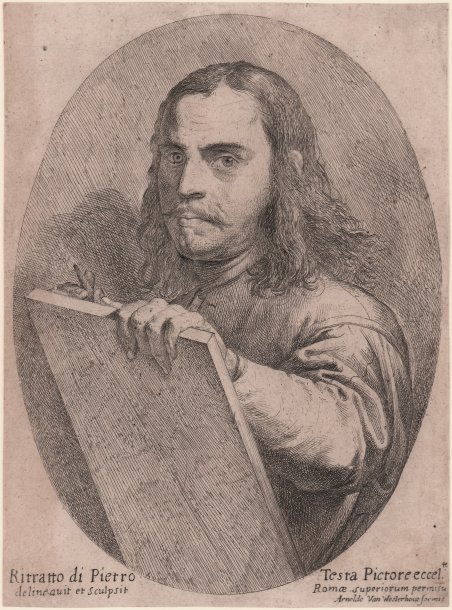
Autoritratto
Autoritratto | Gravures | TESTA detto "Il Lucchesino" Pietro
Mode de Paiement
- PayPal
- Carte bancaire
- Virement bancaire
- Pubblica amministrazione
- Carta del Docente
Détails
- Année
- 1645
- Format
- 170 X 230
- Graveurs
- TESTA detto "Il Lucchesino" Pietro
- Thème
- Ritratti
- Description
- Bartsch, p. 215, n. 1; Bellini, pp. 64-65, n. 35; Cropper, p. 230, n. 106
Description
Acquaforte, 1645 circa, in basso, nei due angoli: Ritratto di Pietro/ ' Testa pictore eccel.te/ delineavit et Sculpsit/ Romae superiorum permisu/ Arnoldo van Westerhout formis ' Esemplare nel terzo stato finale, con l’indirizzo dell’editore fiammingo Arnold van Westerhout (1651-1725). Buona prova, impressa su carta vergata coeva priva di filigrana, rifilata al rame, leggera ossidazione nella parte sinistra, nel complesso in buono stato di conservazione. "Testa appears considerably older here than in the drawing made by his friend Pierfrancesco Mola in 1637. The dense shadows of the etching and the style of the red chalk preparatory study, Testa now in the Real Academia de Bellas Artes de San Fernando in Madrid, support the date of around 1645 suggested by the apparent age of the artist. Many of Testa's allegorical inventions may be seen as a kind of self-portraiture, but in this intimate image Testa depicts himself in the very act of self-portrayal in the most direct way, without idealism and without symbol." E. Cropper, Pietro Testa, p. 230 n. 106. La vicenda artistica di Pietro Testa, detto il Lucchesino dalla sua città d’origine, è assai tormentata. Poco o nulla si sa del suo primo apprendistato nella città natale. Arrivato a Roma nel 1629, fu probabilmente dapprima a scuola presso il Domenichino, poi presso la bottega di Pietro da Cortona, suo vero maestro. Il carattere introverso dell’artista gli procurò comunque sempre difficoltà con ' i suoi colleghi: il Cortona infatti fu costretto a cacciarlo dalla sua scuola per l’atteggiamento di sprezzante superiorità assunta dall’allievo . Il Testa frequentò allora la casa del suo primo mecenate, il celebre collezionista Cassiano del Pozzo, per il quale eseguì disegni dall’antico. Fu probabilmente nella sua casa che conobbe il pittore Nicolas Poussin, che influenzerà profondamente la sua arte sia nella sua prima fase di adesione tizianesca ' al movimento neo-veneto, sia nel periodo più maturo, a partire dagli anni 1635 in poi, caratterizzati da un intellettualismo classicheggiante. Resta comunque il fatto che le sue incisioni (che ammontano a 40 tavole circa) furono considerate fin dall’antichità, a partire dal Sandrart e dal Baldinucci, le opere grafiche più importanti del '600 italiano. ' Etching, circa 1645. Inscribed in the lower plate mark outside the oval: ' Ritratto di Pietro/ ' Testa pictore eccel.te/ delineavit et Sculpsit/ Romae superiorum permisu/ Arnoldo van Westerhout formis ' . Third final state, with the address of ' Arnold van Westerhout (1651-1725). A good impression, printed on contemporary paper, trimmed to the platemark, in good condition. "Testa appears considerably older here than in the drawing made by his friend Pierfrancesco Mola in 1637. The dense shadows of the etching and the style of the red chalk preparatory study, Testa now in the Real Academia de Bellas Artes de San Fernando in Madrid, support the date of around 1645 suggested by the apparent age of the artist. Many of Testa's allegorical inventions may be seen as a kind of self-portraiture, but in this intimate image Testa depicts himself in the very act of self-portrayal in the most direct way, without idealism and without symbol." E. Cropper, Pietro Testa, p. 230 n. 106. Pietro Testa was called Lucchesino for he was born in Lucca. There are but a few news about his apprenticeship in his hometown; for sure, he went to Rome in 1629 to study in the school of Domenichino first and then, towards the end of the year, he moved to the studio of his real master, Pietro da Cortona. His introvert temper caused him a lot of troubles; Cortona, in fact, was obliged to send him away due to his hostile and disdainful behaviour. Testa went then to the house of his first patron, the famous collector Cassiano del Pozzo, and for him he realized his drawings from antiques. Maybe it was in this house that he met Nicolas Poussin who deeply influenced his art both in the neo-Venetian phase and the intellectual classicist one, from 1635. His engravings though, about 40 pieces, have been considered, starting from Sandrart and Bladinucci, the most important graphic works of the Italian XVII century. Cfr. Bartsch, p. 215, n. 1; Bellini, pp. 64-65, n. 35; Cropper, p. 230, n. 106