CAPITOLII · ROMANII · VERA · IMAGO · VT · NUNC · EST ·
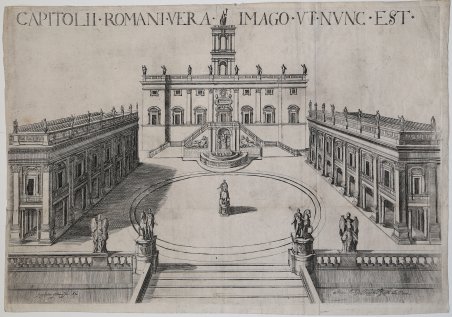
CAPITOLII · ROMANII · VERA · IMAGO · VT · NUNC · EST ·
Mode de Paiement
- PayPal
- Carte bancaire
- Virement bancaire
- Pubblica amministrazione
- Carta del Docente
Détails
- Année
- 1600
- Format
- 530 X 375
- Graveurs
- AELST Nicolas van
Description
Acquaforte e bulino, 1600, firmata in basso a destra: «Nicolaus Van Aelst formis» (negli esemplari di primo stato). Iscritto in basso a sinistra: «Superiorum permissu 1600». Opera parte dello "Speculum Romanae Magnificentiae”.Iscritto in alto: «· CAPITOLII · ROMANII · VERA · IMAGO · VT · NUNC · EST · ».Esemplare nel secondo stato, con l’imprint “in Roma Per Gio. Jacomo Rossi alla Pace” che sostituisce quello di Van Aelst e con la data 1650 che segue l’indicazione del privilegio. Inoltre, la fontana raffigurata nella parte sinistra dell’edizione Van Aelst lascia spazio al completamento del palazzo Senatorio.Nicola Van Aelst fu attivo a Roma tra il 1585 e l’anno della sua morte, il 1613. Nel 1588 ottenne il privilegio papale per stampare le grandi opere di Sisto V e fu in prima linea nella produzione incisoria che doveva propagandare Roma per il Giubileo del 1600. L’incisione qui rappresentata «non scende in particolari: le finestre di mezzanino non hanno festoni di stucco, il fregio non ha le imprese di Clemente VIII, ma il portale del palazzo è quello “ricco”, con le colonne inalveolate e l’iscrizione della presa di Ferrara del 1599-1600. Non sembrano esserci dubbi: l’ordine gigante è precedente il 1600 ed è opera di Giacomo Della Porta. Ma in questa stampa, datata, l’ordine gigante si trova solo al centro della facciata, non sulle torri, e mancano le specchiature; è presente, però, un grande stemma papale che chiude completamente la finestra centrale del secondo ordine di aperture, visibile anche nell’incisione di Greuter del 1618 senza che sia leggibile l’emblema. L’impresa del papa che lo fece porre è invece ben leggibile nell’incisione di Falda del 1676 si tratta del drago alato di Paolo V Borghese (1605-1621). La stampa di van Aelst, dunque nonostante il millesimo, non può essere del 1600 ma posteriore» (cfr. Anna Bedon, p. 295). L’opera appartiene allo ' Speculum Romanae Magnificentiae, la prima iconografia della Roma antica. ' Lo ' Speculum ' ebbe origine nelle attività editoriali di Antonio Salamanca e Antonio Lafreri (Lafrery). Durante la loro carriera editoriale romana, i due editori - che hanno lavorato insieme tra il 1553 e il 1563 - hanno avviato la produzione di stampe di architettura, statuaria e vedutistica della città legate alla Roma antica e moderna. Le stampe potevano essere acquistate individualmente da turisti e collezionisti, ma venivano anche acquistate in gruppi più grandi che erano spesso legati insieme in un album. Nel 1573, Lafreri commissionò a questo scopo un frontespizio, dove compare per la prima volta il titolo Speculum Romanae Magnificentiae. Alla morte di Lafreri, due terzi delle lastre di rame esistenti andarono alla famiglia Duchetti (Claudio e Stefano), mentre un altro terzo fu distribuito tra diversi editori. Claudio Duchetti continuò l’attività editoriale, implementando le lastre dello Speculum con copie di quelle “perdute” nella divisione ereditaria, che fece incidere al milanese Amborgio Brambilla. Alla morte di Claudio (1585) le lastre furono cedute – dopo un breve periodo di pubblicazione degli eredi, in particolare nella figura di Giacomo Gherardi - a Giovanni Orlandi, che nel 1614 vendette la sua tipografia al fiammingo Hendrick van Schoel. Stefano Duchetti, al contrario, cedette le proprie matrici all’editore Paolo Graziani, che si associò con Pietro de Nobili; il fondo confluì nella tipografia De Rossi passando per le mani di editori come Marcello Clodio, Claudio Arbotti e Giovan Battista de Cavalleris. Il restante terzo di matrici della divisione Lafreri fu suddiviso e scisso tra diversi editori, in parte anche francesi: curioso vedere come alcune tavole vengano ristampate a Parigi da Francois Jollain alla metà del XVII secolo. Diverso percorso ebbero alcune lastre stampate da Antonio Salamanca nel suo primo periodo; attraverso il figlio Francesco, confluirono nella tipografia romana di Nicolas van A. Etching and engraving, 1600, signed at bottom right: "Nicolaus Van Aelst formis" (in the first state only). Inscribed at bottom left: "Superiorum permissu 1600". Work part of the "Speculum Romanae Magnificentiae".Inscribed at the top: "- CAPITOLII - ROMANII - VERA - IMAGO - VT - NUNC - EST - ".Exemple of the second state, with the imprint “in Roma Per Gio. Jacomo Rossi alla Pace" that replaces that of Van Aelst and with the date 1650 that follows the indication of the privilege. In addition, the fountain depicted on the left side of the Van Aelst edition leaves space for the completion of the Senatorial Palace.Nicola Van Aelst was active in Rome between 1585 and the year of his death, 1613. In 1588 he obtained the papal privilege to print the great works of Sixtus V and was in the forefront of the engraving production that was to propagandize Rome for the Jubilee of 1600. The engraving represented here "does not go down in detail: the mezzanine windows do not have stucco festoons, the frieze does not have the feats of Clement VIII, but the portal of the palace is the "rich" one, with the inalveolate columns and the inscription of the Ferrara's capture of 1599-1600. There do not seem to be doubts: the giant order is previous to 1600 and is the work of Giacomo Della Porta. But in this print, dated, the giant order is found only in the center of the facade, not on the towers, and the mirrors are missing; there is, however, a large papal coat of arms that completely closes the central window of the second order of openings, also visible in the engraving of Greuter of 1618 without the emblem being readable. The feat of the pope who had it placed, however, is clearly legible in the 1676 engraving of Falda, the winged dragon of Paul V Borghese (1605-1621). The print by van Aelst, therefore, despite the thousandth, cannot be dated 1600 but later" (cf. Anna Bedon, p. 295). The work belongs to the Speculum Romanae Magnificentiae, the earliest iconography of ancient Rome. ' The Speculum originated in the publishing activities of Antonio Salamanca and Antonio Lafreri (Lafrery). During their Roman publishing careers, the two editors-who worked together between 1553 and 1563-started the production of prints of architecture, statuary, and city views related to ancient and modern Rome. The prints could be purchased individually by tourists and collectors, but they were also purchased in larger groups that were often bound together in an album. In 1573, Lafreri commissioned a frontispiece for this purpose, where the title Speculum Romanae Magnificentiae appears for the first time. Upon Lafreri's death, two-thirds of the existing copperplates went to the Duchetti family (Claudio and Stefano), while another third was distributed among several publishers. Claudio Duchetti continued the publishing activity, implementing the Speculum plates with copies of those "lost" in the hereditary division, which he had engraved by the Milanese Amborgio Brambilla. Upon Claudio's death (1585) the plates were sold - after a brief period of publication by the heirs, particularly in the figure of Giacomo Gherardi - to Giovanni Orlandi, who in 1614 sold his printing house to the Flemish publisher Hendrick van Schoel. Stefano Duchetti, on the other hand, sold his own plates to the publisher Paolo Graziani, who partnered with Pietro de Nobili; the stock flowed into the De Rossi typography passing through the hands of publishers such as Marcello Clodio, Claudio Arbotti and Giovan Battista de Cavalleris. The remaining third of plates in the Lafreri division was divided and split among different publishers, some of them French: curious to see how some plates were reprinted in Paris by Francois Jollain in the mid-17th century. Different way had some plates printed by Antonio Salamanca in his early period; through his son Francesco, they goes to Nicolas van Aelst's. Other editors who contributed to the Speculum were the brothers Michele and Francesco Tramezzino (au. Cfr.
