Chiesa di S. Giacomo con l'hospedale de gl' Incurabili su' la Via del Corso, architettura di Francesco da Volterra
Chiesa di S. Giacomo con l'hospedale de gl' Incurabili su' la Via del Corso, architettura di Francesco da Volterra | Gravures | FALDA Giovanni Battista

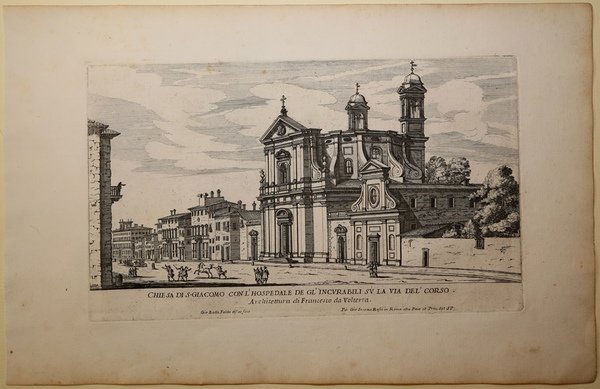

Chiesa di S. Giacomo con l'hospedale de gl' Incurabili su' la Via del Corso, architettura di Francesco da Volterra
Chiesa di S. Giacomo con l'hospedale de gl' Incurabili su' la Via del Corso, architettura di Francesco da Volterra | Gravures | FALDA Giovanni Battista
Mode de Paiement
- PayPal
- Carte bancaire
- Virement bancaire
- Pubblica amministrazione
- Carta del Docente
Détails
- Année
- 1669
- Lieu d'édition
- Roma
- Format
- 290 X 172
- Graveurs
- FALDA Giovanni Battista
Description
La chiesa di S. Giacomo in Augusta fu inaugurata nel 1602, e fu sempre adibita come cappella maggiore dell'Ospedale S. Giacomo. Tra i più antichi ospedali sorti a Roma nel medioevo, quello di S. Giacomo situato tra Via dei Corso e Via Ripetta fu il terzo a sorgere, dopo quello di S. Spirito in Saxia e il secondo presso la Basilica di S. Giovanni in Laterano. L'espressione "in Augusta" deriva dalla presenza, nelle vicinanze, del mausoleo dell'imperatore Augusto. L'ospedale sorse per cura degli esecutori delle ultime volontà del Card. Pietro Colonna defunto nel 1326, e fu detto degli Incurabili perché qui venivano curati i malati di sifilide che venivano respinti dagli altri ospedali. Nel '500 divenne Archiospedale ed ebbe per armi ed insegna l'immagine della beata Vergine Maria e dell'Apostolo S. Giacomo maggiore, pellegrino a Compostella, sotto i quali si aggiunge una carriola con l'infermo dentro, in atto di implorare pietà. E sotto la scritta: Fate l'elemosina a li poveri infermi dell'incurabili. Esemplare di primo stato, avanti la numerazione, tratto da ' Il nuovo teatro delle fabriche, et edificii, in prospettiva di Roma moderna, sotto il felice pontificato di N. S. papa Alessandro VII. ' Opera in tre volumi, edita da Giovanni Giacomo de Rossi tra il 1665 e il 1669, illustra le fabbriche realizzate o ampliate durante il pontificato di Alessandro VII Chigi, mentre il III si riferisce alle chiese restaurate dal pontefice Clemente IX. ' L'opera aveva lo scopo di divulgare la nuova immagine di Roma, con i suoi palazzi, chiese e giardini, secondo un progetto unitario di espansione urbana, in sintonia con i criteri del colto e raffinato Fabio Chigi: il papa, infatti, decise di aprire nuove strade, di abbellire con fontane e monumenti la città, anche a dimostrazione della potenza finanziaria e culturale della sua famiglia. Prima di allora l'incisione di veduta a Roma, che pure aveva prodotto numerose serie dì stampe da Etienne Dupérac a Giacomo Lauro, si era interessata principalmente alla ripresa della città antica. Bisognerà attendere proprio il completamento dei rinnovamenti urbanistici e delle realizzazioni architettoniche dei papi seicenteschi, per assistere alla diffusione di raccolte dedicate alla città moderna. ' Giovan Battista Falda ha contribuito, con la vasta serie di incisioni di vedute, a divulgare un'immagine della città di Roma legata alla magnificenza e munificenza dei Papi seicenteschi: città ricca di chiese, palazzi, giardini che si affiancavano ai resti del glorioso passato. ' L'incisore dedicò tutta la sua pur breve vita a creare, attraverso precise ed attente vedute prospettiche, piante e stampe su avvenimenti cittadini, canonizzazioni, ingressi di pontefici e reali stranieri, un grosso affresco unitario che celebrasse nel suo insieme la nuova grandezza raggiunta dalla Roma moderna, grazie soprattutto alla geniale e lungimirante opera di papa Alessandro VII Chigi (1655 - 1667). ' Dopo la morte del Falda, verrà pubblicato, sempre dalla tipografia De Rossi, ' Il quarto libro del nuovo teatro delli palazzi in prospettiva di Roma moderna dato in luce sotto il felice pontificato di nostro signore papa Innocenzo XII, di Alessandro Specchi, edito nel 1699 e naturale prosecuzione della raccolta. ' Acquaforte, impressa su carta vergata coeva, con margini, in ottimo stato di conservazione. Magnifico esemplare, nel primo stato avanti il numero. Spedale di S. Giacomo was the third large Roman hospital to be founded after those of S. Spirito in Sassia and S. Giovanni in Laterano; it was built in 1339 by Cardinal Pietro Colonna to provide assistance to the pilgrims who entered Rome from nearby Porta del Popolo. It was known as S. Giacomo in Augusta because the neighbourhood was named after Augustus' mausoleum; in 1515 Pope Leo X officially named it Ospedale degli Incurabili because it focused on assisting those affected by a venereal disease which spread into Italy towards the end of the XVth century and for which no cure was found (later on it was called syphilis); the hospital had a mortuary chapel (S. Maria in Porta Paradisi) by Antonio da Sangallo. In 1583 Cardinal Antonio Maria Salviati promoted the reconstruction of the hospital and of its church along Via del Corso; the new buildings were designed by Francesco Capriani da Volterra and after his death in 1599 by Carlo Maderno, who in particular completed the façade added two small bell towers The hospital was almost entirely rebuilt in the XIXth century. Example in the first state, before the number, taken from ' Il nuovo teatro delle fabriche, et edificii, in prospettiva di Roma moderna, sotto il felice pontificato di N. S. papa Alessandro VII. One of the most important architectural projects of the seventeenth century was the urban renovation of Rome. Under the brilliant leadership of Pope Alessandro VII (1655-1667), Rome dramatically emerged as one of the most modern and beautiful cities of the new Baroque age. Within several decades spacious roadways were constructed, monumental buildings arose, and many public squares appeared with elaborate fountains and monuments. To be sure, this massive undertaking was meant to underline the absolute power of the Papacy but it also brought forth a new flowering of Italian art and architecture. ' The ' Nuovo Teatro ' was initiated in 1665 to depict the new Rome in a series of etchings. What it gave to future generations was a magnificent historical record of views etched by two of Italy's greatest architectural artists. ' The printing and publishing of these important etchings was entrusted to Giacomo de Rossi (1626-1691), the head of the most dominant Roman publishing house. ( Sons and nephews of de Rossi, in fact, continued the publishing house until 1738 when the business was sold to Pope Clement XII to form the basis of the ' Regia Calcografia.) ' Altogether, four sets of ' Nuovo Teatro ' were created during the seventeenth century. Volumes one and two were both published in the year of 1665 and dealt mainly in views of the new piazzas, gardens, terraces and their surrounding buildings. Volume 3 was published in 1669 and concentrated upon the newly constructed churches of Rome. Every plate from the first three sets was both designed and etched by the influential architectural artist, Giovanni Battista Falda (1643-1678). For reasons unknown the fourth and final volume ' Il quarto libro del nuovo teatro delli palazzi in prospettiva di Roma moderna dato in luce sotto il felice pontificato di nostro signore papa Innocenzo XII, (52 etchings) did not appear until 1699. ' It was published by Giacomo's successor, Domenico de Rossi, and featured views of the palaces and stately homes of Rome. Each plate was designed and etched by the famous architect and etcher, Alessandro Specchi (1668-1729). ' Etching, printed on contemporary laid paper, with margins, in good condition. Cfr.