Colonna Traiana
Colonna Traiana | Gravures | AELST Nicolas van
Colonna Traiana
Colonna Traiana | Gravures | AELST Nicolas van
Mode de Paiement
- PayPal
- Carte bancaire
- Virement bancaire
- Pubblica amministrazione
- Carta del Docente
Détails
- Année
- 1589
- Format
- 320 X 540
- Graveurs
- AELST Nicolas van
Description
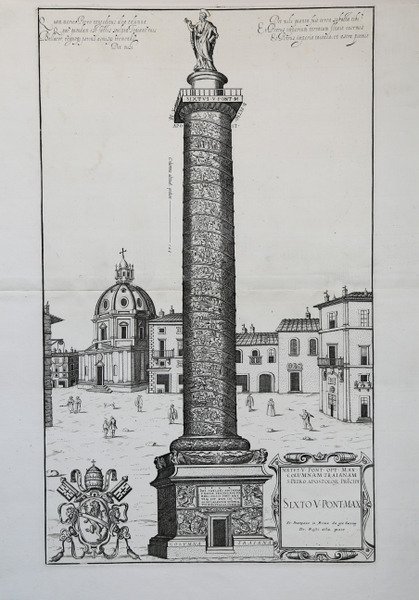
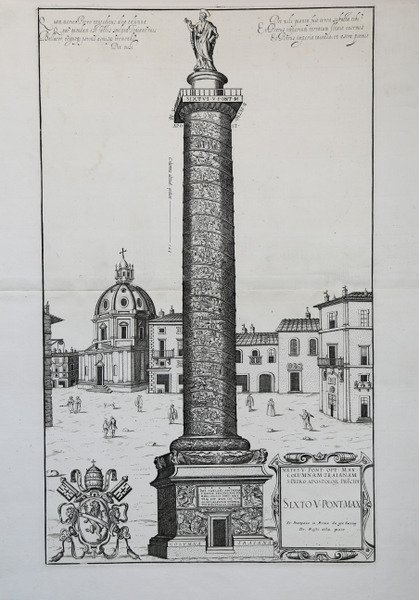
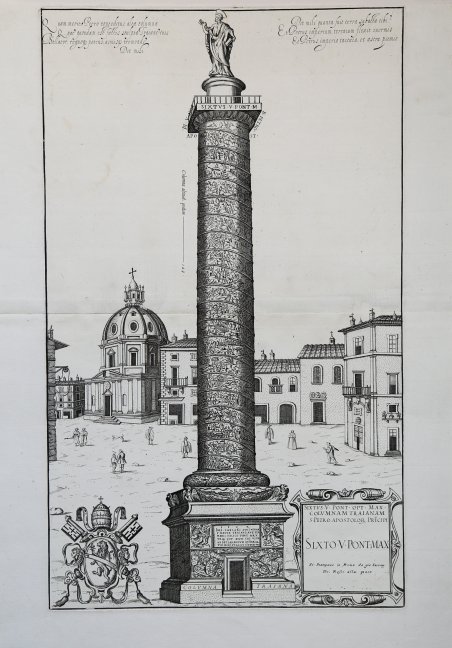
Colonna Traiana con la statua di san Pietro.Acquaforte e bulino, 1589, firmato e datato in lastra «Nicolaus van Aelst Bruxellensis formiis aeneis incis[am] dicauit Anno MDLXXXVIIII» (esemplari di primo stato).Opera parte dello "Speculum Romanae Magnificentiae”, incisa da Ambrogio Brambilla per l’editore Nicolas van Aelst. Esemplare nel secondo stato, con l’imprint “Si Stampano in Roma da gio Iacomo De Rossi alla Pace” che sostituisce la firma del Van Aelst. La lastra è completamente ritoccata e sulla sinistra è rappresentata la chiesa del Nome di Maria, sorta al posto della chiesa di San Bernardo della Compagnia, che invece è rappresentata nella tiratura originale della lastra. Rimane lo stemma di papa Sisto V.Iscritto e firmato in basso a destra: «SIXTVS V PONT[IFEX] OPT[IMVS] MAX[IMVS] COLVMNAM TRAIANAM S. PETRO APOSTOLOR[VM] PRI[N]CIPI // SIXTO V PONT[IFEX] MAX[IMVS]» [Sisto V P.O.M. [dedicò] la colonna traiana a san Pietro Principe degli Apostoli].Iscritto in alto, a sinistra e destra della colonna: «Quam merito Petro conceditur alta columna / Quae quondam est factis sculpta Traiane tuis / Bellator, regnoq[ue] potens armisq[ue] tremende / Dic mihi // Dic mihi quanta fuit terra subacta tibi / Et Petrus imperium terrarum flexit inermis / Et Petrus imperio tartara et astra premit» [Oh quanto giustamente si consacra a Pietro questa altissima colonna che in antico fu scolpita con le tue gesta, o Traiano, tremendo combattente, potente per il regno e per le armi // Dimmi quante furono le terre a te assoggettate. Pietro invece piegò inerme l’impero delle terre: e col suo potere Pietro doma il tartaro e gli astri].La statua di san Pietro fu sollevata sulla colonna Traiana il 4 dicembre 1587. Il modello di creta era stato realizzato dall’architetto Leonardo Soriani (? - 1589) che restaurò diverse antichità in Vaticano e fu impegnato nella basilica di Santa Maria Maggiore, e dall’architetto Tommaso Della Porta (? - 1618) che realizzò diverse statue per la decorazione delle terrazze a san Pietro. Il bronzo venne fuso da Bastiano Torrigiani (? - 1596) che operò soprattutto come fonditore, realizzando anche il busto di Sisto V oggi al Museo Kaiser Friedrich di Berlino. Per il bronzo di san Pietro furono fusi mezzo cannone di Castel Sant’Angelo, tre porte provenienti rispettivamente da Sant’Agnese, Scala santa e Portico di san Pietro, e una parte di un antico pilastro del Pantheon. Sulla sinistra della colonna si vede il disegno, molto raro, della chiesa di San Bernardo della Compagnia, fondata nel 1418 da Francesco dei Foschi e demolita nel 1748 per l’erigenda fabbrica del Nome di Maria.Lo “Speculum” ebbe origine nelle attività editoriali di Antonio Salamanca e Antonio Lafreri. Durante la loro carriera editoriale romana, i due editori stranieri - che hanno lavorato insieme tra il 1553 e il 1563 - hanno avviato la produzione di stampe di architettura, statuaria e vedutistica della città legate alla Roma antica e moderna. Le stampe potevano essere acquistate individualmente da turisti e collezionisti, ma venivano anche acquistate in gruppi più grandi che erano spesso legati insieme in un album. Nel 1573, Lafreri commissionò a questo scopo un frontespizio, dove compare per la prima volta il titolo "Speculum Romanae Magnificentiae". Alla morte di Lafreri, due terzi delle lastre di rame esistenti andarono alla famiglia Duchetti (Claudio e Stefano), mentre un altro terzo fu distribuito tra diversi editori. Bellissima prova, impressa su carta vergata coeva, ampi margini, in perfetto stato di conservazione. Bibliografia Marigliani, Lo splendore di Roma nell’Arte incisoria del Cinquecento (2016), n. IV.14; G. Battelli, 1952, VIII, Col. 1487; C. D’Onofrio, 1965, pp. 179-80; R. Lanciani, II, 1990, p. 131; C. Conti - G. Martines, 1993, p. 34; C. Witcombe, 2008, pp. 361, 364. Etching and engraving, 1589, signed and dated on plate: “Nicolaus van Aelst Bruxellensis formiis aeneis incis[am] dicauit Anno MDLXXXVIIII” (examples of first state only).Work part of the "Speculum Romanae Magnificentiae", engraved by Ambrogio Brambilla for the publisher Nicolas van Aelst. Example of the second state, with the imprint "Si Stampano in Roma da gio Iacomo De Rossi alla Pace" that replaces the signature of Van Aelst. The plate is completely retouched and on the left is represented the Church of the Name of Mary, built in place of the Church of San Bernardo della Compagnia which is represented in the original early state of the plate. The coat of arms of Pope Sixtus V remains.At the bottom right: "SIXTVS V PONT[IFEX] OPT[IMVS] MAX[IMVS] COLVMNAM TRAIANAM S. PETRO APOSTOLOR[VM] PRI[N]CIPI // SIXTO V PONT[IFEX] MAX[IMVS]" [Sisto V P.O.M. He dedicated the Trajan column to St. Peter Prince of the Apostles].Inscribed at the top, left and right of the column: "Quam merito Petro conceditur alta columna / Quae quondam est factis factis sculpta Traiane tuis / Bellator, regnoq[ue] potens armisq[ue] tremende / Dic mihi // Dic mihi quanta fuit terra subacta tibi / Et Petrus imperium terrarum flexit inermis / Et Petrus imperio tartara et astra premit" [Oh how rightly is consecrated to Peter this very high column that in ancient times was carved with your deeds, o Trajan, tremendous fighter, powerful for the kingdom and for weapons // Tell me how many lands were subjected to you. Peter instead bent the empire of the lands unarmed: and with his power Peter tamed the Tartar and the stars].The statue of St. Peter was raised on the Trajan column on December 4, 1587. The clay model was made by the architect Leonardo Soriani (? - 1589) who restored several antiquities in the Vatican and was engaged in the basilica of Santa Maria Maggiore, and by the architect Tommaso Della Porta (? - 1618) who made several statues for the decoration of the terraces of St. Peter. The bronze was cast by Bastiano Torrigiani (? - 1596) who worked mainly as a smelter, also making the bust of Sixtus V today at the Kaiser Friedrich Museum in Berlin. For the bronze of St. Peter were cast half cannon of Castel Sant'Angelo, three doors from Sant'Agnese, Scala santa and Portico di San Pietro, and part of an ancient pillar of the Pantheon. On the left of the column you can see the very rare drawing of the church of San Bernardo della Compagnia, founded in 1418 by Francesco dei Foschi and demolished in 1748 for the building of the Name of Mary (cf. Marigliani IV.14).Beautiful proof, printed on contemporary laid paper, wide margins, in perfect state of preservation. This print comes from the “Speculum Romanae Magnificentiae” (The Mirror of Roman Magnificence). The Speculum found its origin in the publishing endeavors of Antonio Salamanca and Antonio Lafreri. During their Roman publishing careers, the two foreign publishers - who worked together between 1553 and 1563 - initiated the production of prints recording art works, architecture and city views related to Antique and Modern Rome. The prints could be bought individually by tourists and collectors, but were also purchased in larger groups which were often bound together in an album. In 1573, Lafreri commissioned a title page for this purpose, which is where the title ‘Speculum Romanae Magnificentiae’ first appears. Lafreri envisioned an ideal arrangement of the prints in 7 different categories, but during his lifetime, never appears to have offered one standard, bound set of prints. Instead, clients composed their own selection from the corpus to be bound, or collected a group of prints over time. When Lafreri died, two-third of the existing copper plates went to the Duchetti family (Claudio and Stefano), while another third was distributed among several publishers. The Duchetti appear to have standardized production, offering a more or less uniform version of the Speculum to their clients. The. Cfr.