Cristo caccia i mercanti dal tempio
Cristo caccia i mercanti dal tempio
Mode de Paiement
- PayPal
- Carte bancaire
- Virement bancaire
- Pubblica amministrazione
- Carta del Docente
Détails
- Année
- 1652
- Format
- 330 X 260
- Graveurs
- JORDAENS Jacob
Description
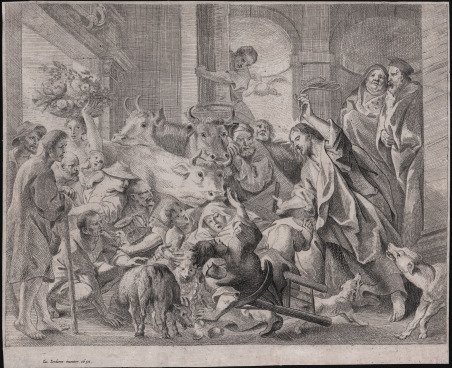
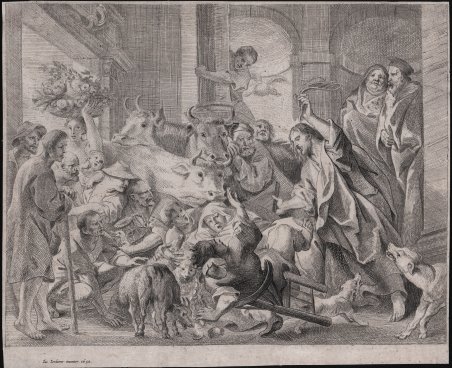
Acquaforte, 1652, firmata nel margine inferior a sinistra: "Iac. Iordaens inuentor. 1652". Primo stato, non descritto dalla bibliografia. La scena illustra la Cacciata dei mercanti dal Tempio: a destra, Cristo si precipita nel Tempio tenendo in alto una corda e rovesciando un tavolo, un uomo è rovesciato dalla sua sedia al centro, l'interno è affollato di persone e animali, due uomini in piedi in una nicchia a destra. Jordaens ha illustrato questo soggetto ripetutamente. Assomiglia molto a un dipinto del Musée du Louvre, Parigi, databile al 1645-50 circa, anche se la composizione della stampa è più semplice e si discosta dalla tela in diversi aspetti. Ci sono sette acqueforti attribuite a Jacob Jordaens (Hollstein 1-3, 5-7 e 9), descritte anche nel catalogo D'Hulst (pp. 132-136). Sebbene tutte indichino Jordaens solo come disegnatore (inventor), sono tradizionalmente considerate anche come incise da lui. Pittore, incisore e disegnatore di arazzi, nativo di Anversa. Lavorò nello studio di Rubens tra il 1637 e il 1638 e divenne il pittore più importante dei Paesi Bassi meridionali dopo la morte di questi, nel 1640. Lavorò anche per il re Carlo I (La storia di Amore e Psiche, intorno al 1640) e la regina Cristina di Svezia (1648); e realizzò diversi dipinti per il municipio di Amsterdam nel 1661. Jordaens era uso firmare i suoi dipinti e la sua corrispondenza olandese con la versione francese del suo nome: 'Jacques Jordaens' (in opposizione all'olandese 'Jacob'). Bellissima prova, impressa su carta vergata coeva, rifilata al rame, restauri perfettamente eseguiti agli angoli inferiori, per il resto in ottimo stato di conservazione. Rara. Bibliografia Hollstein, Dutch and Flemish etchings, engravings and woodcuts c.1450-1700, n. 2; D’'Hulst, Jacob Jordaens (1593-1678). I: Paintings and Tapestries; II: Drawings and Prints, B94. Etching, 1652, lettered in lower margin, at left: "Iac. Iordaens inuentor. 1652". Undescribed early state. Christ driving out the money changers. Christ rushes into the Temple at right holding aloft a rope and overturning a table, a man is knocked from his chair at centre, the interior is crowded with people and animals, two men standing in a niche at right; undescribed early state. Jordaens illustrated this subject repeatedly. It most closely resembles a painting in the Musée du Louvre, Paris, dateable to c.1645-50, though the print's composition is simpler, and diverges from the canvas in several respects. There are seven etchings attributed to Jacob Jordaens (Hollstein 1-3, 5-7 and 9), also described in D'Hulst catalogue (pp.132-136). Although these are all lettered with Jordaens as the designer ('inventor'), they are traditionally considered as also made by him. Jacob Jordaens (1593 – 1678) was a painter, etcher and tapestry designer in Antwerp. Worked in Rubens studio between 1637 and 1638 and became the most important painter in the Southern Netherlands after Rubens' death in 1640. Also employed by King Charles I (The Story of Cupid and Psyche, around 1640) and Queen Christina of Sweden (1648); and he made several paintings for the Town Hall in Amsterdam in 1661. A fine impression, printed on contemporary laid paper, trimmed to the platemark, perfect repairs at the lower corners, otherwise good condition. Rare. Bibliografia Hollstein, Dutch and Flemish etchings, engravings and woodcuts c.1450-1700, n. 2; D’'Hulst, Jacob Jordaens (1593-1678). I: Paintings and Tapestries; II: Drawings and Prints, B94. Cfr.
