Discus Chronologicus Regum Utriusque Siciliae et Ducum Principumque Italiae Praecipuorum
Discus Chronologicus Regum Utriusque Siciliae et Ducum Principumque Italiae Praecipuorum | Gravures | WEIGEL Christoph
Discus Chronologicus Regum Utriusque Siciliae et Ducum Principumque Italiae Praecipuorum
Discus Chronologicus Regum Utriusque Siciliae et Ducum Principumque Italiae Praecipuorum | Gravures | WEIGEL Christoph
Mode de Paiement
- PayPal
- Carte bancaire
- Virement bancaire
- Pubblica amministrazione
- Carta del Docente
Détails
- Année
- 1718
- Lieu d'édition
- Norimberga
- Format
- 355 X 430
- Graveurs
- WEIGEL Christoph
- Thème
- Carte Storiche
Description
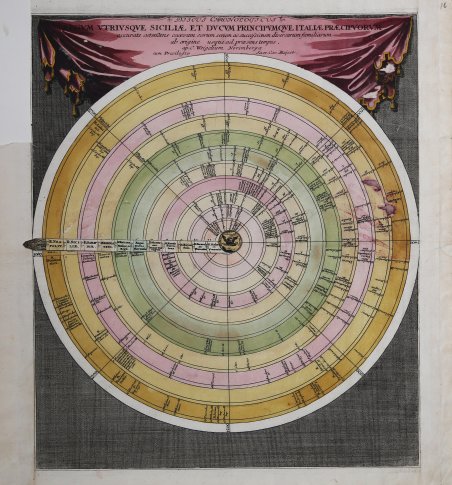
Raro e curioso calendario dei regni e ducati in Italia, nella forma di diagramma circolare, con una volvella movibile. Ogni cerchio corrisponde a una giurisdizione, dall’anno 1000 al 1800, ma senza voci a stampa dopo il 1718. Riporta tutti i re, principi e duchi dei più importanti regni e ducati italiani a partire dall’anno 1000: Regno di Napoli, Regno di Sicilia, Ducato di Savoia, Ducato di Milano, Ducati Estensi, Granducato di Toscana, Ducato di Mantova, del Monferrato, di Mirandola, di Parma e Piacenza, di Massa e Carrara. ' Il calendario è tratto dal Bequemer Schul- und Reisen-Atlas, intitolato anche Atlas scholasticus et itinerarius di Christoph Weigel. Il noto atlante di viaggio di Weigel, pubblicato in collaborazione con il professor Johann David Köhler, venne stampato per la prima volta a Norimberga nel 1718. Johann David Köhler (18 gennaio 1684 - 10 marzo 1755) è stato uno storico tedesco. I suoi obiettivi accademici erano sulle monete romane come manufatti storici, armi antiche e genealogia. Köhler ha anche lavorato come bibliotecario universitario ad Altdorf e ha contribuito alla prima letteratura bibliografica. Christoph Weigel il Vecchio era un tedesco orafo, incisore, stampante e cartografo tedesco. ' Inizialmente è stato apprendista come incisore nel centro editoriale di Augusta, in seguito al quale ha ricoperto diverse posizioni di Vienna e Francoforte. Nel 1698, è diventato un cittadino della città di Norimberga e ha stabilito lì il proprio studio editoriale. Weigel è noto per aver lavorato a stretto contatto con i più importanti editori di Norimberga: Johann Baptist Homann [1663-1724] e con il fratello, Johann Christoph Weigel [1654 - 1726] e l'accademico tedesco, Johann David Koehler [1684 -1755], il secondo nella pubblicazione di una serie di uscita atlanti scolatici. La sua produzione cartografica include un Atlas Scolasticus [1712], Bequemer Schul und Reisen Atlas (in associazione con Koehler) [1724], e Antiquus Orbis del 1724. Dopo la morte di Weigel nel 1725, la gestione dell'attività passò alla sua vedova, che ha pubblicato postumi molte delle mappe e atlanti del marito. La società passò poi a suo figlio, Johann Christoph Weigel il Giovane [d.1746], che in seguito è entrato in partnership con Adam Gottlieb Schneider, formando la ditta Schneider-Weigel, che ha continuato l'attività editoriale fino al XIX secolo. Acquaforte, finemente colorata a man in epoca, in ottimo stato di conservazione. Comprende la volvella girevole spesso mancante. Rare and curious calendar of kingdoms and duchies in Italy, in the form of a circular diagram, with a movable volvella. Each circle corresponds to a jurisdiction, from the year 1000 to 1800, but without printed entries after 1718. It shows all the kings, princes, and dukes of the most important Italian kingdoms and duchies from the year 1000: Kingdom of Naples, Kingdom of Sicily, Duchy of Savoy, Duchy of Milan, Duchy of Este, Grand Duchy of Tuscany, Duchy of Mantua, Duchy of Monferrato, Duchy of Mirandola, Duchy of Parma and Piacenza, and Duchy of Massa and Carrara. The calendar is taken from the Bequemer Schul- und Reisen-Atlas, also titled Atlas scholasticus et itinerarius by Christoph Weigel. Weigel's well-known travel atlas, published in collaboration with Professor Johann David Köhler, was first printed in Nuremberg in 1718. Johann David Köhler (January 18, 1684 - March 10, 1755) was a German historian. His academic pursuits were on Roman coins as historical artifacts, ancient weapons and genealogy. Köhler also worked as a university librarian in Altdorf and contributed to the early bibliographical literature. Christoph Weigel the Elder [1654-1725] was a German goldsmith, engraver, printer and mapmaker. He was initially apprenticed as an engraver in the publishing center of Augsburg, after which he held various positions in Vienna and Frankfurt. In 1698, he became a citizen of the city of Nuremberg and established his own publishing firm there. Weigel is known to have worked closely with the most prominent of the Nuremberg map publishers, Johann Baptist Homann [1663-1724] as well as with his brother, Johann Christoph Weigel [1654 - 1726] and the German academic, Johann David Koehler [1684-1755], the latter in the publication of a number of School atlases. His cartographic output included the Atlas Scholasticus [1712], Bequemer Schul und Reisen Atlas (in association with Koehler) [1724], and the Orbis Antiquus 1724. ' Following Weigel's death in 1725, control of the firm passed to his widow, who published many of her late husband's maps and atlases posthumously. The widow Weigel eventually ceded control of the firm to her son, Johann Christoph Weigel the Younger [d.1746], who later went into partnership with Adam Gottlieb Schneider, forming the firm of Schneider-Weigel. Which continued as Nuremberg publishers until the early 19th century. Cfr.