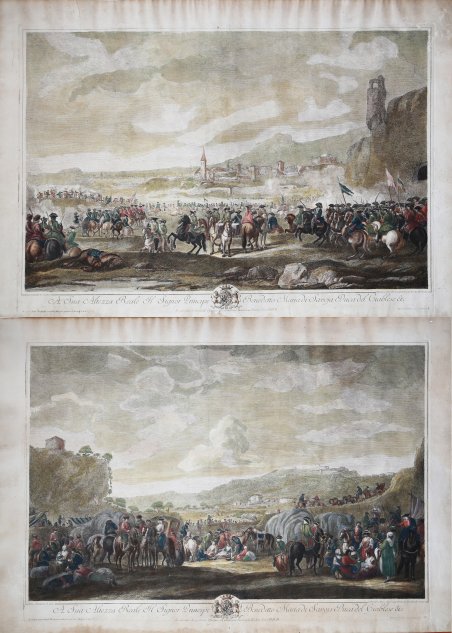
Coppia di incisioni all’acquaforte e bulino, finemente colorate a mano in epoca, circa 1766, firmate in lastra in basso a destra. Da due dipinti di Francesco Simonini. Magnifiche prove, impresse su due fogli reali di carta vergata coeva, con pieni margini, leggere abrasioni al recto, piccole ossidazioni, per il resto in ottimo stato di conservazione. ' Francesco Simonini (Parma 1686 – Firenze dopo il 1755) giunse a Venezia verso il 1730 divenendo il pittore prediletto del Maresciallo Von der Schulenburg, per trent’anni comandante a capo delle forze di terra della Serenissima, che lo incarica di ritrarre le più importanti battaglie delle campagne contro i Turchi in una serie di tele, oggi in parte conservate al Niedersächsisches Landesmuseum di Hannover. A documentare quest’attività di “cronista di guerra” sono i numerosi disegni eseguiti dal pittore durante le campagne militari contro i turchi in Dalmazia e durante la difesa di Corfù. Teodoro Viero, allievo del Golinetto, venne a Venezia nel 1755 per perfezionarsi nell'arte dell'intaglio ed aprì un negozio di stampe che ebbe fortuna. Di lui si ricordano, particolarmente, dodici teste dal Piazzetta e queste celebri battaglie dal Simonini. A proposito di questi rami, così scrive il Gradenigo 1749: “Teodoro Viero, incisore in rame a Venezia formò un'opera da stamparsi in rame di dodici capricciose teste dell'immortale pittore veneziano Gio. Batta Piazzetta. Egli anche compì oramai il gran lavoro di quattro rami che esprimono: il primo un Esercito posto in ordinanza di battaglia; il 2 la Battaglia formale; 3 il Riposo de Soldati dopo la vittoria medesima; 4 lo Spoglio del Campo nemico; altre volte su quadri dipinti dal celebre defonto Francesco Simonini, il tutto dispensato alla di lui Casa nella Contrada di S. Leone a prezzi discreti”. Una domanda di privilegio privativo presentata dal Viero il 18 febbraio 1766, ci fornisce ulteriori particolari su questi suoi lavori. Scriveva: “da undeci anni abitante in Venezia, dopo l'assidua Scuola del celebre Pitteri dal medesimo frequentata, si trova ora in istato di produrre al Pubblico quattro Battaglie del celebre Francesco Simonini da esso travagliate per tre anni di tempo, di una grandezza, e di una fattura non comune, e che è affatto nuova nella Dominante, come dal confronto si può chiaramente vedere”, così che il Senato, mentre il 31 maggio 1766 gli concedeva il privilegio per le quattro stampe delle Battaglie riconosciute anche dai Riformatori dello Studio di Padova effettivamente “di fattura non comune e affatto nuova”, si riservava, per le altre, di decidere quando gliene sarebbe stato presentato almeno un saggio. ' Rare ed affascinanti opere. Bibliografia Rodolfo Gallo, in Ateneo Veneto, L’incisione nel ‘700 a Venezia e Bassano, pp. 184-186; G. Sestieri, I pittori di battaglie, pp. 464 -465. Pair of etchings with engraving, finely hand colored at the time, about 1766, signed in plate at lower right. After two paintings by Francesco Simonini. Magnificent impressions, printed on contemporary laid paper, with full margins, light abrasions on the front, small rust, otherwise in excellent condition. Francesco Simonini (Parma 1686 - Florence after 1755) arrived in Venice around 1730 became the favorite painter of Marshal Von der Schulenburg, for thirty years commander of the ground forces of the Venetian Republic, which commissioned him to paint the most important battles the campaigns against the Turks in a series of paintings, now partly preserved in the Niedersächsisches Landesmuseum in Hanover. To document this activity of "chronicler of war" are the many drawings made by the artist during the military campaigns against the Turks in Dalmatia during the defense of Corfu. Teodoro Viero, a student of Golinetto, came to Venice in 1755 to specialize in the art of carving, and opened a print shop that had luck. Remember him particularly twelve heads after Piazzetta, and these famous battles after Simonini. With regard to these works, writes the Gradenigo 1749: "Teodoro Viero, copper engraver in Venice formed a work to be printed in copper twelve heads capricious immortal Venetian painter Giovanni Battista Piazzetta. He also performed the now great job of expressing four branches: the first one Army post in order of battle, the Battle formal 2, 3 Rest of the soldiers after the victory itself; 4 Examination of the range enemy, other times on boards paintings by famous deceased Francesco Simonini, all dispensed to him in the House district of S. Lion decent prices". A question of privilege made by the Private Viero February 18, 1766, provides further details on these works. Wrote that "from 11 years living in Venice, after assiduous School celebrated Pitteri the same popular, is now in a state of produce to the public four Battles of the famous Francesco Simonini troubled by it for three years of time, of a magnitude, and an invoice is not common, and that is nothing new in the Dominant, as you can clearly see from the comparison, "so that the Senate, May 31, 1766 and granted him the privilege for four prints of Battles also recognized by the Riformatori dello Studio di Padova actually "invoice uncommon and entirely new", is reserved for the other to decide when to him it would have been presented at least one essay. Rare and fascinating works. Bibliografia Rodolfo Gallo, in Ateneo Veneto, L’incisione nel ‘700 a Venezia e Bassano, pp. 184-186; G. Sestieri, I pittori di battaglie, pp. 464 -465. ' Cfr.

 Découvrez comment utiliser
 Découvrez comment utiliser