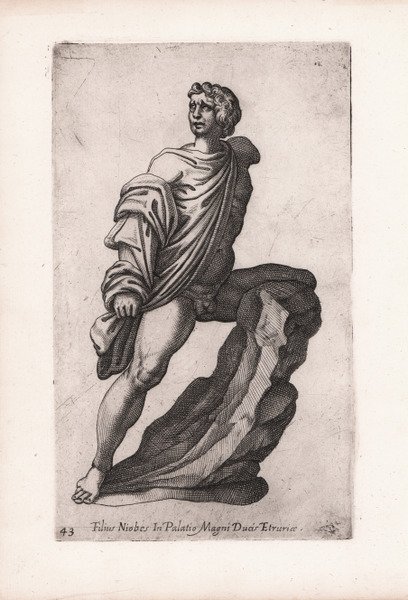
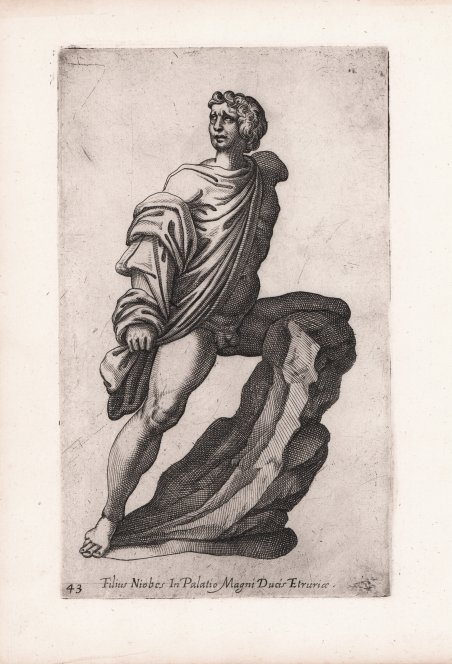
Filius Niobes. (Niobide che sale su una roccia)
Filius Niobes. (Niobide che sale su una roccia) | Gravures | CAVALIERI Giovanni Battista de’
Filius Niobes. (Niobide che sale su una roccia)
Filius Niobes. (Niobide che sale su una roccia) | Gravures | CAVALIERI Giovanni Battista de’
Mode de Paiement
- PayPal
- Carte bancaire
- Virement bancaire
- Pubblica amministrazione
- Carta del Docente
Détails
- Année
- 1584
- Lieu d'édition
- Roma
- Format
- 135 X 220
- Graveurs
- CAVALIERI Giovanni Battista de’
Description
primi mesi del 1583 nella vigna appartenuta a Gabriele e Tomaso Tommasini, posta a breve distanza da San Giovanni in Laterano, a Roma, furono rinvenute tredici sculture, in massima parte ancora in un invidiabile stato di conservazione. La scoperta, di per sé già sensazionale considerato il numero dei marmi rinvenuti, apparve a tutti ancora più singolare dal momento che la quasi totalità delle statue componeva un grandioso gruppo che illustrava una delle storie più tragiche del mito antico: l’uccisione dei figli di Niobe. Questa donna, moglie di Amphione re di Tebe, aveva, infatti, insultato Latona, dichiarando di essere una madre migliore di lei. Questo atto di tracotanza (hybris ' in greco) fu duramente punito dalla dea che inviò i figli Apollo e Artemide a uccidere i sette figli maschi e le sette figlie femmine dell’insolente donna. Niobe, straziata dal dolore, anche se trasformata in pietra, non cessò di piangere e le sue lacrime si mutarono in una fonte perenne. Questo collegamento fra la figura della madre e l’acqua fu, probabilmente, la ragione che consacrò la fortuna di questo gruppo come decorazione ideale di ninfei monumentali. Anche per i Niobidi fiorentini, come per il gruppo che ornava il Ninfeo-Stadio di Villa Adriana o quello degli Horti Sallustiani, è molto probabile l’originaria sistemazione in una fontana ad emiciclo eretta nell’area degli antichi Horti Lamiani, i cui resti vennero in luce negli sterri ottocenteschi dell’Esquilino in prossimità dell’attuale Piazza Vittorio Emanuele. Il gruppo fiorentino avrebbe, quindi, fatto parte della decorazione di un ninfeo inserito in uno dei vasti parchi di proprietà imperiale che cingevano ad occidente il centro di Roma e nel quale le statue sarebbero state disposte seguendo il profilo della struttura, con il gruppo di Niobe e la figlia minore posto al centro. Opera tratta dall’Antiquarum statuarum urbis Romae…Io. Baptista de Cavalleris authore, la prima raccolta sistematica di illustrazioni di sculture antiche conservate nelle collezioni romane, che si deve all’opera dell’incisore e disegnatore Giovanni Battista Cavalieri (1525 circa - 1601) nella seconda metà del XVI secolo. Il repertorio, punto di riferimento per gli studi antiquari, conobbe grande diffusione e contribuì ad orientare l'interesse degli studiosi dell'epoca verso la statuaria antica. Il numero delle tavole, circa 50 nelle prime edizioni (databili circa al 1561/62) venne ampliato successivamente; prima del 1584 furono pubblicati i libri I e II con 100 incisioni numerate di sculture, organizzate per collezioni di appartenenza. Nel 1594 videro la luce il III e IV volume dell’opera, in cui comparvero altre 100 nuove tavole, stavolta ordinate in base all’iconografia dei soggetti. Le sculture sono raffigurate su sfondi neutri, privi di riferimenti architettonici. L’opera, con il titolo ' Antiquarum statuarum Urbis Romae primus, ' senza data, venne dedicata prima a Ottone Truchsess von Walburg – prima in qualità di diacono di S. Maria in Trastevere (1561/62) e poi di cardinale di Albano (1562/70). In seguito, con il titolo ' Antiquarum statuarum Urbis Romae primus et secundus liber ' il frontespizio reca la dedica al cardinale Ludovico Madruzzo, ed è databile al 1584/85. Nel 1594, con il titolo ' Antiquarum Statuarum Urbis Romae tertius et quartus liber, escono cento nuove tavole con dedica al cardinale G. Paluzzi degli Albertoni, del giugno 1593. Si tenga presente che, mentre nei primi due libri le statue erano pubblicate secondo le collezioni, nel terzo e quarto sono raggruppate per soggetto. La raccolta contiene, oltre alle incisioni di Giovanni Battista Cavalieri alcune tavole firmate da Cherubino Alberti, Orazio de Santis e altri famosi incisori dell’epoca. Giovanni Battista de Cavalieri o Cavalleris fu incisore, stampatore e editore. Originario di Villa Lagarina, nei pressi di Trento, risulta attivo a Venezia (dal 1559) e a Roma, dove nel 1577 apri. At the beginning of 1583, thirteen sculptures were found in the vineyard belonging to Gabriele and Tomaso Tommasini, located a short distance from St. John in Lateran in Rome, most of which were still in an enviable state of preservation. The discovery, already sensational in itself considering the number of marbles found, was perceived as even more singular since almost every statue appeared to be part of a grandiose group illustrating one of the most tragic stories of ancient myth: the murder of Niobe's children. As a matter of fact, this woman, wife of Amphion, the king of Thebes, had insulted Latona, claiming that she was a better mother than her. This act of hubris (hybris ' in Greek) was severely punished by the goddess, who sent her sons Apollo and Artemis to kill the seven sons and seven daughters of the insolent woman. Despite being turned into a stone, Niobe, torn by grief, couldn’t stop weeping and her tears became an everlasting fountain. This connection between water and maternal figure was probably the reason behind the fortune of this group, that was considered the ideal decoration for monumental ' nymphaeums. It is very likely that also the Florentine Niobids, as well as the group that used to decorate the Nymphaeum-Stadium of Villa Adriana or the one of the Horti Sallustiani, were originally placed in a hemicycle fountain erected in the area of the ancient Horti Lamiani, the remains of which were brought to light in the 19th-century excavations on the Esquiline Hill in the area of today’s Piazza Vittorio Emanuele. Therefore, the Florentine group would have been part of the decoration of a nymphaeum built inside one of the vast parks owned by the emperor that encircled the Western side of the centre of Rome, and in which the statues would have been arranged following the outline of the structure, with the group of Niobe and her younger daughter placed in the centre Plate taken from the ' Antiquarum statuarum urbis Romae.Io. Baptista de Cavalleris authore, ' the first systematic collection of illustrations of ancient sculptures preserved in Roman collections, which is due to the work of the engraver and draftsman Giovanni Battista Cavalieri (1525 circa - 1601) in the second half of the 16th century. The repertory, a point of reference for antiquarian studies, was widely circulated and contributed to direct the interest of scholars of the time towards ancient statuary. The number of plates, about 50 in the first editions (datable to about 1561/62) was subsequently enlarged; before 1584 books I and II were published with 100 numbered engravings of sculptures, organized according to the collections they belonged to. In 1594 come to the light of the III and IV volume of the work, in which appeared other 100 new tables, this time ordered according to the iconography of the subjects. The sculptures are depicted on neutral backgrounds, without architectural references. The work, with the title ' Antiquarum statuarum Urbis Romae primus, ' undated, was first dedicated to Ottone Truchsess von Walburg - first as deacon of S. Maria in Trastevere (1561/62) and then as cardinal of Albano (1562/70). Later, with the title ' Antiquarum statuarum Urbis Romae primus et secundus liber, ' the frontispiece is dedicated to Cardinal Ludovico Madruzzo, and can be dated 1584/85. In 1594, with the title ' Antiquarum Statuarum Urbis Romae tertius et quartus liber, ' one hundred new plates were published with a dedication to Cardinal G. Paluzzi degli Albertoni, dated June 1593. Please note that, while in the first two books the statues were published according to collections, in the third and fourth are grouped by subject. The collection contains, in addition to the engravings of Giovanni Battista Cavalieri some plates signed by Cherubino Alberti, Orazio de Santis and other famous engravers of the time. Giovanni Battista de Cavalieri or Cavalleris was an engraver, printer and publisher. Born in Villa Lagarina, near Trento, is a. Cfr.