Fregio ornamentale
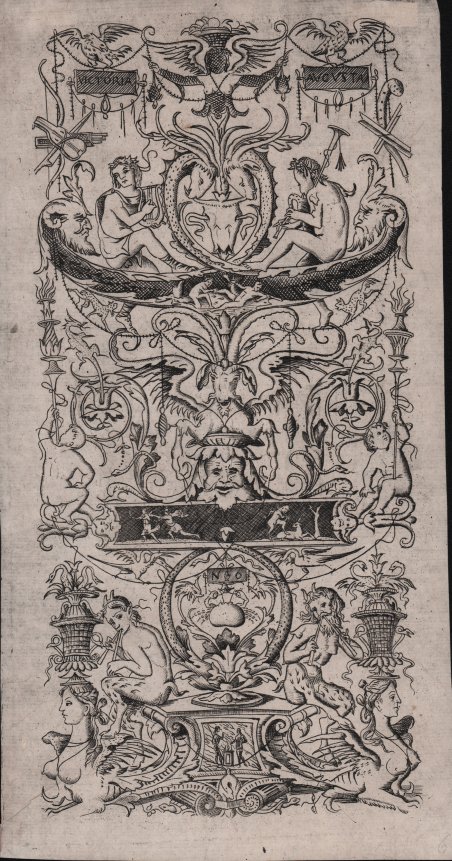
Fregio ornamentale
Mode de Paiement
- PayPal
- Carte bancaire
- Virement bancaire
- Pubblica amministrazione
- Carta del Docente
Détails
- Année
- 1510
- Format
- 128 X 265
- Graveurs
- ROSEX detto Nicoletto da Modena Nicoletto
Description
Bulino, 1510 circa, firmato in lastra con il monogramma “N. O.”, nel nastro verso il basso. Nei due nastri in alto, sormontati da due aquile, le parole “VICTORIA” e “AUGUSTA”.Bella prova, impressa su carta vergata, rifilata ai margini, in ottimo stato di conservazione.Questo fregio ornamentale che reca in alto le parole "VICTORIA AUGUSTA" (la vittoria augustea), sembra illustrare la rifioritura delle arti resa possibile dall'avvento della pace. Questo tema e la scritta richiamano in modo specifico la famosa "Pax Augusta", la pace di Augusto, a cui si fa allusione anche in un altro dei pannelli grotteschi di Nicoletto (H. 107) recante le iscrizioni "VICTORIA AUGUSTI", "SPES PUBLICA" (speranza della gente) e "PAX AETERN (pace eterna). In questo fregio la lira di Apollo, dio delle arti, è giustapposta con strumenti più rustici, la cornamusa e flauti di fauni e satiri Le scene inserite raffigurano argomenti correlati: la storia di Apollo e Dafne, Pan con le sue pipe e lo scuoiamento di Marsia dopo la sua sconfitta contro Apollo in un concorso musicale. L'opera appartiene a una serie di quattro pannelli ornamentali che probabilmente era stata pensata per ricordare la storia di Roma: Il giudizio di Paride, nel primo pannello, era il preludio alla guerra di Troia, che portò alla fuga di Enea e, in definitiva, alla fondazione di Roma. Il secondo e il terzo pannello, che trattano le guerre vittoriose, possono alludere alla creazione dell'Impero Romano che fu, infine, consolidato grazie alla Pax Augusta.La finezza della tecnica e il tipo di ornamento suggeriscono che queste incisioni furono realizzate da Nicoletto durante il suo primo viaggio a Roma, nel 1507, durante il quale è noto che visitò la Casa aurea di Nerone, che a quel tempo era una fonte primaria per lo studio della decorazione grottesca. In realtà, Nicoletto non imitò direttamente gli ornamenti neroniani, piuttosto seguì l’interpretazione fornita da Pinturicchio, Signorelli e altri. Attivo tra la fine del Quattrocento e il terzo decennio del Cinquecento, fu il più prolifico tra gli incisori italiani delle origini. Dopo gli esordi in ambito emiliano, in cui appaiono chiaramente visibili le relazioni che Nicoletto intrattenne con la cultura ferrarese e con la bottega bolognese di Francesco Francia, dal 1487 l’incisore è documentato a Padova per circa un ventennio, ebbe modo di maturare, sotto l’influsso della scuola di Andrea Mantegna, una visione libera ed eccentrica dell’antico, è da ricondurre la celebre incisione raffigurante ' Quattro donne ignude, nota in tre esemplari e firmata e datata 1500. Nel 1507, Rosex si trasferì a Roma. La produzione capitolina si caratterizza per un rinnovato interesse verso il mondo classico, testimoniato dalle stampe raffiguranti ' Apelle, la ' Statua equestre di Marc’Aurelio ' e la serie dei ' Pannelli ornamentali, in cui la decorazione a grottesca è trattata come soggetto autonomo. È probabile che il soggiorno romano fosse di breve durata, dal momento che nel 1510 Nicoletto è documentato a lavoro nel palazzo ducale di Modena. L’attività degli ultimi anni, in cui è ravvisabile la conoscenza delle incisioni di Marcantonio Raimondi e di Giulio Campagnola, appare riconoscibile per la preponderanza dell’elemento architettonico e per la nuova centralità della figura umana nello spazio. Anche il segno incisorio è contraddistinto da una maggiore omogeneità e da ombreggiature più felici. Bibliografia Hind 1938-48 106.II; Bartsch XIII.286.57; Early Italian Engravings from the National Gallery of Art, no. 175. Engraving, 1510 circa, signed with monogram “N. O” in the bottom panel. In two panels at top, 'VICTORIA' and 'AUGUSTA'.Good example, printed on laid paper, trimmed at margins, in very good condition.“This panel, inscribed "VICTORIA AUGUSTA" (the victory of Augustus), appears to illustrate the flourishing of the arts made possible by the advent of peace. This theme and the inscription specifically recall the famous "Pax Augusta," the peace of Augustus, which is also alluded to in another of Nicoletto's grotesque panels (H. 107) (fig. 24-1), which bears the inscriptions "VICTORIA AUGUSTI," "SPES PUBLICA" (hope of the people), and "PAX AETERN (eternal peace). In our print the lyre of Apollo, god of the arts, is juxtaposed with more rustic instruments, the bagpipe and flutes of fauns and satyrs. The inset scenes depict related subjects: the story of Apollo and Daphne, Pan with his pipes, and the flaying of Marsyas after his defeat by Apollo in a musical contest. It seems likely that the entire series of ornament panels was meant to recall the history of Rome. The Judgment of Paris, in the first panel, was a prelude to the Trojan War, which led to Aeneas's flight and ultimately to the founding of Rome. The second and third panels, which deal with victorious wars, may allude to the creation of the Romarn Empire, which was finally consolidated under the Pax Augusta.” “The fineness of the technique and the type of grotesque ornament em- ployed suggest that these prints were executed by Nicoletto during his first trip to Rome. We know that he visited the Golden House of Nero, which at that time was a prime source for the study of grotesque decoration, in 1507. Actually, Nicoletto did not directly imitate the Neronic style of ornament, as Giovanni da Udine was to do later instead he followed the interpretation of it developed by Pinturicchio, Signorelli, Aspertini, and others” Jacqueline L. Sheehan. Active between the end of the fifteenth century and the third decade of the sixteenth century, he was the most prolific of the early Italian engravers. After the beginnings in Emilia, in which appear clearly visible relations that Nicoletto entertained with the culture of Ferrara and with the workshop of Francesco Francia in Bologna, from 1487 the engraver is documented in Padua for about twenty years, he had the opportunity to mature, under the influence of the school of Andrea Mantegna, a free and eccentric vision of the ancient, is to be attributed the famous engraving depicting Four naked women, known in three copies and signed and dated 1500. In 1507, Rosex moved to Rome. The Capitoline production is characterized by a renewed interest in the classical world, as evidenced by prints depicting Apelles, the Equestrian Statue of Marc'Aurelius and the series of ornamental panels, in which the grotesque decoration is treated as an independent subject. It is likely that the Roman stay was of short duration, since in 1510 Nicoletto is documented at work in the ducal palace of Modena. The activity of the last years, in which is recognizable the knowledge of the engravings of Marcantonio Raimondi and Giulio Campagnola, is recognizable for the preponderance of the architectural element and for the new centrality of the human figure in the space. Also the engraving sign is characterized by a greater homogeneity and by better shading. Bibliografia Hind 1938-48 106.II; Bartsch XIII.286.57; Early Italian Engravings from the National Gallery of Art, no. 175. Cfr.
