Il martirio di S. Lorenzo
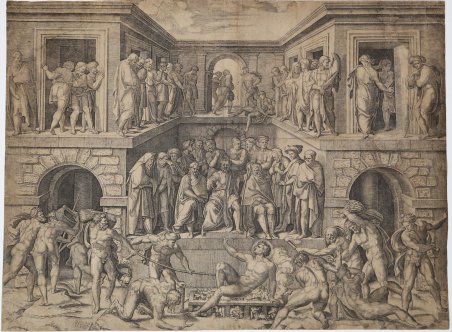
Il martirio di S. Lorenzo | Gravures | RAIMONDI Marcantonio
Il martirio di S. Lorenzo
Il martirio di S. Lorenzo | Gravures | RAIMONDI Marcantonio
Mode de Paiement
- PayPal
- Carte bancaire
- Virement bancaire
- Pubblica amministrazione
- Carta del Docente
Détails
- Année
- 1525
- Format
- 575 X 426
- Graveurs
- RAIMONDI Marcantonio
Description
Bulino, 1525 circa, sulla tavoletta in basso a sinistra “BACCIUS/BRANDIN/INVEN”, a sinistra della tavoletta la sigla dell’incisore MAF. Esemplare nel secondo stato finale. Da un soggetto di Baccio Bandinelli. Bella impressione, ricca di toni e di contrasti, esemplare applicato su supporto cartaceo ottocentesco, pieghe di carta e strappi restaurati, nel complesso in buono stato di conservazione. L'incisione di Marcantonio Raimondi deriva dall'invenzione di Baccio Bandinelli che - intorno al 1525 - aveva ricevuto da papa Clemente VII l'incarico di affrescare il martirio dei Santi Cosma e Damiano e quello di San Lorenzo sulle pareti laterali della cappella del coro di San Lorenzo a Firenze. Sebbene l’affresco non venne mai realizzato, il pontefice fu così entusiasta del disegno del Bandinelli che ne commissionò l’incisione al Raimondi, e nominò Baccio cavaliere di S. Pietro per il suo genio creativo. Il lavoro sull’incisione fu interrotto quando Marcantonio fu incarcerato per la sua suite lasciva “I Modi”. Rilasciato grazie alla mediazione di Baccio, Raimondi completò l’intaglio con il disappunto di Bandinelli, che non fu soddisfatto anche per l'errata iscrizione del suo nome BRANDIN, ma il papa non accolse queste critiche e anzi, secondo il racconto di Vasari, ritenne che “l’incisione fosse più accurata del disegno”. La scena di Bandinelli si basa sul racconto del Massacro secondo il vangelo di Matteo 2:16-18. La composizione comprende una cinquantina di figure, molte delle quali sono spettatori vestiti che occupano la sporgenza superiore dell’edificio. La figura barbuta isolata a sinistra potrebbe essere un autoritratto di Baccio. Al centro della composizione, il prefetto romano è seduto, con accanto due cortigiani; intorno a loro, sono in piedi altre dodici figure. Sotto, in primo piano, S. Lorenzo (circa 2225 – 258) viene bruciato vivo su una graticola per non aver voluto consegnare al prefetto i tesori della Chiesa, distribuendoli invece a i poveri, e quando il prefetto gli chiese dove fosse il tesoro, lui indicò una turba di malati, storpi ed emarginati. Intorno al Santo, varie figure che cooperano alla sua tortura, alimentando il fuoco e tenendolo fermo sulla graticola. I torturatori sono raffigurati nudi in tutta la loro muscolarità, a sottolineare il virtuosismo nella resa del corpo umano che Baccio aveva coltivato in personale rivalità con Michelangelo. ' Passavant e Delaborde segnalano il disegno preparatorio a Monaco di Baviera, Staatliche Graphische Sammlungen, inv. 2215, matita rossa, mm 428 x 575, Oberhuber/ Gnann 1999, p. 358-359 n. 268, ripr. a p. 358). Engraving, 1525, inscribed on the plate al lower left “BACCIUS/BRANDIN/INVEN”, to left of tablet MAF. Second state of two.Good impression, strong and contrasted, example applied on nineteenth-century paper, trimmed at margins, folds of paper and tears restored, overall in good condition.A great deal is known about this magnificent engraving, which assessed four centuries later as "one of the great monuments part of the commission for frescoes on the lateral walls of the means more, Lawre was renowned in its own time as "a truly very rare thing" and where in the history of engraving." The composition originated as part of the commission for frescoes on lateral walls on the high altar of San Lorenzo, Florence, given to Baccio Bandinelli by Pope Clement VII in about 1525. Several studies for individual figures have been identified in addition to a composion sketch in the Louvre. Although the fresco itself was never realized, "the Pope was so delighted that he commis- half-re sioned Marcantonio [Raimondi] to engrave it, and he created Baccio a knight of St. Peter for his genius." (Vasai). Work on the engraving was interrupted when Marcantonio was briefly jailed for producing the lascivious suite I Modi. Released through Bandinellis intervention, he completed the print but not, evidently, to Bandinelli's satisfaction. Marcantonio, however, cleverly got to the pope first, showing done him Bandinelli's prototype and his own print. To Bandinelli's chagrin Clement concluded that Marcantonio's "engraving erful was more skillful than Baccio's drawing" Typically, even late in the life Bandinelli still fumed over Marcantonio's misspelling with of his name on the print: "instead of engraving Band, [he] engraved Brand, whence many people who did not know interpreted it as Brandi, Brandini and Brindinelli." (Vasari).As was done by his predecessors, Bandinellis elaborate staging of the Massacre expands on the laconic account in Matthew 2 16-18. The composition features some fifty figures, many of them heavily robed spectators who occupy narrow ledge along the top level of a very peculiar building, (The bearded figure isolated on the far left may be Bandinelli's berhuber self portrait.) In the center of the composition, the Roman prefect sits on a raised platform to which there appears no means of access. Two seated courtiers flank him; twelve more, clustered in groups of three, stand around him. Below which Lawrence (c. 225-258) is tortured in an effort to learn the whereabouts of the church's treasure, which had been entrusted to him by Pope Sixtus II shortly before his own martyrdom. In fact, Lawrence had distributed the treasure to the poor, and when asked the whereabouts of the treasure, he pointed to the people and gave the infuriating answer that they were the church's treasure. The prefect scowls out at the viewer, his right arm raised elf was in a gesture of command. In the foreground, the nude martyr half-reclines on the gridiron on which he is being roasted, his pose reminiscent of Adam in Michelangelo's Sistine ceiling or an ancient river god (see, for example, Boorsch, fig. 12). Around him are men who carry out his punishment, bringing fire and kindling and stoking the flames. One uses a long pole to push Lawrence down onto the grill as though enacting Lawrence's jocular taunt to the prefect: “You have me wll howing done on one side, turn me over and eat!”. Depicted nude, the tormentors stand or crouch in poses that display their powerful musculature, highlighting the virtuosity in rendering the human form that Bandinelli cultivated in personal rivalry with Michelangelo. Taking into account the "fantastic setting, the tortured attitudes and hallucinatory stares of the figures," Bernice Davidson characterizes Bandinelli's Martyrdom as a "particular form of brilliant irrationality." BERNARD BARRYTE Cfr. Bartsch, XIV.89.104; Barryte, p. 462 n. 88; Delaborde n. 85.