La Calunnia di Apelle
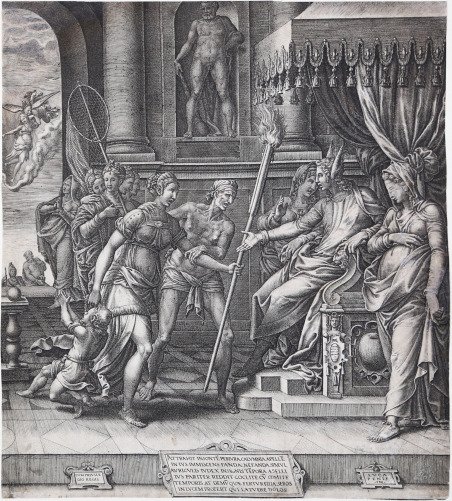
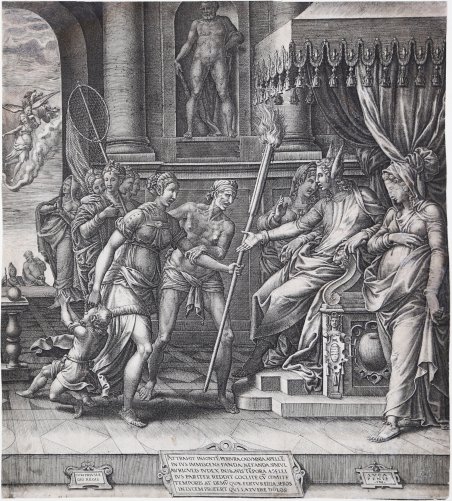
La Calunnia di Apelle
Mode de Paiement
- PayPal
- Carte bancaire
- Virement bancaire
- Pubblica amministrazione
- Carta del Docente
Détails
- Année
- 1560
- Format
- 316 X 350
- Graveurs
- GHISI detto "Il Mantovano" Giorgio
Description
Bulino, 1560, firmato e datato in lastra in basso al centro. 'GEOR/GIVS/GHISI/MANT/.F./1560', lettered on the step at base on three tablets. Left: 'CVM PRIVILE/GIO REGIS'; centre: 'ATTRAHIT INSONTE PERIVRA CALVMNIA APELLE/IN IVS IMMISCENS FANDA NEFANDA SIMVL/AVRICVLIS IVDEX INSIGNIS TEPORA ASELLI/IVS PARITER REDDIT COCLITE CV COMITE/TEMPORIS AT DEMV QVAE FERTVR FILIA; SEROS/IN LVCEM PROFERIT QVI LATVERE DOLOS'; right: 'LVCA/PENIS/.IN.' Esemplare nel terzo stato di sei, avanti l’indirizzo dell’editore Honerougt. Magnifica prova, ricca di toni, impressa su carta vergata coeva, rifilata all’interno della linea marginale con perdita di parte incisa, restauri ricostruttivi agli angoli superiori, difetti minori, per il resto in buono stato di conservazione. ' L’opera deriva da un soggetto di Luca Penni. Scrive Bellini: “Dopo la parentesi mantovana, con quest'opera il Ghisi torna a riprodurre artisti attivi in terra francese. Scegliendo di raffigurare la Calunnia l'artista si inseriva in un filone iconografico frequentemente trattato nel XV e nel XVI secolo, forse a causa delle sottili implicazioni allegoriche che il soggetto comportava nei confronti della figura del cortigiano. Il soggetto dell'opera, come viene indicato nella tavoletta in basso a sinistra, deriva da Luca Penni, sebbene al momento non si conoscano disegni o dipinti dell'artista raffiguranti la Calunnia, ad eccezione di un disegno conservato al Gabinetto Disegni del Castello Sforzesco di Milano (inv. 4868, C 519), in tutto simile all'incisione, salvo alcuni particolari, come la mancanza delle due figure che nell'incisione si vedono sul fondo a sinistra, la mancanza del gradino in primo piano e l'assenza delle circonferenze e dei rombi inscritti nei riquadri. Il disegno, penna, acquerello e biacca, nello stesso verso del bulino, misura mm. 330x320 e porta in basso, in grafia antica, un'indicazione relativa a Luca Penni. A nostro parere, tuttavia, questo foglio deve essere considerato una copia tratta da un'esemplare dell'incisione del II stato, anch'esso privo, come il disegno, del gradino, delle tavolette con le scritte e dei rombi e delle circonferenze nel pavimento. Volendo poi indagare a quali fonti il Penni possa essersi ispirato per la sua composizione e dando ipoteticamente per supposto che l'incisione del Ghisi riproduca fedelmente una composizione del Penni, sembra di poter dire che il Penni si sia rivolto a diverse fonti, quali il disegno del Mantegna La Calunnia (London BM, inv. 1860.6.16.85) o l'incisione di Girolamo Mocetto (Bartsch 1811, XIII, p. 113, n. 10; Hind V, p. 165, n. 12) che riproduce tale disegno, o ancora il dipinto del Botticelli (Firenze, Uffizi), o un disegno di Raffaello (Louvre inv. 3878) raffigurante La Calunnia di Apelle, o una sua copia con sfondo architettonico. (London BM, inv. 1872.10.12.3268, vedi fig. 133), o infine il dipinto Allegoria della Calunnia di Apelle, presente a Pesaro nella Villa Imperiale (databile intorno al 1529-1532)” (cfr. Paolo Bellini, L’opera incisa di Giorgio Ghisi, 1998, pp. 173-179). Bibliografia Bartsch XV.411.64; Le Blanc II.296.59; Albricci 1982, no. 48; Boorsch, Lewis, and Lewis 1985, n. 27, III/VI; Bellini 1998, n. 40, III/VI. Engraving, 1560 circa, signed and dated on the throne: 'GEOR/GIVS/GHISI/MANT/.F./1560', lettered on the step at base on three tablets. Left: 'CVM PRIVILE/GIO REGIS'; centre: 'ATTRAHIT INSONTE PERIVRA CALVMNIA APELLE/IN IVS IMMISCENS FANDA NEFANDA SIMVL/AVRICVLIS IVDEX INSIGNIS TEPORA ASELLI/IVS PARITER REDDIT COCLITE CV COMITE/TEMPORIS AT DEMV QVAE FERTVR FILIA; SEROS/IN LVCEM PROFERIT QVI LATVERE DOLOS'; right: 'LVCA/PENIS/.IN.' Example in the third state of six, before publisher Honerougt's address. Magnificent proof, rich in tone, printed on contemporary laid paper, trimmed inside the marginal line with loss of engraved part, reconstructive restorations to upper corners, minor defects, otherwise in good condition. ' No corresponding drawing or painting by Luca Penni has yet been identified with certainty. A drawing in the Gabinetto dei Disegni del Castello Sforzesco di Milano, inv. no. 4868, in the same direction and with identical dimensions, is executed in Penni's manner, but Albricci does not think it may be a preparatory drawing for this print. Bellini writes: "After the parenthesis in Mantua, with this work Ghisi returns to reproduce artists active in France. Choosing to depict the Calumny, the artist inserted himself in an iconographic vein frequently treated in the fifteenth and sixteenth centuries, perhaps because of the subtle allegorical implications that the subject entailed for the figure of the courtier. The subject of the work, as indicated in the panel at lower left, derives from Luca Penni, although at the moment there are no known drawings or paintings by the artist depicting Calumny, with the exception of a drawing conserved in the Gabinetto Disegni of the Castello Sforzesco in Milan (inv. 4868, C 519), which is similar to the engraving, except for some details, such as the lack of the two figures that in the engraving can be seen on the bottom left, the lack of the step in the foreground and the absence of the circles and rhombuses inscribed in the boxes. The drawing, pen, watercolour and white lead, in the same direction as the burin, measures 330x320 mm. and bears at the bottom, in old handwriting, an indication of Luca Penni. In our opinion, however, this sheet must be considered a copy taken from an exemplar of the engraving of the IInd state, which also lacks, like the drawing, the step, the tablets with the inscriptions and the rhombuses and circumferences in the floor. In order to investigate which sources Penni drew inspiration for his composition and hypothetically assuming that Ghisi's engraving faithfully reproduces one of Penni's compositions, it seems possible to say that Penni turned to various sources, such as Mantegna's drawing La Calunnia (London BM, inv. 1860.6.16.85) or Girolamo Mocetto's engraving (Bartsch 1811, XIII, p. 113, no. 10; Hind V, p. 165, no. 12) reproducing this drawing, or Botticelli's painting (Florence, Uffizi), or a drawing by Raphael (Louvre inv. 3878) depicting Apelles' La Calunnia, or a copy of it with an architectural background. (London BM, inv. 1872.10.12.3268, see fig. 133), or finally the painting Allegory of Calumny by Apelle, present in Pesaro in the Villa Imperiale (datable to around 1529-1532)" (cf. Paolo Bellini, L'opera incisa di Giorgio Ghisi, 1998, pp. 173-179). Bibliografia Bartsch XV.411.64; Le Blanc II.296.59; Paris 1972, no. 351 (entry by Henri Zerner); Albricci 1982, no. 48; Boorsch, Lewis, and Lewis 1985, n. 27 (third state of six); Bellini 1998, n. 40 (third state of six). Cfr.
