La Decollazione del Battista
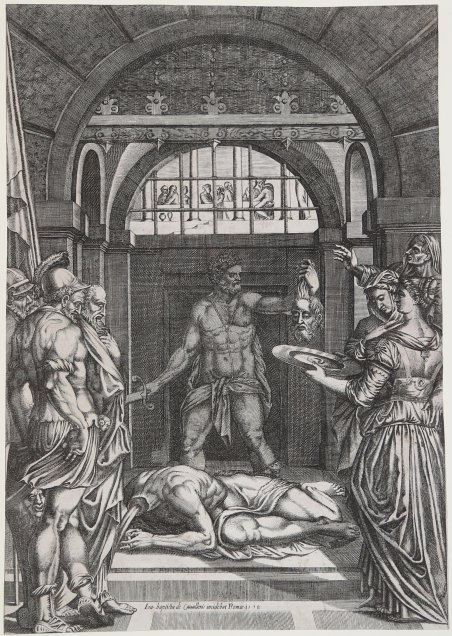
La Decollazione del Battista
Mode de Paiement
- PayPal
- Carte bancaire
- Virement bancaire
- Pubblica amministrazione
- Carta del Docente
Détails
- Année
- 1578
- Format
- 301 X 432
- Graveurs
- CAVALIERI Giovanni Battista de’
Description
Bulino, 1578, datato e firmato in lastra, in basso al centro, 'Ioa baptista de Cavalleris incidebat Romae 1578'. Magnifica prova, ricca di toni, impressa su carta vergata coeva con filigrana “cerchio con stella a quattro punte”, rifilata alla linea marginale, in ottimo stato di conservazione.L’incisione riproduce, nello stesso verso, la splendida pala d’altare completata sotto la direzione di Giorgio Vasari nel 1553, per la chiesa romana che proprio da quest’opera prende il nome di S. Giovanni Decollato. La scena, sviluppata in profondità, è ambientata all’interno della prigione in cui il Battista era stato rinchiuso da Erode. Ai lati, due file formato a sinistra da soldati, a destra da ancelle. La loro disposizione guida/conduce lo spettatore verso il centro della stanza, dove giace decapitato il corpo del Battista Il risalto della sua figura è ottenuto con un abile gioco di luci ed ombre: la figura del suo carnefice, che con la mano sinistra tiene dai capelli la testa del Battista, nell’atto di riporla sul vassoio, è delineata con un tratteggio molto fitto, così da risultare completamente in ombra, quale figura tenebrosa e malvagia.Opera di grande rarità. Engraving, Signed and dated lower centre: 'Ioa baptista de Cavalleris incidebat Romae 1578'. Only stateAfter Giorgio Vasari's altarpiece in the same direction, in the Roman church of San Giovanni Decollato,from which takes its name San Giovanni Decollato, Rome.A great impression, printed on contemporary laid paper with "star in a cricle" watermark, trimmed to the platemark, very good condition.Vasari’s painting has similarities of the same story by Andrea del Sarto and by Dürer. Unlike these two artists, Vasari graphically depicts the blood spurting from the arteries in the Baptist’s neck. Cranach’s woodcut may be the ultimate source for this treatment.The scene takes place in the prison where the Baptist had been imprisoned by Herod. On either side, two rows formed to the left by soldiers, on the right from maids. Their layout / guide takes the viewer into the center of the room, where lies the body of the Baptist beheaded. His figure is emphasized by a clever use of light and shadow. The figure of the executioner, who holds in his left hand the head of the Baptist, in the act of storing it on the tray, is outlined with a very dense hatch, so as to be completely in the shade, as dark and evil figure. Cfr. Scorsetti, in Grafica d’Arte 49, 2002, no. 15; S. Gregory, Vasari and the Renaissance Print, p. 352.
