La mandria in cammino
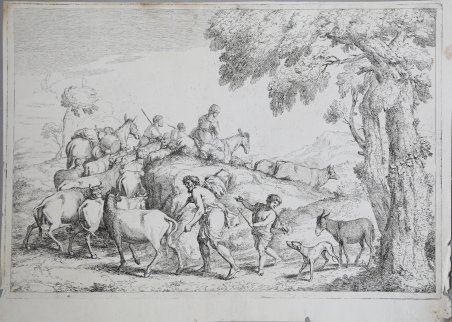
La mandria in cammino
Mode de Paiement
- PayPal
- Carte bancaire
- Virement bancaire
- Pubblica amministrazione
- Carta del Docente
Détails
- Année
- 1760
- Format
- 430 X 295
- Graveurs
- ZOMPINI Gaetano
Description
Acquaforte e puntasecca, 1760 circa, priva di data ed indicazioni editoriali. Stato unico. Della serie “Varii Capricci, e paesi inventati, e disegnati dal celebre Gio. Benedetto Castiglione Genovese tratti dalla raccolta zanettiana. Incisi all'acquaforte da Gaetano Zompini Pittore Veneto. Ora novamente raccolti, e pubblicati”, edita a Venezia nel 1786. Quest’edizione del 1786 comprende un frontespizio, inciso da Giuseppe Maria Del Pian, e 12 tavole, di cui le prime tre dedicate all’educazione di Achille. Poiché tre tavole della serie sono datate 1758 e due 1759, è probabile che una prima edizione della serie, senza frontespizio, e limitata a pochissimi esemplari, sia stata ultimata verso il 1760. La raccolta fu riedita nel 1786 su iniziativa di John Strange divenuto proprietario, tramite l’agente Giovanni Maria Sasso, dei rami acquistati presso gli eredi Zanetti. Cinque rami della serie recano il monogramma AMZ di Antonio Maria Zanetti a cui in passato, erroneamente, sono state attribuite tutte le incisioni. La teoria era anche avvalorata dal fatto che quattro stampe recano in calce, nel primo stato, la dedica a personaggi amici di Zanetti, e dalla lettera del 16 gennaio 1759 in cui Algarotti, scrivendo a Zanetti, lodava due stampe derivate da disegni di Castiglione. Santifaller, invece, evidenziò le affinità stilistiche tra le stampe derivate da Castiglione e quelle di Zompini, attribuendone a lui le incisioni. Sopher suggerisce che Zanetti abbia aggiunto il suo monogramma e le dediche ad amici e parenti al fine di far passare le stampe come sue, come una sorta di scherzo. Algarotti sarebbe stato uno dei destinatari che erano stati ingannati. Bozzolato (1978) suggerì che Zanetti iniziò l'opera ma poi la consegnò a Zompini, "senza dubbio il vero autore". La collaborazione con Zanetti sarebbe limitata a poche lastre, probabilmente le cinque che recano il monogramma AMZ. Magnifica prova, impressa su carta vergata coeva con filigrana delle “tre mezze lune”, con margini, in buono stato di conservazione. Bibliografia D. Succi, La Serenissima nello specchio di rame, pp. 765-769, n. 66; ' Bozzolato 4; TIB p. 117, 81. Etching and drypoint, circa 1760, lacking date and editorial markings. Only state. From the series “Varii Capricci, e paesi inventati, e disegnati dal celebre Gio. Benedetto Castiglione Genovese tratti dalla raccolta zanettiana. Incisi all'acquaforte da Gaetano Zompini Pittore Veneto. Ora novamente raccolti, e pubblicati”, published in Venice in 1786. This edition of 1786 includes a frontispiece, engraved by Giuseppe Maria Del Pian, and 12 plates, the first three of which are dedicated to the education of Achilles. Since three plates of the series are dated 1758 and two 1759, it is likely that a first edition of the series, without frontispiece, and limited to very few copies, was completed around 1760. The collection was reissued in 1786 on the initiative of John Strange became the owner, through the agent Giovanni Maria Sasso, of the plates purchased from the heirs Zanetti. Five plates of the series bear the monogram AMZ of Antonio Maria Zanetti to whom, in the past, were erroneously attributed all the engravings. The theory was also supported by the fact that four prints bear at the bottom, in the first state, the dedication to people who were friends of Zanetti, and by the letter of January 16, 1759 in which Algarotti, writing to Zanetti, praised two prints derived from drawings by Castiglione. Santifaller, on the other hand, pointed out the stylistic affinities between the prints derived from Castiglione and those of Zompini, attributing the engravings to him. Sopher suggests that Zanetti added his monogram and dedications to friends and relatives in order to pass the prints off as his own, as a sort of joke. Algarotti would have been one of the recipients who were duped. Bozzolato (1978) suggested that Zanetti started the work but then handed it over to Zompini, "without a doubt the real author". The collaboration with Zanetti would be limited to a few plates, probably the five bearing the AMZ monogram. Magnificent proof, printed on contemporary laid paper with watermark of the "three half moons", with margins, in good condition. Bibliografia D. Succi, La Serenissima nello specchio di rame, pp. 765-769, n. 66; Bozzolato 4; TIB p. 117, 81. Cfr.
