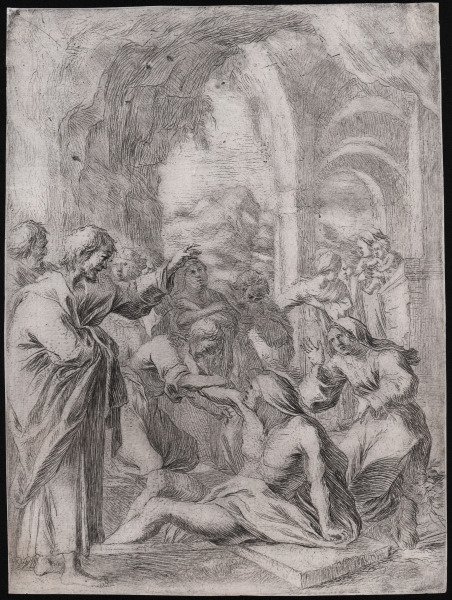
Acquaforte, 1617-1618 circa, priva di firma ed indicazioni editoriali. Magnifica prova, impressa su carta vergata coeva, rifilata al rame, in perfetto stato di conservazione. ' Opera anonima, recentemente e concordemente assegnata a Claude Vignon dalla critica, con un passato controverso in quanto ad attribuzione: “Jesus-Christ ressussitant Lazare, gravé à l'eau forte par le même sans doutte pendant son séjour ? Rome” (Gesù Cristo che risuscita Lazzaro, inciso all'acquaforte dalla stessa persona senza dubbio durante il suo soggiorno a Roma) scrive Pierre Mariette a proposito di questa lastra e aggiunge a margine del foglio: "9: h. 6.9. Lar. aucun nom d'artiste, gravé sur un cuivre qui n'est pas bien bruny” (senza alcun nome d'artista, inciso su un rame non ben brunito). L’opera è rimasta a lungo sotto il nome di Georges Lallemand. Fu, infatti, considerata come un'opera del maestro lorenese da Le Blanc, Meaume, così come da Robert Dume?nil che lo descrisse in uno dei suoi cataloghi di vendita (19-20 novembre 1858, n° 167): “Jésus- Christ ressuscitant Lazare. Notre Seigneur debout, pieds nus à la gauche du devant, bénit de la main gauche élevée Lazare assis sur la pierre qui recou- vrait sa tombe, dont les jambes sont encore dedans. La scène se passe dans un vaste souterrain composé de beaucoup de figures. Morceau sans nom ni marque, qui a mal réussi à l'opération de l'eau-forte.” Weigert, nel 1973, ha messo in dubbio tale attribuzione. Paola Pacht Bassani, nel catalogo Claude Vignon (1593-1670), ritiene che si debba dare credito a Mariette e vedere qui senza esitazione la prima incisione di Vignon, che può essere datata intorno al 1617-1618. L’opera, inoltre, all'Albertina di Vienna e alla Bibliothèque Nationale di Parigi, è classificata sotto il nome di Claude Vignon. L’incisione è piuttosto maldestra, a giudicare dai difetti di morsura, dalla durezza del ritocco con il bulino, dallo studio approssimativo della prospettiva e dell'anatomia, e dall'incerto posizionamento delle figure. L'attribuzione a Vignon sembra essere confermata dalla scelta stessa di certi tipi che, di per sé, valgono quasi una firma: vediamo soprattutto la figura di Cristo che annuncia quella dello stesso personaggio nella suite Miracula Domini Nostri Jesu Christi degli anni 1630-1640, quella dell'apostolo immediatamente dietro, e infine quella della figura con il viso ampio e il cappello, posta un po' a destra. D'altra parte, il gusto per tale ambientazione e per questo tipo di scrittura prepara la ricerca che ispirerà presto, in modo molto più maturo, L'adorazione dei Magi del 1619 o La regina di Saba del 1624. Qui, l'artista si allontana completamente dal mondo caravaggesco e, ancor più che nel Martirio di San Matteo, si sottomette allo stile manierista e veneziano. In particolare, fu molto colpito dalle incisioni dello Schiavone (Andrea Meldolla). Basta vedere l'uso della grafica con tratti spesso così duri ed evidenti, le grandi curve semplificate che formano l'arabesco, il gusto per la fluidità delle forme e dell’atmosfera, e infine il ritmo rotatorio che, non senza difficoltà, emerge dalla composizione. Pittore e disegnatore prolifico, Claude Vignon fu coinvolto nella stampa durante la sua lunga carriera. È probabile che abbia imparato a dipingere da Jacob Bunel, anche lui di Tours, un decoratore che lavorava per i reali francesi, e che probabilmente abbia studiato con Georges Lallemant a Parigi. Vignon andò poi a Roma, dove nel 1617 realizza il suo primo dipinto datato, Il martirio di San Matteo, mostra la forte influenza di Caravaggio e iniziò un’amicizia che durerà tutta la vita con Pierre Brebiette e con il mercante d'arte ed editore di stampe Francois Langlois, conosciuto come Ciartres. Le acqueforti di Vignon a volte mancano di abilità tecnica e mostrano un mordente macchiato nei primi stati, dando loro un aspetto quasi "casuale" e spesso diverso da prova a prova. Quando si s. Etching, 1617-1618 circa, without printing details. Magnificent proof, printed on contemporary laid paper, trimmed to the copperplate, in perfect condition. ' Anonymous work, recently and unanimously assigned to Claude Vignon by the critics, with a controversial past in terms of attribution: “Jesus-Christ ressussitant Lazare, gravé à l'eau forte par le même sans doutte pendant son séjour ? Rome” Mariette writes about this plate and he adds in the margin of the sheet “9: h. 6.9. Lar. aucun nom d'artiste, gravé sur un cuivre qui n'est pas bien bruny”, yet it is under the name of Georges Lallemand that the piece has long remained. ' Indeed, it was considered as a work of the Lorraine master by Le Blanc Renouvier, Meaume, as well as by Robert-Dume?nil, who describes it in one of his sale catalogs (19-20 November 1858, no. 167): “Jésus- Christ ressuscitant Lazare. Notre Seigneur debout, pieds nus à la gauche du devant, bénit de la main gauche élevée Lazare assis sur la pierre qui recou- vrait sa tombe, dont les jambes sont encore dedans. La scène se passe dans un vaste souterrain composé de beaucoup de figures. Morceau sans nom ni marque, qui a mal réussi à l'opération de l'eau-forte”. Weigert, in 1973, questioned this attribution. Paola Pacht Bassani, in the catalog Claude Vignon (1593-1670), believes that Mariette should be credited and see here without hesitation the first preserved engraving of Vignon, which can be dated around 1617-1618. The work, moreover, at the Albertina in Vienna and the Bibliothèque Nationale in Paris, is classified under the name of Claude Vignon. The engraving is rather clumsy, judging by the defects of morsure, the hardness of the retouching with the burin, the approximate study of perspective and anatomy, and the uncertain positioning of the figures. The attribution to Vignon seems to be confirmed by the choice of certain types which, in themselves, are almost worth a signature: above all the figure of Christ which announces that of the same character in the Miracula Domini Nostri Jesu Christi of the years 1630-1640, that of the apostle immediately behind, and finally that of the character with the broad face and the hat, placed a little to the right. On the other hand, the taste for such an environment and for this type of writing, prepares the research that will soon inspire, and in a much more mature way, The Adoration of the Magi of 1619 or the Queen of Sheba of 1624. Here, the artist deviates completely from the Caravaggesque world and, even more than in the Martyrdom of Saint Matthew, he submits to the Mannerist and Venetian tradition. In particular, he was very impressed by Schiavone's engravings. It is enough to see the use of graphics with strokes that are often so hard and obvious, the large, simplified curves that form the arabesque, the taste for fluidity of form and atmosphere, and finally the rotary rhythm that, not without difficulty, emerges from the composition. ' A prolific painter and draftsman, Claude Vignon was involved with printmaking throughout his long career. It is likely that he learned to paint from Jacob Bunel, also of Tours, a decorator who worked for French royalty, and that he probably studied with Georges Lallemant in Paris. Vignon then went to Rome, where in 1617 his first dated painting, The Martyrdom of Saint Matthew, shows the strong influence of Caravaggio. Around 1618, during his stay in Italy, Vignon began to make etchings; one reproduced a painting by Simon Vouet, another —The Adoration of the Magi— recorded a drawing and painting of his own creation (Louvre; Dayton Art Institute). He began lifelong friendships with Pierre Brebiette and with the art dealer and print publisher Francois Langlois, known as Ciartres. Vignon's etchings sometimes lack technical skill and exhibit spotty foul biting in early states, giving them a casual look that appeals to today's taste. In published states the plate is usually cleaned up. Cfr.

 Découvrez comment utiliser
 Découvrez comment utiliser