La roccia dei filosofi
La roccia dei filosofi | Gravures | Della BELLA Stefano
La roccia dei filosofi
La roccia dei filosofi | Gravures | Della BELLA Stefano
Mode de Paiement
- PayPal
- Carte bancaire
- Virement bancaire
- Pubblica amministrazione
- Carta del Docente
Détails
- Année
- 1661
- Format
- 210 X 265
- Graveurs
- Della BELLA Stefano
Description
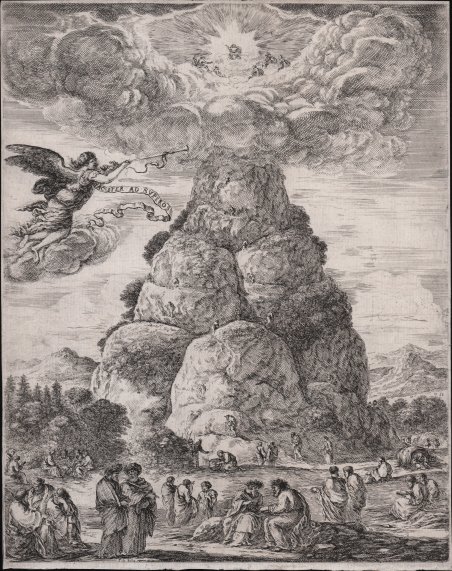
La roccia dei filosofi, o il Monte Parnaso; al centro, una grande montagna, con ai piedi vari filosofi, vestiti con abiti antichi, con Diogene nella sua botte a destra, e Archimede con una sfera armillare al centro, con varie figure che salgono sul Parnaso la cui cima è coperta dalle nuvole. A sinistra, un angelo con una tromba e uno stendardo che punta verso la montagna. Acquaforte, circa 1661, firmata in lastra in basso a sinistra S. D. Bella. Esemplare del secondo stato, con l’iscrizione al centro HAC ITER AD SUPEROS; un solo primo stato della lastra, ante litteram, è conosciuto [catalogo della collezione Rignon, Torino 1873]. Magnifica incisione allegorica di Stefano della Bella, dal significato controverso. In passato, si pensava che l’opera fosse associata e realizzato in occasione delle nozze di Alfonso d'Este con Laura Martinozzi nel 1655 (cfr. Jombert n. 185, 18). Tuttavia, un esemplare della stampa trovato allegato a una tesi pubblicata da Leonardo Marsilio nel 1661 sul tema dei sei “monti”, l'arme della famiglia Chigi, induce De Vesme a ritenere che si tratti di un'allegoria dedicata a papa Alessandro VII, membro della famiglia Chigi eletto Pontefice nel 1655. Il monte è percorso da diversi gradini che corrisponderebbero ai gradi da compiere per giungere alla virtù e alla beatitudine. Inoltre, le gibbosità che caratterizzano il monte sono sei come nello stemma della famiglia Chigi. Si conoscono diversi disegni preparatori per la realizzazione della stampa, tra cui alcuni conservati agli Uffizi (invv. 303, 346P, 8009F) e uno alla Biblioteca Marucelliana (inv. D68) Stefano della Bella fu uno degli incisori più interessanti e originali nella Firenze del XVII secolo e può considerarsi l’unico geniale continuatore dell’opera di Jacques Callot. La sua educazione artistica ebbe inizio a Firenze nella bottega degli orafi Gasparo Mola e Orazio Vanni, e la precisione del segno, tipica dell’arte orafa resterà caratteristica del suo stile. Studiò poi presso Giovanni Battista Vanni e forse anche presso il Cantagallina e Cesare Dandini, ma ben presto si dedicò all'incisione. Il suo vero maestro può considerarsi Jacques Callot, l’incisore francese che soggiornò a lungo a Firenze lasciando una forte impronta nel panorama artistico della città. Gli anni più importanti della sua carriera sono quelli che trascorre a Parigi, dal 1639 al 1650, stipendiato da Lorenzo de' Medici: lavorò insieme ad Israel Silvestre, con gli editori Langlois, Ciartres e Pierre Mariette, per stampatori francesi e per commissioni di gran prestigio, come quelle del 1641 per il cardinale Richelieu che gli affidò le illustrazioni delle sue imprese guerresche. Magnifica prova, ricca di toni, impressa su carta vergata coeva con filigrana ' "testa coronata di profilo nel cerchio" (cfr. Lieure L.21), rifilata al rame o con sottili margini, in ottimo stato di conservazione. Bibliografia B. De Vesme/Massar, Stefano della Bella, p. 61, n. 69.II. The rock of the philosophers, or Mount Parnassus; in the center, a large mountain, with various philosophers at their feet, dressed in ancient garb, with Diogenes in his barrel to the right, and Archimedes with an armillary sphere in the center, with various figures ascending Parnassus whose summit is covered by clouds. On the left is an angel with a trumpet and banner pointing toward the mountain. Etching, ca. 1661, signed in plate at lower left S. D. Bella. Specimen from the second state, with the inscription in the center HAC ITER AD SUPEROS; only one first state of the plate, ante litteram, is known [Rignon collection catalog, Turin 1873]. Magnificent allegorical engraving by Stefano della Bella, with controversial significance. In the past, the work was thought to be associated with and made on the occasion of Alfonso d'Este's wedding to Laura Martinozzi in 1655 (see Jombert no. 185, 18). However, a specimen of the print found attached to a thesis published by Leonardo Marsilio in 1661 on the theme of the six “mounts,” the arms of the Chigi family, leads De Vesme to believe that it is an allegory dedicated to Pope Alexander VII, a member of the Chigi family who was elected pontiff in 1655. The mount is traversed by several steps that would correspond to the degrees to be completed to reach virtue and beatitude. In addition, the gibbosities that characterize the mount are six as in the coat of arms of the Chigi family. Several preparatory drawings for the making of the print are known, including some preserved in the Uffizi (invv. 303, 346P, 8009F) and one in the Marucelliana Library (inv. D68) Stefano della Bella was one of the most interesting and original engravers in 17th-century Florence and can be considered the only brilliant continuator of Jacques Callot's work. His artistic education began in Florence in the workshop of the goldsmiths Gasparo Mola and Orazio Vanni, and the precision of sign, typical of the goldsmith's art, will remain characteristic of his style. He then studied under Giovanni Battista Vanni and perhaps also under Cantagallina and Cesare Dandini, but soon turned to engraving. His real master can be considered Jacques Callot, the French engraver who stayed in Florence for a long time and left a strong imprint on the city's artistic scene. The most important years of his career were the ones he spent in Paris, from 1639 to 1650, salaried by Lorenzo de' Medici: he worked together with Israel Silvestre, with the publishers Langlois, Ciartres and Pierre Mariette, for French printers and for commissions of great prestige, such as those of 1641 for Cardinal Richelieu, who entrusted him with illustrations of his warlike exploits. Around 1647, during a trip to Holland, where he executed etchings with views of the port of Amsterdam, he met Rembrandt, and from that date we note a profound echo of the Dutchman's art in Della Bella's graphic work. Magnificent proof, rich in tone, printed on coeval laid paper with watermark “crowned head in profile in circle” (cf. Lieure L.21), trimmed to copperplate or thin margins, in excellent condition. Bibliografia B. De Vesme/Massar, Stefano della Bella, p. 61, n. 69.II. Cfr.