Le Grandi Miserie della Guerra - Arruolamento delle truppe
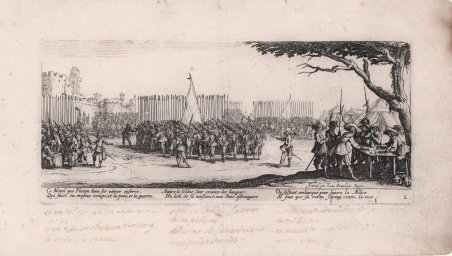
Le Grandi Miserie della Guerra - Arruolamento delle truppe
Mode de Paiement
- PayPal
- Carte bancaire
- Virement bancaire
- Pubblica amministrazione
- Carta del Docente
Détails
- Année
- 1633
- Format
- 115 X 57
- Graveurs
- CALLOT Jacques
Description
Acquaforte, 1633, della serie Le Grandi Miserie della Guerra.Esemplare del secondo stato di tre, avanti la firma di Callot e con la lastra numerata.Magnifica prova, impressa su carta vergata coeva con filigrana “corno da caccia” (Lieure 47), con margini, in perfetto stato di conservazione.Callot incise due serie di stampe che illustrano le miserie della guerra. La prima, in un formato più piccolo e quindi chiamata Le Piccole miserie della guerra, è costituita da sei stampe, che Callot incise intorno al 1632. Le piccole miserie di solito sono considerati come schizzi preliminari per le più famose Grandi Miserie. Les Grandes Misères et Malheurs de la Guerre, furono pubblicate nel 1633, nel corso del conflitto paneuropeo conosciuto come la Guerra dei Trent'anni, con il privilegio reale di Luigi XIII. La serie è composta da 18 incisioni, incluso il frontespizio.La dimensione delle immagini incise è piuttosto piccola, 113-115 x 51-57 mm; questo obbligherebbe chi le osserva a esaminarle molto da vicino, in modo da poter vedere chiaramente i dettagli di ogni stampa. La loro forma rettangolare, crea un allungamento del campo pittorico che promuove una sorta di scansione progressiva nella visualizzazione. Inoltre, il testo sotto l'immagine, che ha un orientamento orizzontale, fornisce la direzione di lettura da sinistra a destra. In ogni di crea un contrasto tra la raffigurazione più indistinta di gruppi di persone e il dettaglio di altri gruppi più esigui nel numero di figure. I diversi scenari e le persone che vi figurano non hanno dei riferimenti evidenti di una specifica nazionalità o identità. Infatti, la mancanza di questi elementi consente esaminare in maniera più generale la natura della guerra, senza entrare in polemica o abbracciare le idee propagandistiche del periodo. Tranne il frontespizio, ogni incisione è accompagnato da sei versi, sotto forma di tre rime baciate, attribuiti a Michel de Marolles, Abbé de Villeloin. Pur non essendoci prove certe, l’attribuzione sembra ragionevole dato che l'abate era un poeta e un grande collezionista de stampe che possedeva, infatti, 1468 stampe di Callot.La serie inizia con tre lastre raffiguranti la guerrain senso stretto: il frontespizio reca gli emblemi della guerra, seguono poi "Il reclutamento delle truppe", e "La Battaglia".Le successive cinque stampe, 4-8, mostrano i crimini commessi dai militari: il saccheggio di una locanda, di una casa, di un chiostro, di un villaggio, e l'assalto ai viandanti.La stampa successiva, la numero 9, illustra la scoperta cattura dei soldati-predoni.Seguono cinque stampe, 10-14, che mostrano le pene di questi soldati: la corda, l’impiccagione, la fucilazione, il rogo, e la ruota.Tre stampe, 15-17, illustrano le sventure che accadono ai soldati: malati e feriti nell'ospedale; mendicanti ed i moribondi per le strade; La vendetta dei contadini.L'ultima stampa, 18, mostra la distribuzione delle ricompense ai soldati. Etching, 1633, from the Large Miseries of War.Second state, dated 1633 (in the title page) and with the plate numbered.A very good impression, printed on contemporary laid paper, with “hunting horn” watermark (Lieure 47), with margins, very good condition.Callot etched two series of prints illustrating the miseries of the war. The first, in a smaller format and therefore called the Small Miseries of War, consist of six prints, which Callot etched ca. 1632. The Small Miseries are usually treated as a preliminary sketches for the more famous Large Miseries.Les Grandes Misères et Malheurs de la Guerre, issued in 1633, during the course of the pan-European conflict known as the Thirty Years War, with a royal privilege from Louis XIII. The series consist of 18 etchings, included the title pahe.The size of the etched images is quite small, 113-115 x 51-57 mm; this would compel a viewer to examine them in close physical proximity, so as to be able to see each print clearly. Their wide, shallow rectangular shape creates an elongation of the pictorial field that promotes a scanning mode of viewing. Moreover, the text below the image, also oriented horizontally, enforces this directional viewing as the eye moves across the printed sheet from left to right. The broad, full landscape pictured in each image draws attention to the general actions of a large number of people as opposed to a few detailed figures. The landscapes and the people within them bear no obvious markers of national specificity or identity. In fact, the lack of these kinds of referents allows the print series to examine the nature of warfare in general, without recourse to the sorts of polemic questions normally taken up by propagandistic images from the periodExcept the titlepage, each plate is accompanied by six lines of verse, in the form of three rhyming couplets, attribued to Michel de Marolles, Abbé de Villeloin. It seems reasonable since the Abbé was a prolific poet and print collector, who owned, in fact, some 1648 prints by Callot.The series begins with three plates depicting war in the narrow sense of the word: the title page, which shows the emblems of war, the “Enlisting of the Troops”, and “The Battle”.The next five print, 4-8, show show crimes committed by soldiers: the pillage of an inn, of an house, of a cloister, of a village, and attack on travelers.The next print, numbered 9, illustrates the capture of the soldier-marauders. It is followed by five prints, 10-14, showing the punishments of these soldiers: by strappado, hanging, firing squad, pyre, and wheel.Three prints, 15-17, illustrating misfortunes of soldiers come next: sick and wounded refuge, dying on the road, and a vengeful attack by peasants.The last print, 18, showing the distribution of awards to soldiers.Callot’s prints are characterized by clear daylight, wide-angle perspective, meticulous drawing, and figures who display little emotion. Cfr. Diane Wolfthal, The Art Bulletin , Vol. 59, N. 2 (Jun., 1977), pp. 222-233; Lieure, 1339-1356.
