Leone che divora un cavallo arabo
Leone che divora un cavallo arabo | Gravures | DELACROIX Ferdinand Victor Eugene
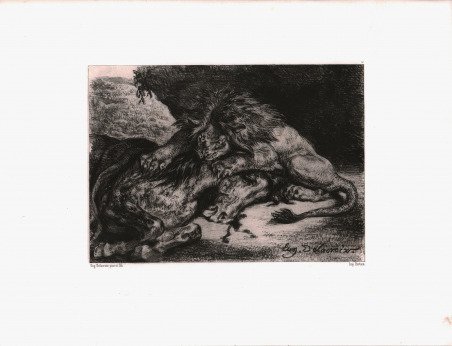
Leone che divora un cavallo arabo
Leone che divora un cavallo arabo | Gravures | DELACROIX Ferdinand Victor Eugene
Mode de Paiement
- PayPal
- Carte bancaire
- Virement bancaire
- Pubblica amministrazione
- Carta del Docente
Détails
- Année
- 1844
- Format
- 265 X 190
- Graveurs
- DELACROIX Ferdinand Victor Eugene
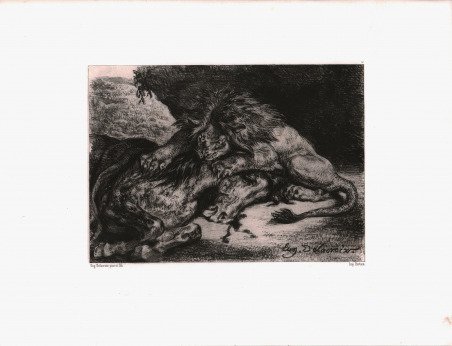
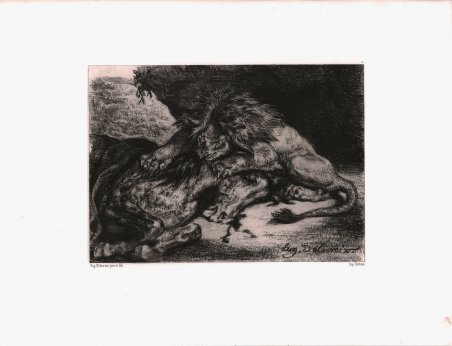
Description
Litografia, 1844, firmata all'interno dell'immagine in basso a destra: "Eug. Delacroix. "; numerata in alto a destra: "17"; in basso, sotto l’immagine: "Eug. Delacroix pinx et lith." e "Imp.Bertauts."; al centro timbro a secco: "LES ARTISTES CONTEMPORAINS". Quarto stato, di cinque. Stampato da Bertauts, Parigi. Pubblicato da Goupil, Vibert & Cie, Parigi per Les Artistes contemporains. In ottimo stato di conservazione La scena raffigura un leone che attacca il corpo di un cavallo nei pressi di una grotta rocciosa. Solo la parte anteriore del cavallo è mostrata, distesa su un fianco a terra. Il leone si accovaccia sopra il cavallo e preme con le zampe anteriori, con gli artigli sfoderati, mentre affonda i denti nel collo del cavallo. C'è un'espressione feroce e selvaggia sul volto del leone. La scena è ambientata in un paesaggio roccioso indefinito. Delacroix viaggiò in Nord Africa nel 1832, visitando il Marocco e l'Algeria - una visita che alimentò il suo interesse per le culture non europee. L'interesse per i luoghi esotici affascinò gli europei e coincise con l'ascesa del turismo; i pittori (molti dei quali non lasciarono mai l'Europa) raffigurarono luoghi lontani e ambienti culturali diversi, compresi gli harem. La ferocia scatenata degli animali selvaggi - in particolare i grandi felini - stimolò l’immaginazione di Delacroix: scene come questa di un leone che attacca un cavallo figurano spesso nella sua produzione artistica. Eugène Delacroix (Charenton-Saint-Maurice ' 1798 ' - ' Parigi ' 1863), è il maggiore pittore romantico francese: la sua opera ' segna una svolta decisiva nella storia della pittura e apre la strada alle correnti realiste ed espressioniste. Allievo di P.-N. Guérin, nel cui studio conobbe Géricault, si formò soprattutto studiando al Louvre le opere di P. P. Rubens e di P. Veronese. Grande fu l'impulso dato alla sua fantasia dalla lettura di Shakespeare, Goethe, Byron e W. Scott. Nel 1825 Delacroix compiva un viaggio in Inghilterra, e qui era impressionato da Turner e da Constable e specialmente si stringeva d'amicizia con R. Bonington, che lo seguiva a Parigi. La Morte di M. Falier, sotto l'impressione della grande pittura veneziana, è ispirata al Byron. Nel 1827 il Salon presentò a fronte J.-D. Ingres, capo della corrente classicheggiante, e il Delacroix, capo della corrente romantica (questi vi espose, tra l'altro, la Morte di Sardanapalo). Le guerre per l'indipendenza ellenica avevano suscitato in Delacroix un profondo interesse per il mondo orientale, cui egli si rivolgeva anche attraverso notevoli studi di miniature persiane. Egli conobbe direttamente l'Oriente soltanto nel 1832 (viaggio in Marocco), e ne riportò un'impressione immediata, che introdusse il mondo islamico nella pittura francese come tema pittorico attuale, di ambiente e di paesaggio, e non soltanto come suggestione letteraria e fantastica. Fu, questo viaggio, uno dei rari avvenimenti della vita del Delacroix (il viaggio in Italia, accarezzato in gioventù, non fu mai compiuto) che fu interamente dedicata alla pittura, sì che il catalogo della sua opera elenca ben 9140 lavori. Grande amico del Delacroix fu Ch. Baudelaire, che all'amico pittore dedicò le pagine più belle della sua prosa critica. Enormi furono la fama del Delacroix e le ripercussioni delle sue opere, esposte regolarmente nei Salons parigini, per molti anni. Bibliografia Delteil, Le Peintre-Graveur Illustré (XIXe et XXe siècles), 126, IV/V. Lithograph, 1844, signed within the image: "Eug. Delacroix. "; lettered: "17" and with production line: "Eug. Delacroix pinx et lith." and "Imp.Bertauts."; blindstamped: "LES ARTISTES CONTEMPORAINS" Fourth state, of five. Printed by Bertauts, Paris. Published by Goupil, Vibert & Cie., Paris for ' Les Artistes contemporains, with the blind stamp. The scene depicts a male lion attacking the body of a horse near a rocky cave. Only the front portion of the horse is shown, lying on its side on the ground. The lion crouches above the horse and presses down with its front paws, claws extended, as it sinks its teeth into the horse's neck. There is a fierce, wild eyed expression on the lion's face. The scene is set in an undefined rocky landscape. Delacroix traveled to North Africa in 1832, visiting Morocco and Algeria--a visit that fueled his interest in non-European cultures. The interest in exotic locales fascinated Europeans and coincided with the rise of tourism; painters (many of whom never left Europe) depicted distant places and different cultural settings, including harems. For the sophisticated and urbane Delacroix, the unleashed ferocity of wild animals--particularly the big cats--stirred his imagination. Scenes such as this of a lion attacking a horse figured frequently in Delacroix's art. Eugène Delacroix (Charenton-Saint-Maurice ' 1798 ' - ' Parigi ' 1863), french painter, draughtsman and lithographer, was one of the towering figures of the Romantic movement and one of the last major artists to devote a large part of his career to mural painting in the heroic tradition. Lorenz Eitner (An Outline of 19th Century European Painting, 1987) describes him as ‘the last great European painter to use the repertory of humanistic art with conviction and originality. In his hands, antique myth and medieval history, Golgotha and the Barricade, Faust and Hamlet, Scott and Byron, tiger and Odalisque yielded images of equal power.’ He was the son of a diplomat, Charles Delacroix, who at the time of his son's birth was ambassador in The Hague, but it has been suggested that his natural father was the great statesman Talleyrand, a friend of the family. His mother, Victoire Oeben, was the daughter of Jean-François Oeben, one of the most distinguished furniture makers of his day. Delacroix had a good education and grew up with a love of literature and music as well as art. In 1815 he began studying with Pierre-Narcisse Guérin, who had earlier taught Géricault (whose work greatly influenced Delacroix), and the following year he enrolled at the École des Beaux-Arts. His real artistic education, however, was gained by copying Old Masters in the Louvre, where he delighted particularly in Rubens and the 16th-century Venetian painters. Throughout his life he remained a keen and perceptive student of his predecessors, and Rubens—with his richness of imagination, warmth of colour, and enormous energy—was a constant source of inspiration. In 1822 his career was brilliantly launched when his first submission to the Salon, the Barque of Dante (Louvre, Paris), a melodramatic scene from Dante's Inferno, was the talking point of the exhibition and was bought by the state. Two years later he had another success at the Salon with the Massacre at Chios (Louvre), inspired by a recent Turkish atrocity in the Greek War of Independence. It aroused much hostile criticism (Gros, who had admired the Barque of Dante, called it ‘the massacre of painting’), but it was awarded a gold medal and once again was bought by the state (with Talleyrand perhaps pulling strings in the background). References Delteil, Le Peintre-Graveur Illustré (XIXe et XXe siècles), 126, IV/V. Cfr.