Paesaggio fluviale
Paesaggio fluviale | Gravures | DUPERAC Etienne
Paesaggio fluviale
Paesaggio fluviale | Gravures | DUPERAC Etienne
Mode de Paiement
- PayPal
- Carte bancaire
- Virement bancaire
- Pubblica amministrazione
- Carta del Docente
Détails
- Année
- 1559
- Format
- 374 X 242
- Graveurs
- DUPERAC Etienne
Description
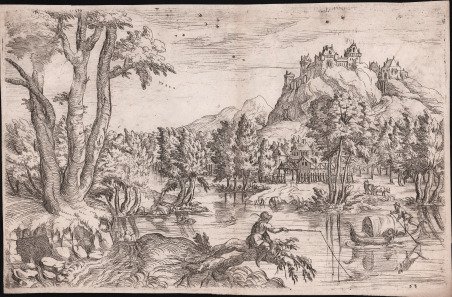
Acquaforte, 1559 circa, firmata in lastra in basso a destra con le iniziali D.B. Molto controversa la storia di questa incisione, che attribuiamo per chiari motivi stilistici e per affinità con altri anonimi analoghi paesaggi, al bordolese Etienne Duperac. L’opera appartiene alla serie dei Paesaggi con soggetti mitologici relativa al breve periodo veneziano del Duperac, con le influenze derivanti dalla pittura di Tiziano. Di estremo interesse, sono realizzate all'acquaforte con tratti che ricordano lo stile degli incisori della scuola di Fontainebleau. ' Il più recente studio su questa opera anonima è di Nathalie Strasser (cfr. Le Beau Style, n. 220), che ricostruisce la sua storia. In una nota sul fiammingo Dirk Barentsen, Mariette annota i seguenti dati: “D. B. su diverse tavole di paesaggio che sono classificate nell'opera di Tiziano e che credo siano incise da Thiery Bernard, in fiammingo Dieterich Barent. Aveva soggiornato a lungo a Venezia ed era stato discepolo di Tiziano, nel quale questo grande pittore aveva la massima fiducia.” Ma questo artista non sembra aver inciso da solo. Per questo Nagler attribuisce questo paesaggio a Dominique Barrière, un allievo di Claude Lorrain. Questa proposta, che collocherebbe l'incisione nella seconda metà del XVII secolo, ci sembra difficile da accettare. Catelli Isola attribuì la stampa a Hieronimus Cock e la incluse nella "serie di 14 tavole che rappresentano paesaggi con scene bibliche e mitologiche" di ispirazione tizianesca. La Strasser classifica l’opera quale anonima, ritenendo comunque la sua origine italiana, in quanto l’esemplare esaminato mostrava la filigrana del “giglio nel singolo cerchio” (Woodward 98) di chiara fattura italica. Tuttavia, sebbene non classificata tra le 87 incisioni attribuite al Duperac da Robert-Dumesnil, non sembrano esserci dubbi sulla sua assegnazione all’artista francese. Nel suo breve soggiorno veneziano, prima di partire per Roma dove divenne il principale esponente delle rappresentazioni archeologiche delle antiche vestigia romane, Duperac collaborò o incise per conto dell’editore asolano Giovanni Francesco Camocio. Di questa serie di paesaggi di ispirazione tizianesca alcuni, anonimi, recano l’indirizzo Apud Camocium. Camocio, era proprietario della libreria Al segno della Piramide a San Lio in Merceria, dove la sua attività principale era la vendita di stampe ed incisioni, riproduzioni calcografiche di opere d’arte e carte geografiche. Scomparve con la pestilenza a Venezia del 1575, e le sue matrici vennero acquisite dalla tipografia rivale di Donato Bertelli, come dimostrano il celebre Isolario di Camocio, ristampato poi da Bertelli e le numerose altre opere di carattere cartografico che Donato ristampa utilizzando le lastre di Camocio. Pertanto, ci sembra altamente plausibile che le “misteriose” iniziali D.B. di questa opera possano essere l’imprint editoriali di Donato Bertelli; iniziali che l’editore usava per numerose opere cartografiche (cfr. Bifolco-Ronca, Cartografia e topografia italiana del XVI secolo, 2018). Dal punto di vista della composizione, la probabile influenza di Tiziano si nota qui, soprattutto nel modo in cui il sito è disposto in ampie diagonali (al motivo vegetale a sinistra corrisponde un motivo roccioso a destra), il punto di vista abbassato che tende a chiudere la composizione sullo sfondo, e il carattere decisamente pastorale della scena paesaggistica che, tuttavia, ha una qualità artificiale che la avvicina alle piccole composizioni puramente immaginarie della seconda metà del XVI secolo: qui l'artista combina motivi architettonici eclettici (il castello in stile nordico, il mulino, la cascina a graticcio) con una natura che esprime una diversità più intellettuale che reale. D'altra parte, i personaggi che popolano la scena, pescatori, cacciatori e lavandaie, sono qui descritti nelle loro attività ordinarie. L'incisore predilige l'uso di linee brevi e rapide . Etching, 1559 circa, signed on the plate in the lower right corner with the initials D.B. The history of this etching is very controversial. We attribute it, for clear stylistic reasons and for affinity with other similar anonymous landscapes, to Etienne Duperac from Bordeaux. The work belongs to the series of Landscapes with mythological subjects related to Duperac's brief Venetian period, with influences derived from Titian's painting. Of extreme interest, they are made in etching with strokes that recall the style of the engravers of the school of Fontainebleau. The most recent study of this anonymous work is by Nathalie Strasser (see Le Beau Style, no. 220), who reconstructs its history. In a note about the Flemish Dirk Barentsen, Mariette retains the following data: "D. B. on several plates of landscapes which one arranges in the work of Titian and which I believe serious by Thiery Bernard, in Flemish Dieterich Barent. He had stayed in Venice for a long time and had been the disciple of Titian, in whom this great painter had the most confidence." But this artist does not seem to have engraved himself. For this reason Nagler attributes the present country view to Dominique Barrière, a pupil of Claude Lorrain. This proposal, which would place the execution of the piece in the second half of the XVII century, seems to us difficult to accept. Catelli Isola gives the print to Cock and includes it in a "series of 14 plates representing landscapes with biblical and mythological scenes" of Titian inspiration. ' Strasser classifies the work as anonymous, believing it to be of Italian origin, since the exemplar examined showed the watermark of the "lily in the single circle" (Woodward 98) of clear Italic manufacture. However, although not classified among the 87 engravings attributed to Duperac by Robert-Dumesnil, there seems to be no doubt about its assignment to the French artist. During his brief stay in Venice, before leaving for Rome where he became the leading exponent of archaeological representations of ancient Roman remains, Duperac collaborated or engraved on behalf of the Asolo publisher Giovanni Francesco Camocio. Of this series of landscapes of Titian inspiration some, anonymous, bear the address Apud Camocium. Camocio was the owner of the bookshop Al segno della Piramide in San Lio in Merceria, where his main activity was the sale of prints and engravings, intaglio reproductions of works of art and maps. He disappeared with the plague in Venice in 1575, and his plates were acquired by the rival typography of Donato Bertelli, as evidenced by the famous Isolario by Camocio, later reprinted by Bertelli, and the many other works of cartographic character that Donato reprinted using the plates of Camocio. Therefore, it seems to us highly plausible that the "mysterious" initials D.B. of this work may be the editorial imprint of Donato Bertelli; initials that the publisher used for numerous cartographic works (cf. Bifolco-Ronca, Cartografia e topografia italiana del XVI secolo, 2018). ' The probable influence of Titian can be seen here, above all, in the way the site is organized in large diagonals (the plant motif on the left is matched by a rock motif on the right), the lowered viewpoint that tends to close off the composition in the background, and the resolutely pastoral character of the scene. The landscape scene, however, has an artificial quality that brings it closer to the small, purely imaginary compositions of the second half of the sixteenth century: here the artist combines eclectic architectural motifs (the Nordic-style castle, the mill, the half-timbered farmhouse) with a nature that expresses a diversity that is more intellectual than real. On the other hand, the characters who populate the scene, fishermen, hunters and washerwomen, are described here in their ordinary activities. The engraver is fond of using short and expeditious lines that he distributes freely, as one would when handling a pen. A. Cfr.