Paesaggio Romano
Paesaggio Romano | Gravures | SWANEVELT Herman van
Paesaggio Romano
Paesaggio Romano | Gravures | SWANEVELT Herman van
Mode de Paiement
- PayPal
- Carte bancaire
- Virement bancaire
- Pubblica amministrazione
- Carta del Docente
Détails
- Année
- 1650
- Format
- 280 X 175
- Graveurs
- SWANEVELT Herman van
Description
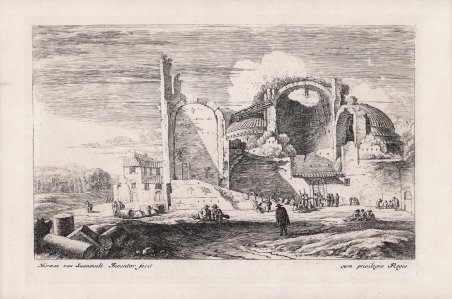
Acquaforte, 1650 circa, firmata in basso a sinistra “Herman van Svanevelt Inventor fecit”; in basso a destra “cum privilegio Regis”. Secondo stato finale.Buon esemplare, impresso su carta vergata coeva, con margini, in ottimo stato di conservazione.La tavola, raffigurante le suore che distribuiscono il pane ai poveri di fronte ad alcune rovine romane, una colonna spezzata in primo piano a sinistra. Appartiene alla serie di Dodici Paesaggi d’Italia. Herman van Swanevelt, detto Herman d'Italie (Woerden, 1603 – Parigi, 1655), è stato un pittore, disegnatore e incisore olandese. Produsse anche un gran numero di incisioni di alta qualità, che (come nel caso di Rembrandt), accrebbero la sua fama sia tra i contemporanei che tra i posteri. Secondo alcuni studiosi, le sue incisioni sono addirittura molto superiori ai dipinti, a causa del prevalere in questi di una fredda tonalità verde nei primi e medi piani e per essere gli ultimi troppo pesanti, scuri e cupi. Aveva un modo particolare di incidere: si esprimeva con tratti orizzontali un po' curvi. Evidenziava poco i contorni, se non per distinguere le masse. Utilizzava la punta secca e maggiormente il bulino, per dare armonia. Lasciò inoltre parecchi disegni, spesso studi preparatori per i suoi dipinti, anch'essi di ottima fattura. Bibliografia Hollstein, Dutch and Flemish etchings, engravings and woodcuts c.1450-1700 (97.II); Bartsch, Le Peintre graveur , 93. Etching, 1650 circa, signed at lower left “Herman van Svanevelt Inventor fecit” and inscribed at lower right “cum privilegio Regis”. Second state, of two.Good example, printed on contemporary laid paper, with margins, in good condition.This plate belongs to a series of Twelve Landscapes, and shows nuns distributing bread to the poor in front of the ruins of a large Roman basilica; a broken column in left foreground. Herman van Swanevelt, known as Herman d'Italie (Woerden, 1603 - Paris, 1655), was a Dutch painter, draughtsman and engraver. He also produced a large number of high-quality engravings, which (as in the case of Rembrandt), increased his fame among both his contemporaries and posterity. According to some scholars, his etchings are even far superior to the paintings, due to the prevalence in these of a cold green hue in the foreground and middle ground and for being the latter too heavy, dark, and gloomy. He had a peculiar way of engraving: he expressed himself with somewhat curved horizontal strokes. He emphasized contours little, except to distinguish masses. He used the dry point and more the burin, to give harmony. He also left several drawings, often preparatory studies for his paintings, which were also of excellent workmanship. Bibliografia Hollstein, Dutch and Flemish etchings, engravings and woodcuts c.1450-1700 (97.II); Bartsch, Le Peintre graveur , 93. Cfr.