Rhetorica
Rhetorica | Gravures | CORT Cornelis
Rhetorica
Rhetorica | Gravures | CORT Cornelis
Mode de Paiement
- PayPal
- Carte bancaire
- Virement bancaire
- Pubblica amministrazione
- Carta del Docente
Détails
- Année
- 1565
- Format
- 282 X 227
- Graveurs
- CORT Cornelis
Description
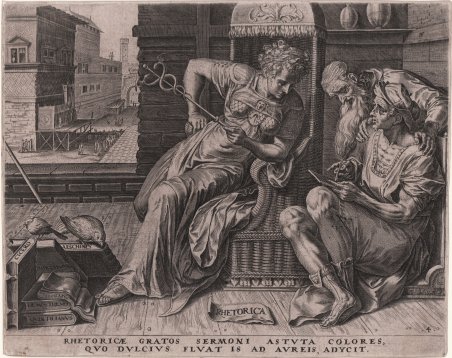
Allegoria della Retorica, rappresentata come una donna seduta, con in mano un caduceo, che si china e dialoga con un uomo seduto che scrive su una tavoletta. Un uomo anziano con la barba lunga appoggia le mani sulla spalla dello studioso più giovane; due uccelli, tra cui un pappagallo, siedono su una pila di libri di autori classici (Cicerone, Quintiliano, Eschilo, Demostene, Socrate). ' Bulino, 1565, della serie Le sette Arti Liberali, da dipinti di Frans Floris; incise da Cornelis Cort e pubblicate da Hieronimus Cock. In alto a destra “FF”. In basso a destra “4”. Due righe a margine “RHETORICÆ GRATOS . ADYCIT”. Questa è una delle sette tavole di Frans Floris incise da Cornelis Cort (New Hollstein 197-203). Si tratta di una serie perduta di dipinti di Floris per la villa del mercante e collezionista d'arte Nicolaas Jongelinck, a Markgravelei, alle porte di Anversa. Dipinti andati perduti che furono esportati a Genova. I disegni preparatori furono forse realizzati dall'allievo di Floris, Simon Jansz Kies. La retorica, l’arte del parlare e dello scrivere in modo ornato ed efficace; sorta nella Grecia antica con i sofisti, con finalità prevalentemente pragmatiche, come tecnica del discorso teso a persuadere (fu quindi applicata all’oratoria giudiziaria), si viene successivamente ampliando nell’età classica e poi medievale e rinascimentale a tecnica del discorso sia orale sia scritto, con finalità anche estetiche, secondo un sistema di regole in cui fu organizzata dapprima da Aristotele, poi dalla trattatistica latina d’età classica (Cicerone, Quintiliano) e tarda (Marziano Capella, Boezio). Nel medioevo la retorica, la grammatica e la dialettica (la quale ultima ha per scopo la dimostrazione non la persuasione) costituivano le tre arti liberali (arti del trivio, in lat. artes sermocinales), distinte dalle quattro arti reali (arti del quadrivio, in lat. artes reales), l’aritmetica, la geometria, la musica e l’astronomia. Dopo una progressiva decadenza nell’età moderna, dovuta alla rivalutazione dei contenuti espressivi, la retorica ha riacquistato uno spazio rilevante nella linguistica e nella critica letteraria contemporanea, come teoria dell’argomentazione e come analisi delle realizzazioni lessicali, grammaticali e stilistiche, di testi scritti o anche orali, e delle loro funzioni espressive. “Like The Labours of Hercules, The Seven Liberal Arts relates to a series of paintings Frans Floris produced in the mid-1550s for the new suburban home of the Antwerp collector Nicolas Jonghelinck. Following the dictates of Martianus Capella's encyclopaedic work De nuptiis Philologiae et Mercurii (On the Marriage of Philology and Mercury), Floris depicted cach liberal art as a female personification instructing figures around her in the practice of the art she embodies. The marginal inscriptions, probably composed by Dominicus Lampsonius, emphasize how each Liberal Art contributes to the advancement of knowledge. The paintings of The Seven Liberal Arts, along with the painting Adam and Eve Lamenting the Death of Abel , were exported to Genoa early in the seventeenth century. In those paintings, as in the prints, books were arranged to show the names of famous philosophers or theorists according to their order in Conrad Gesner's great Bibliotheca Universalis of 1545. It is likely that the room in which these pictures were installed was Jonghelinck's library, real or imagined, with these tomes suggestive of the works that a merchant with humanistic aspirations might hope to possess” (cf. Edward Wouk, in J. van Grieken - G. Luijten - J. van der Stock, "Hieronymus Cock: The Renaissance in Print", exh.cat. Royal Library of Belgium in Brussels and Fondation Custodia in Paris, New Haven and London, 2013, cat.no.44). Magnifica prova, impressa su carta vergata coeva, rifilata al rame, in ottimo stato di conservazione. Bibliografia Edward Wouk, in J. van Grieken - G. Luijten - J. van der Stock,. Rhetoric, a seated woman, holding a caduceus, leans over and engages with a seated man writing on a tablet; an elderly man with a long beard places his hands on the shoulder of the younger scholar; two birds, including a parrot, sit on a pile of books labelled "CICERO" etc on the ground. Engraving, 1565, after Frans Floris. Lettered upper right "FF". Below right "4". Two lines in the margin "RHETORICÆ GRATOS . ADYCIT". This is one from a series of seven plates after Frans Floris, engraved by Cornelis Cort (New Hollstein 197-203). After a lost series of paintings by Floris for the villa of merchant and art-collector Nicolaas Jongelinck, in Markgravelei, just outside of Antwerp; after which they were exported to Genoa. The preparatory drawings were possibly made by Floris's pupil Simon Jansz Kies. “Like The Labours of Hercules, The Seven Liberal Arts relates to a series of paintings Frans Floris produced in the mid-1550s for the new suburban home of the Antwerp collector Nicolas Jonghelinck. Following the dictates of Martianus Capella's encyclopaedic work De nuptiis Philologiae et Mercurii (On the Marriage of Philology and Mercury), Floris depicted cach liberal art as a female personification instructing figures around her in the practice of the art she embodies. The marginal inscriptions, probably composed by Dominicus Lampsonius, emphasize how each Liberal Art contributes to the advancement of knowledge. The paintings of The Seven Liberal Arts, along with the painting Adam and Eve Lamenting the Death of Abel , were exported to Genoa early in the seventeenth century. In those paintings, as in the prints, books were arranged to show the names of famous philosophers or theorists according to their order in Conrad Gesner's great Bibliotheca Universalis of 1545. It is likely that the room in which these pictures were installed was Jonghelinck's library, real or imagined, with these tomes suggestive of the works that a merchant with humanistic aspirations might hope to possess” (cf. Edward Wouk, in J. van Grieken - G. Luijten - J. van der Stock, "Hieronymus Cock: The Renaissance in Print", exh.cat. Royal Library of Belgium in Brussels and Fondation Custodia in Paris, New Haven and London, 2013, cat.no.44). Engraving, printed on contemporary laid paper, trimmed on the platemark, in good condition. Bibliografia Edward Wouk, in J. van Grieken - G. Luijten - J. van der Stock, "Hieronymus Cock: The Renaissance in Print", n. 44; The New Hollstein: Dutch and Flemish etchings, engravings and woodcuts 1450-1700, n. 133.I; Bierens de Haan, L'oeuvre gravé de Cornelis Cort, graveur hollandais 1533-1578, n. 227; Van de Velde, Frans Floris (1519/20-1570), Leven en Werken, 120; Riggs, Hieronymus Cock, Printmaker and Publisher, n. 81; Wouk, Frans Floris (1519/20-1570): Imagining a Northern Renaissance, n. 133. Cfr.