Ritratto maschile
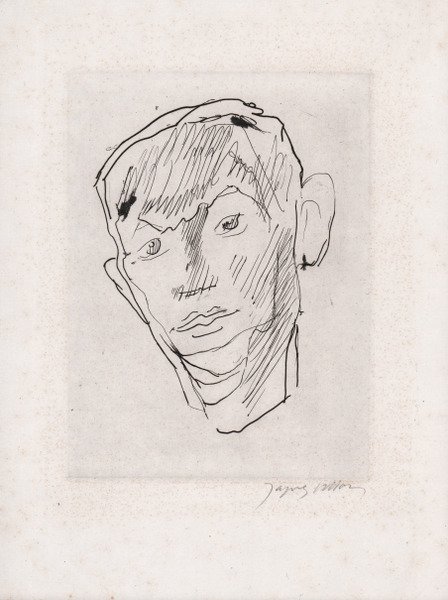
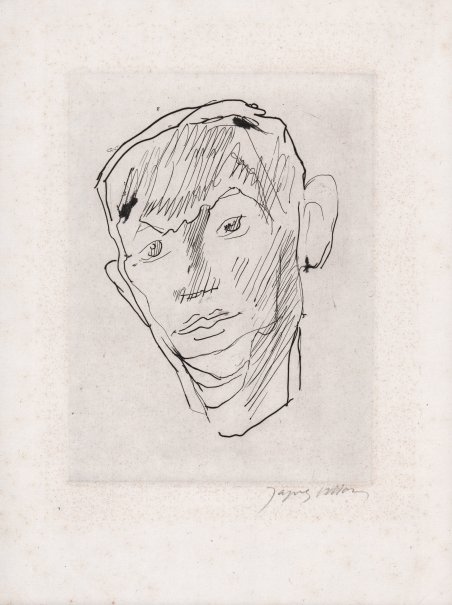
Ritratto maschile
Mode de Paiement
- PayPal
- Carte bancaire
- Virement bancaire
- Pubblica amministrazione
- Carta del Docente
Détails
- Année
- 1956
- Format
- 160 X 215
- Graveurs
- VILLON Jacques
Description
Acquaforte, 1956 circa, impressa su carta Cina bianca, firmata a matita in basso a destra Jacques Villon. Tiratura in bianco e nero. Prova di stampa per l’opera, stampata su carta filigranata Arches, che verrà pubblicata nel libro Laus Veneris di Algernon Charles Swinburne, stampato a Parigi G. Leblanc, imprimeur; Manuel Bruker, éditeur, Paris 1956 con tiratura di 150 esemplari numerati. L’opera contiene 10 incisioni di Jacques Villon; il presente ritratto costituisce la prima delle tavole, ma è terminato ad acquatinta a colori e non firmato a matita dalll’artista. Il catalogo ragionato dell’opera grafica di Villon, non contempla esemplari di questa opera firmati dall’artista: “Texte de Swinburne, traduction de Vielé-Griffin, illustré de 10 fortes tirées sur fond de couleur, dont 6 hors-texte. Ces eaux-fortes ont été gravées en collaboration avec Fiorini. De cet ouvrage imprimé sur vélin d'Arches à la forme il a été tiré 150 exemplaires numérotés de 1 à 150. Aux 15 premiers exemplaires il a été joint une suite complète sur Japon impérial et une suite en noir sur Chine. Il a été tiré en outre 20 exemplaires numérotés de I à XX avec une suite en noir sur Chine appliqué et la décomposition du frontispice, pour les Bibliophiles de l'Etoile, et hors commerce, sur papier impérial, 6 exemplaires marqués des lettres A à F avec une suite sur Montval en sanguine, une suite sur Chine en noir et une suite complète sur papier nacre” (cfr. Colette de Ginestet et Catherine Pouillon, Jacques Villon: Les Estampes et les Illustrations, Catalogue Raisonné, p. 426). Jacques Villon è lo pseudonimo del pittore e incisore Gaston Duchamp (Damville, Eure, 1875 - Puteaux, Parigi, 1963), fratello di R. Duchamp-Villon e di M. Duchamp. In una prima fase della produzione artistica Villon elaborò un linguaggio originale che fonde suggestioni fauves a una personale interpretazione delle istanze cubist, mentre successivamente le sue esperienze pittoriche si volsero allo studio della luce. Si dedicò giovanissimo all'incisione seguendo l'insegnamento del nonno, pittore e incisore, Émile Nicolle. Dopo gli studi secondari, si stabilì, nel 1894, a Parigi dove, scelto lo pseudonimo dal poeta preferito, François Villon, collaborò con disegni e incisioni di accento impressionista a giornali satirici (Chat noir, Gil Blas, L'assiette au beurre) ed eseguì serie di manifesti per cabarets. Dalla scansione geometrica di piani realizzata attraverso modulazioni cromatiche tra il 1919 e il 1922, giunse gradualmente all'astrazione. Seguì un periodo di difficoltà economiche durante il quale l'artista fu costretto ad abbandonare quasi completamente la pittura e a dedicarsi alla riproduzione in incisione di opere di artisti moderni per una galleria parigina. Tornato dal 1930 a dipingere, Villon si dedicò in particolare allo studio della luce elaborando opere segnate da una più complessa orchestrazione cromatica di gamme pure. Bellissimo esemplare di questa rara prova. Bibliografia Colette de Ginestet et Catherine Pouillon, Jacques Villon: Les Estampes et les Illustrations, Catalogue Raisonné, pp. 426-427, App. 1. Etching, circa 1956, impressed on white China paper, signed in pencil at lower right Jacques Villon. Proof for the work, printed on Arches watermarked paper, which will be published in the book Laus Veneris by Algernon Charles Swinburne, printed in Paris by Manuel Bruker in 1956, with a print issue of 150 numbered copies. The work contains 10 etchings by Jacques Villon; the present portrait constitutes the first of the plates, but it is finished in aquatint in color and not signed in pencil by the artist. ' The catalog raisonné of Villon's graphic work, does not include examples of this work signed by the artist: “Texte de Swinburne, traduction de Vielé-Griffin, illustré de 10 fortes tirées sur fond de couleur, dont 6 hors-texte. Ces eaux-fortes ont été gravées en collaboration avec Fiorini. De cet ouvrage imprimé sur vélin d'Arches à la forme il a été tiré 150 exemplaires numérotés de 1 à 150. Aux 15 premiers exemplaires il a été joint une suite complète sur Japon impérial et une suite en noir sur Chine. Il a été tiré en outre 20 exemplaires numérotés de I à XX avec une suite en noir sur Chine appliqué et la décomposition du frontispice, pour les Bibliophiles de l'Etoile, et hors commerce, sur papier impérial, 6 exemplaires marqués des lettres A à F avec une suite sur Montval en sanguine, une suite sur Chine en noir et une suite complète sur papier nacre” (cfr. Colette de Ginestet et Catherine Pouillon, Jacques Villon: Les Estampes et les Illustrations, Catalogue Raisonné, p. 426). ' Jacques Villon is the pseudonym of the painter and engraver Gaston Duchamp (Damville, Eure, 1875 - Puteaux, Paris, 1963), brother of R. Duchamp-Villon and M. Duchamp. In a first phase of artistic production Villon developed an original language that blends suggestions of Fauves to a personal interpretation of Cubist instances, while later his pictorial experiences turned to the study of light. At a very young age he dedicated himself to engraving following the teaching of his grandfather, painter and engraver, Émile Nicolle. After secondary studies, he settled in Paris in 1894, where he chose the pseudonym of his favorite poet, François Villon, collaborated with drawings and engravings of impressionist accent to satirical newspapers (Chat noir, Gil Blas, L'assiette au beurre) and performed series of posters for cabarets. From the geometric scanning of plans realized through chromatic modulations between 1919 and 1922, he gradually reached abstraction. This was followed by a period of economic difficulties during which the artist was forced to abandon painting almost entirely and to devote himself to the reproduction in engraving of works by modern artists for a Parisian gallery. Returning to painting in 1930, Villon dedicated himself in particular to the study of light, developing works marked by a more complex chromatic orchestration of pure ranges. Beautiful example of this rare work. ' Bibliografia Colette de Ginestet et Catherine Pouillon, Jacques Villon: Les Estampes et les Illustrations, Catalogue Raisonné, pp. 426-427, App. 1. Cfr.
