Santa Cecilia rifiuta di venerare la statua di Giove
Santa Cecilia rifiuta di venerare la statua di Giove | Gravures | ROSA Francesco
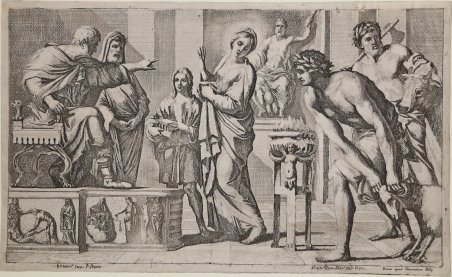
Santa Cecilia rifiuta di venerare la statua di Giove
Santa Cecilia rifiuta di venerare la statua di Giove | Gravures | ROSA Francesco
Mode de Paiement
- PayPal
- Carte bancaire
- Virement bancaire
- Pubblica amministrazione
- Carta del Docente
Détails
- Année
- 1670
- Format
- 370 X 227
- Graveurs
- ROSA Francesco
Description
Acquaforte, 1670 circa, in basso a sinistra: ' Domini.s Inv. P. Romae; a destra: ' fran.s Rosa Rom.s Del. Scv. ' Esemplare nel secondo stato di due con l’indirizzo dell’editore Vincenzo Billy aggiunto nel margine inferiore, a destra: ' Romae apud Vincentium Billy. Questa incisione è un'immagine speculare del dipinto del Domenichino nella chiesa di S. Luigi dei Francesi a Roma. Magnifica prova , ricca di contrasto, impressa su carta vergata coeva con filigrana “stella nel doppio cerchio”,rifilata al rame, in eccellente stato di conservazione. Molto rara. Francesco Rosa nacque a Roma il 25 novembre 1638. Le principali informazioni biografiche si ricavano dall’anonima Vita di Francesco Rosa, aggiunta alle Vite de’ pittori, scultori e architetti viventi di Lione Pascoli, fonte che ha permesso di chiarire definitivamente gli equivoci relativi alla biografia e alla produzione artistica di Rosa dovuti alla sua sovrapposizione con l’omonimo pittore genovese (Genova, 1635-40 circa - Venezia, 1710) e con il napoletano Pacecco de Rosa (Napoli, 1607-1656). ' Dalla Vita pascoliana si apprende come il giovane Francesco «sino all’età di dodici anni», quando rimase orfano di entrambi i genitori, frequentò il Collegio romano, dove conobbe Pier Filippo Bernini, figlio del celebre artista. Dopo una prima formazione con il non altrimenti noto «Placido Palermitano», Rosa entrò nella bottega di Giovanni Angelo Canini, attraverso il quale sviluppò il proprio interesse per la pittura classicista e si avvicinò alle tecniche incisorie. A questi stessi anni risale la frequentazione dell’anziano Nicolas Poussin, dal quale apprese a comporre erudite scene di soggetto storico-letterario. L’opinione artistica sulla qualità delle poche acqueforti di Rosa è negativa. Bartsch, oltre a segnalare l’errata morsura in due acqueforti, osserva che queste opere sono così ingenue da escludere la possibilità che Rosa fosse un pittore. Negativa è anche l'opinione espressa da Nagler nel suo Künstler-Lexikon. Francesco Rosa mostra affinità di soggetto con Annibale Carracci e Domenichino. Probabilmente, non si avvaleva di uno stampatore professionista e gli errori di morsura citati da Bartsch, che sono evidenti nelle sue opere, lasciano credere che le abbia stampate lui stesso. In due casi, tuttavia, le sue incisioni ebbero una seconda tiratura: con il parigino Bertrand Le Sieur e, con questa Santa Cecilia, con Vincenzo Billy a Roma. Le stampe di Francesco Rosa sono piuttosto rare; si distinguono per il loro stile molto personale e mostrano il tentativo di tradurre in stampa gli effetti chiaroscurali tipici della pittura. Bibliografia P. Bellini, ' F. R., in ' The Illustrated Bartsch, XLVII, New York 1987, pp. 133-137; ' Le Blanc C., Manuel De L'amateur D'estampes, 3; Nagler G.K., Neues Allgemeines Künstler-Lexikon, 3. Etching, 1670 circa, inscribed at lower left, in the margin: Domini.s Inv. P. Romae; at lower right, in the margin: fran.s Rosa Rom.s Del. Scv. ' Example in the second state of two, with the address of Vincenzo Billy added at lower right: Romae apud Vincentium Billy. This etching is a mirror image of a painting by Domenichino in the churgh of S. Luigi dei Francesi in Rome. Excellent work, rich in shades, printed on contemporary laid paper with “double encircled star” watermark, trimmed close to platemark, in very good condition. Extremely rare. Francesco Rosa was born in Rome on November 25, 1638. The main biographical information is obtained from the anonymous Vita di Francesco Rosa, added to Lione Pascoli's Vite de' pittori, scultori e architetti viventi, a source that has made it possible to clarify once and for all the misunderstandings regarding Rosa's biography and artistic production due to his overlap with the Genoese painter of the same name (Genoa, c. 1635-40 - Venice, 1710) and with the Neapolitan Pacecco de Rosa (Naples, 1607-1656). ' From the Vita pascoliana we learn how the young Francesco “until the age of twelve,” when he was orphaned of both parents, attended the Roman College, where he met Pier Filippo Bernini, son of the famous artist. After an initial training with the not otherwise known “Placido Palermitano,” Rosa entered the workshop of Giovanni Angelo Canini, through whom he developed his interest in classicist painting and approached engraving techniques. Artistic opinion on the quality of Rosa's few etchings is negative. Bartsch, in addition to pointing out the erroneous moisture in two etchings, notes that these works are so naive as to rule out the possibility that Rosa was a painter. Also negative is the opinion expressed by Nagler in his Künstler-Lexikon. Francesco Rosa shows affinities in subject matter with Annibale Carracci and Domenichino. He probably did not employ a professional printer, and the biting errors cited by Bartsch, which are evident in his works, suggest that he printed them himself. In two cases, however, his engravings had second printings: with the Parisian Bertrand Le Sieur and, with this Santa Cecilia, with Vincenzo Billy in Rome. Francesco Rosa's prints are quite rare; they are distinguished by their very personal style and show an attempt to translate into print the chiaroscuro effects typical of painting. Bibliografia P. Bellini, ' F. R., in ' The Illustrated Bartsch, XLVII, New York 1987, pp. 133-137; ' Le Blanc C., Manuel De L'amateur D'estampes, 3; Nagler G.K., Neues Allgemeines Künstler-Lexikon, 3. Cfr. TIB, 47,06.003 II/II.