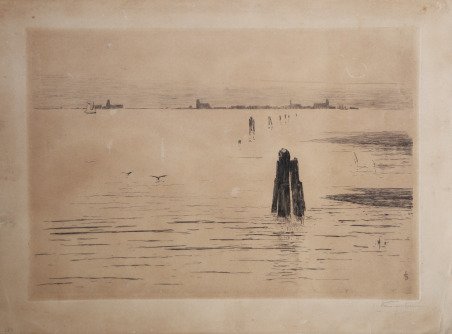
Sulla laguna
Sulla laguna | Gravures | GRAVESANDE Carel Nicolaas Storm
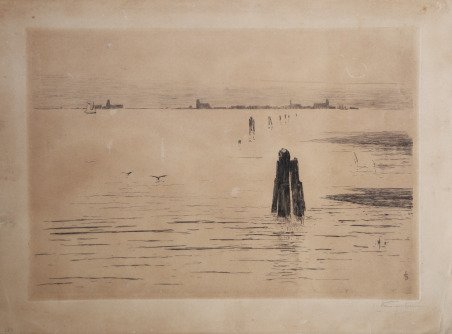
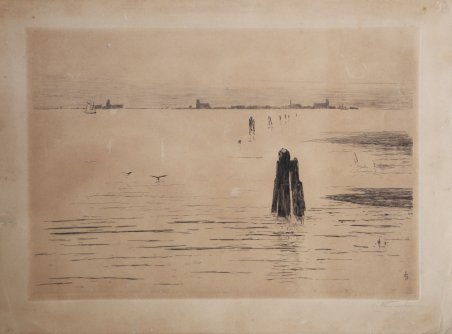
Sulla laguna
Sulla laguna | Gravures | GRAVESANDE Carel Nicolaas Storm
Mode de Paiement
- PayPal
- Carte bancaire
- Virement bancaire
- Pubblica amministrazione
- Carta del Docente
Détails
- Année
- 1900
- Format
- 400 X 280
- Graveurs
- GRAVESANDE Carel Nicolaas Storm
Description
Acquaforte, circa 1900, monogrammata in lastra in basso a destra e firmata a matita in basso a destra. Buona prova, impressa su carta coeva, con margini, diffusa ed omogenea brunitura, per il resto in buono stato di conservazione. Carel Nicolaas Storm van 's Gravesande (Breda, 21 gennaio 1841 – L'Aia, 7 febbraio 1924) è stato un pittore, incisore e litografo olandese associato alla Scuola dell'Aia. È noto soprattutto per i paesaggi marini, i ritratti di interni e le nature morte. Dopo aver conseguito la laurea in legge all'Università di Leida, contro il volere della famiglia si trasferì a Bruxelles, dove studiò con Willem Roelofs, Paul Gabriël e Félicien Rops, che gli insegnatò l'incisione. Nel 1893 tornò nei Paesi Bassi e si stabilì a L'Aia, dove divenne membro della Scuola dell'Aia. Continuò comunque a viaggiare, con soggiorni a Parigi, Wiesbaden (per due anni), Keulen e Berlino. Nel 1900 ricevette la medaglia d'oro all'Exposition Universelle. Gli viene attribuito il merito di aver contribuito a creare un rinnovato interesse per l'incisione come forma d'arte indipendente; la sua produzione grafica comprende oltre 400 incisioni, per lo più panorami e paesaggi urbani. Con Willem Witsen, è stato co-fondatore del "Nederlandse Etsclub" (Dutch Etching Club). Come litografo, si ritiene che sia stato tra i primi a utilizzare lastre di alluminio, piuttosto che pietra o zinco. Etching, circa 1900, monogrammed in plate at lower right and signed in pencil at lower right. Good proof, printed on contemporary paper, with margins, difuse oxidathion, otherwise in good condition. Carel Nicolaas Storm van 's Gravesande (21 January 1841, Breda - 7 February 1924, The Hague) was a Dutch painter, etcher and lithographer; associated with the Hague School. He is best known for seascapes, interior portraits and still-lifes. He came from an aristocratic family. Although he expressed an early interest in art, his father insisted that he study law. He did so, at the University of Leiden, and graduated in 1865. Three years later, he defied his family's wishes and moved to Brussels, where he studied with Willem Roelofs, Paul Gabriël and Félicien Rops, who taught him etching and became a lifelong friend. In 1893, he returned to the Netherlands and settled in The Hague, where he became a member of the Hague School, a group of artists who had been heavily influenced by the Barbizon School. He continued to travel, however, with stays in Paris, Wiesbaden (for two years),Cologne and Berlin. In 1900, he was awarded a gold medal at the Exposition Universelle. He is credited with helping to create a renewal of interest in etching as an independent art form and produced more than 400 etchings; mostly landscapes and cityscapes. With Willem Witsen, he was a co-founder of the "Nederlandse Etsclub" (Dutch Etching Club). As a lithographer, he is believed to have been among the first to use aluminum plates, rather than stone or zinc. ' Cfr.