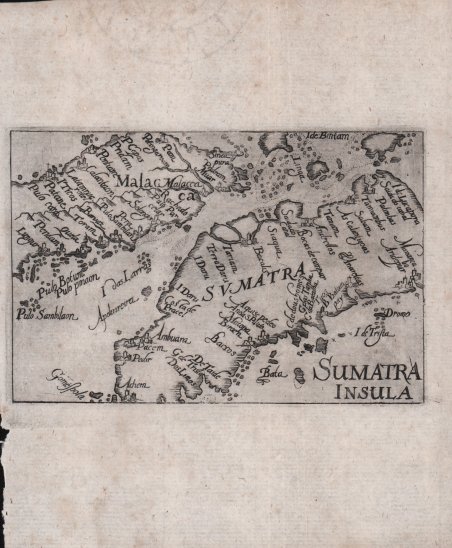
Rarissima carta di Singapore e Sumatra pubblicata nella prima edizione della traduzione tedesca di Hieronymus Megiser del famoso resoconto di viaggio di Ludovico di Varthema in Arabia, Siria, Persia, Etiopia, India e Indie Orientali. "Varthema's Itinerario, first published in 1510, had an enormous impact at the time, and in some respects determined the course of European expansion towards the Orient" (Howgego). L'edizione del 1510, pubblicata in italiano a Roma, non aveva illustrazioni. Mappa tratta da Hodaeporicon Indiae Orientalis; Das ist: Warhafftige Beschreibung der ansehnlich lobwürdigen Reyß, welche der edel, gestreng und weiterfahrne Ritter, H. Ludwig di Barthema von Bononien aus Italia bürtig, in die Orientalische und Morgenländer, Syrien, beide Arabien, Persien und Indien, auch in Egypten und Ethyopien, zu Land und Wasser persönlich verrichtet [.] stampato a Lipsia Henning Groß, 1608. Ludovico di Varthema o Barthema (ca. 1468-1517) salpò da Venezia per l'Egitto nel 1502 e viaggiò attraverso Alessandria, Beirut, Tripoli e Aleppo, arrivando a Damasco nell'aprile del 1503. Qui si arruolò nella guarnigione mamelucca e proseguì via terra verso Khaybar, Medina e La Mecca, diventando così il primo europeo a entrare nelle due città più sacre dell'Islam. I suoi viaggi lo portarono anche in Arabia del Sud, in Persia, in India, a Goa, a Cochin e, presumibilmente, nell'istmo malese, a Sumatra, a Banda, nelle Molucche, nelle Isole delle Spezie, nel Borneo, a Giava e a Malacca. È stato spesso suggerito, tuttavia, che egli non si sia mai spinto più a est di Ceylon e che il resoconto del resto del suo viaggio sia stato assemblato da storie tramandate da altri, ma anche in queste regioni molte delle sue informazioni sembrano essere accurate. Grazie alla sua conoscenza dell'arabo e dell'Islam, Varthema fu in grado di apprezzare la cultura locale dei luoghi che visitò. Colpito e affascinato, descrive non solo riti e rituali, ma anche aspetti sociali e geografici e dettagli della vita quotidiana. Descrive in modo dettagliato La Mecca e il pellegrinaggio islamico, e la sua descrizione dell'Hejaz (la costa occidentale dell'Arabia sul Mar Rosso, che comprende La Mecca e Medina) è particolarmente preziosa perché precedente all'occupazione ottomana del 1520. Tornò infine a Lisbona nel 1508. Il resoconto di Varthema divenne un bestseller non appena apparve nel 1510 e passò attraverso una ventina di edizioni in varie lingue nei successivi cinquant'anni. Sicuramente ha fornito a molti europei il primo sguardo sulla cultura islamica e sulle culture extraeuropee in generale. Riferimenti Howgego, to 1800, V15 (solo altre edizioni); D. F. Lach, Asia in the making of Europe I, pp. 164-166, 503, 593-594. A very rare map of Singapore and Sumatra published in the first edition of Hieronymus Megiser's German translation: Ludovico di Varthema's famous account of travels to Arabia, Syria, Persia, Ethiopia, India and the East Indies; a highly important and adventurous narrative including the first printed eyewitness account of any place in today's United Arab Emirates. "Varthema's Itinerario, first published in 1510, had an enormous impact at the time, and in some respects determined the course of European expansion towards the Orient" (Howgego). The 1510 edition, published in Italian at Rome, had no illustrations. Map taken from Varthema, Lodovico di. ' Hodaeporicon Indiae Orientalis; Das ist: Warhafftige Beschreibung der ansehnlich lobwürdigen Reyß, welche der edel, gestreng und weiterfahrne Ritter, H. Ludwig di Barthema von Bononien aus Italia bürtig, in die Orientalische und Morgenländer, Syrien, beide Arabien, Persien und Indien, auch in Egypten und Ethyopien, zu Land und Wasser persönlich verrichtet [.], Leipzig, Henning Groß, 1608. Ludovico di Varthema or Barthema (ca. 1468-1517) sailed from Venice to Egypt in 1502 and travelled through Alexandria, Beirut, Tripoli and Aleppo, arriving in Damascus in April 1503. There he enrolled in the Mameluke garrison and proceeded overland to Khaybar, Medina and Mecca, thereby becoming the first European to enter the two holiest cities of Islam. His travels took him further to South Arabia, Persia, India, Goa, Cochin, and supposedly the Malay isthmus, Sumatra, Banda, the Moluccas, the Spice Islands, Borneo, Java and Malacca. It has often been suggested, however, that he never came further east than Ceylon and that the account of the rest of his journey was assembled from stories passed on by others, but even in these regions much of his information appears to be accurate. Thanks to his knowledge of Arabic and of Islam, Varthema was able to appreciate the local culture of the places he visited. Impressed and fascinated, he describes not only rites and rituals, but also social and geographical aspects and details of daily life. He gives a detailed description of Mecca and the Islamic pilgrimage, and his description of the Hejaz (the west coast of Arabia on the Red Sea, including Mecca and Medina) is especially valuable as it pre-dates the Ottoman occupation of 1520. He finally returned to Lisbon in 1508. Varthema's account became a bestseller as soon as it appeared in 1510 and went through about twenty editions in various languages in the next fifty years. It certainly provided many Europeans with their first glimpse of Islamic culture and of non-European cultures in general. ' References Howgego, to 1800, V15 (other eds. only). D. F. Lach, Asia in the making of Europe I, pp. 164-166, 503, 593-594. Cfr.

 Découvrez comment utiliser
 Découvrez comment utiliser