Tarvisi
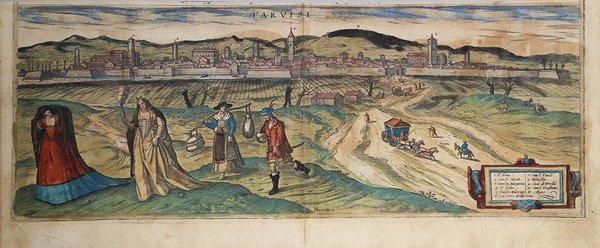
Tarvisi
Mode de Paiement
- PayPal
- Carte bancaire
- Virement bancaire
- Pubblica amministrazione
- Carta del Docente
Détails
- Année
- 1598
- Lieu d'édition
- Anversa e Colonia
- Format
- 492 X 190
- Graveurs
- BRAUN & Franz HOGENBERG Georg
- Description
- Van der Krogt 4, 36.
Description
Bella veduta prospettica di Treviso, pubblicata nel quinto volume del ' Civitates Orbis Terrarum. L’opera è inserita nel ' Civitates Orbis Terrarum, il primo atlante devoto esclusivamente alle piante e vedute delle principali città del mondo. Stampato in sei volumi tra il 1572 ed il 1617 ebbe grande fortuna e diffusione, tanto che ne furono stampate diverse edizioni tradotte in latino, tedesco e francese. ' Nel 1572, a Colonia, George Braun (1541-1622), chierico della città, pubblica il primo dei sei volumi del ' Civitates Orbis Terrarum, ' che contiene - in totale - oltre 500 prospettive, viste a volo d’uccello e mappe di città di tutto il mondo, il cui ultimo volume fu pubblicato nel 1617. Frans Hogenberg (1535-1590) realizzò le tavole per i primi quattro libri, e Simon van den Neuwel (Novellanus, attivo dal 1580) quelli per i volumi V e VI. L'autore si proponeva di raffigurare “non icones et typi urbium”, cioè non immagini generiche e tipizzate, “sed vrbes ipsae admirabili caelaturae artificio, spectantium oculis subiectae appareant”: non vogliono alludere o idealizzare ma rappresentare fedelmente sulla carta, riprodurre con esattezza, e in tempo reale, quello che l'occhio vede, così come annunciato nella prefazione al primo volume del ' Civitates Orbis Terrarum, Colonia 1572. La città fortificata è vista da Sud. Così Braun descrive la città: “Treviso è una nobile città della Marca Trevigiana, molto famosa nella storia dei Goti, poiché il padre del re Totila, che regnò a Verona e a Treviso, si dilettava particolarmente in questa città e vi abitava lui stesso, e suo figlio Totila, che poi divenne re degli Ostrogoti, vi nacque e fu educato. La città di Treviso ha tutte le necessità della vita in abbondanza, poiché è molto ben fornita di grano, vino, altri frutti e bestiame. Nella città sul fiume Sile ci sono molte fontane e magnifici edifici e case”. Incisione su rame, finemente acquarellata, in ottime condizioni. Testo latino al verso. The work is included in the ' Civitates Orbis Terrarum, the first atlas devoted exclusively to plans and views of the world's major cities. Printed in six volumes between 1572 and 1617 it was so successful and widespread that several editions translated into Latin, German and French were printed. In 1572, in Cologne, George Braun (1541-1622), a cleric of the city, published the first of six volumes of the ' Civitates Orbis Terrarum, ' containing - in total - more than 500 perspectives, bird's-eye views and maps of cities around the world, the last volume of which was published in 1617. Fransz Hogenberg (1535-1590) produced the plates for the first four books, and Simon van den Neuwel (Novellanus, active since 1580) those for volumes V and VI. The author set out to depict "non icones et typi urbium," that is, not generic and typified images, "sed urbes ipsae admirabili caelaturae artificio, spectantium oculis subiectae appareant": not intended to allude or idealize but to represent faithfully on paper, to reproduce exactly, and in real time, what the eye sees, as announced in the preface to the first volume of ' Civitates Orbis Terrarum. The fortified city of Treviso is seen from the south, in its picturesque setting on the banks of the Sile River with the Alps (11) in the background. The tallest tower in the city is the Torre del Comune (6) on the Piazza dei Signori, which is surrounded by palaces with open arcades. Further left is the cathedral of San Pietro (1). Further left again is the Dominican church of San Nicolò. Commentary by Braun: “Treviso is a noble town in the March of Treviso and very famous in the history of the Goths, since the father of King Totila, who ruled in Verona and Treviso, took particular delight in this town and lived there himself, and his son Totila, who later became king of the Ostrogoths, was born and educated there. The city of Treviso has all the necessities of life in abundance, for it is very well supplied with grain, wine, other fruits and cattle. In the city on the River Sile there are very many drinking fountains and magnificent buildings and houses.” Copper engraving, hand coloured, in very good condition. Latin text on verso. Cfr. Van der Krogt 4, 36.
