The Romans Polite to Strangers. Palazzo Ruspoli al Corso Rome
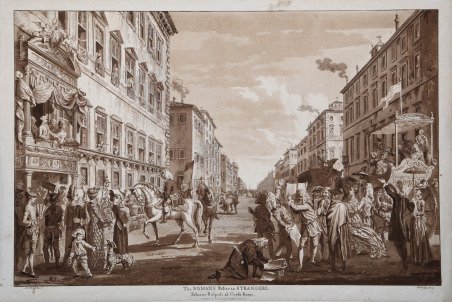
The Romans Polite to Strangers. Palazzo Ruspoli al Corso Rome
Mode de Paiement
- PayPal
- Carte bancaire
- Virement bancaire
- Pubblica amministrazione
- Carta del Docente
Détails
- Année
- 1781
- Format
- 550 X 375
- Graveurs
- SANDBY Paul
- Thème
- Scuola Inglese & Americana
Description
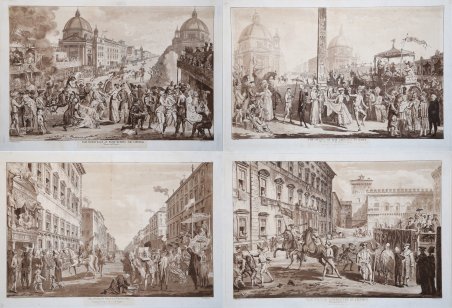
Acquatinta stampata ad inchiostro bistro, 1781, firmata in lastra in basso a destra e datate in basso al centro. Magnifica prova, impressa su carta vergata coeva con filigrana, sottili margini, leggere abrasioni al verso, nel complesso in eccellente stato di conservazione. Una ' delle quattro famose vedute del carnevale romane incise dal Sandby su disegno di David Allan (Alloa 1744 - Edimburgo 1796). Alla grande maggioranza di pitture, incisioni,acquerelli e disegni che illustrano le feste del carnevale romano con un eccesso di "colore", si contrappone questa serie, che descrive quei medesimi festosi eventi con un asciutto e spiritoso sguardo pur rilevandone la nascosta eleganza e sontuosità. Le acquetinte di Sandby sono tratte da una serie di dieci disegni di Allan eseguiti durante i suoi soggiorni romani e ora conservati nella Collezione Reale del Castello di Windsor. La tecnica dell’acquatinta, conferisce all’opera quel particolare tono simile all’acquarello rendendo le opere molto affascinanti. ' Aquatint printed in bistro ink, 1781, signed in plate at lower right and dated at lower center. Magnificent proof, printed on coeval laid paper with watermark, thin margins, light abrasions on verso, overall in excellent condition. One of the four famous Roman carnival views engraved by Sandby from a drawing by David Allan (Alloa 1744 - Edinburgh 1796). To the great majority of paintings, engravings, watercolors and drawings that illustrate the festivities of the Roman carnival with an excess of "color", is contrasted this series, which describes those same festive events with a dry and witty look while noting the hidden elegance and sumptuousness. Sandby's aquatints are taken from a series of ten drawings by Allan made during his Roman sojourns and now housed in the Royal Collection of Windsor Castle. Paul Sandby was a landscape painter and printmaker. David Allan was one of the first painters in Scotland to record the everyday life of ordinary people. He was based in Rome from around 1767 to 1777 where he painted historical subjects, portraits and the everyday life around him in a series of watercolours. In Scotland he enjoyed a successful career as both an artist and a teacher of art. Some of David Allan's watercolours of Rome were copied by Paul Sandby in London, as prints. The technique of aquatint (used here) allowed the engraver to create the effect of colour washes with the addition of etched lines for detail. This is a technique that provides an additional layer of meaning to the scene. The aquatint allows tonal variation and contrast which in turn creates atmosphere. There is a tremendous amount of detail in the print, and any British observer at the time would have received a good impression of what Rome was like from this print. Sandby's re-creation of Allan's watercolour would have made the image much more accessible through multiple copies. Only the most popular or marketable images would be copied as prints. The composition is quite complex. The background of the street and buildings is rendered with single point perspective, where the landscape appears to recede away to a single point in the distance. The viewpoint Allan chose was a low one. This means that the buildings appear to loom over the scene and a lot of sky is shown. In contrast, the action on the ground occupies only the lower third of the composition; Allan did not "zoom in" on any one aspect but created a general view of the scene. In this view, two British travellers on horseback are confronted by the extravagant costumes and masked figures from the entertainers at a Roman carnival. Despite their politeness these grotesque figures are slightly disturbing. Perhaps this scene demonstrates the alien and disorientating feeling of visiting a new city and discovering bizarre customs which the traveller has never experienced before. Cfr.
