Tomba di Anzio Lupo
Tomba di Anzio Lupo | Gravures | LAFRERI Antonio
Tomba di Anzio Lupo
Tomba di Anzio Lupo | Gravures | LAFRERI Antonio
Mode de Paiement
- PayPal
- Carte bancaire
- Virement bancaire
- Pubblica amministrazione
- Carta del Docente
Détails
- Année
- 1551
- Format
- 290 X 435
- Graveurs
- LAFRERI Antonio
Description
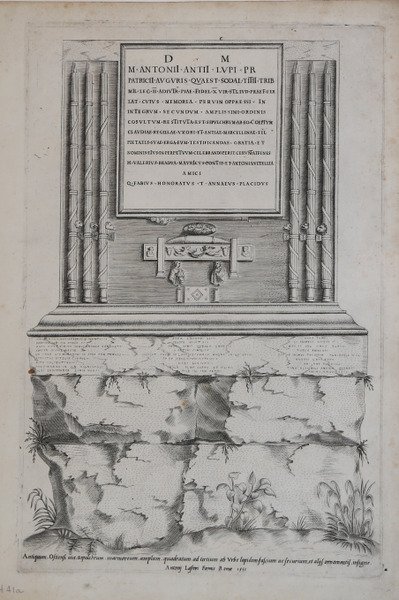
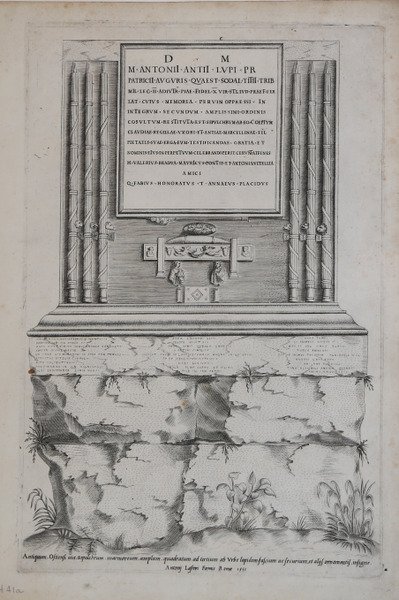
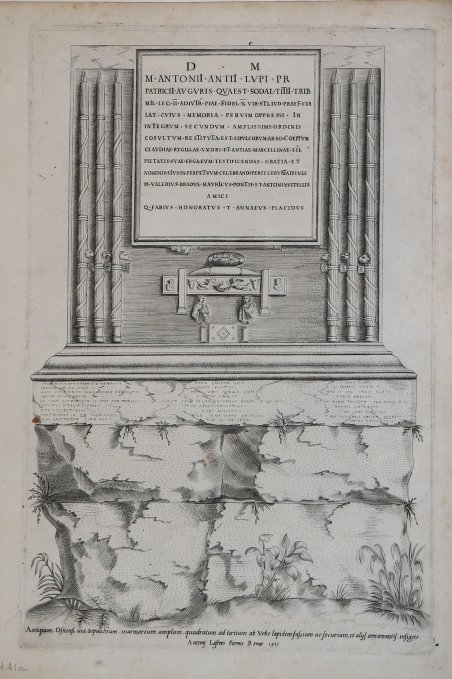
Bulino, 1551, firmato in basso al centro: « Antonij Lafreri Formis Romæ 1551». Parte dello "Speculum Romanae Magnificentiae".Esemplare nel primo stato di tre (cfr. Rubach 303) o secondo stato di quattro (cfr. Alberti, n. 61) con l'indirizzo di Lafreri e la data aggiunti in basso al centro.Iscritto in basso al centro: « Antiquum, Ostiensi uia, sepulchrum marmoreum amplum quadratum ad tertium ab Vrbe lapidem fascium ac securium et alijs ornamentis insigne ». [Antico sepolcro marmoreo, alla Via Ostiense, ampio, quadrato, al terzo lapide dall’Urbe, ragguardevole per l’ornamento dei fasci e delle scuri]La stampa ritrae il sepolcro eretto lungo la via Ostiense in onore del prefetto di Roma Antonio Anzio Lupo (oggi non più esistente). Il monumento venne sacrificato per abbellire la cappella Sistina di S. Maria Maggiore eretta per volontà di Sisto V (1585-1590). Infatti i marmi che incrostano le pareti furono prelevati da «vari edifici classici quali il Spetizodium, il mausoleo di Antius Lupus e dal Mons Superagius» (Liliana Borroero). A questa prima edizione del Lafréry (1551) fecero seguito quella di Giovanni Orlandi (1602) e, successivamente, quella di Hendrick van Schoel. L’opera appartiene allo ' Speculum Romanae Magnificentiae, la prima iconografia della Roma antica. ' Lo ' Speculum ' ebbe origine nelle attività editoriali di Antonio Salamanca e Antonio Lafreri (Lafrery). Durante la loro carriera editoriale romana, i due editori - che hanno lavorato insieme tra il 1553 e il 1563 - hanno avviato la produzione di stampe di architettura, statuaria e vedutistica della città legate alla Roma antica e moderna. Le stampe potevano essere acquistate individualmente da turisti e collezionisti, ma venivano anche acquistate in gruppi più grandi che erano spesso legati insieme in un album. Nel 1573, Lafreri commissionò a questo scopo un frontespizio, dove compare per la prima volta il titolo Speculum Romanae Magnificentiae. Alla morte di Lafreri, due terzi delle lastre di rame esistenti andarono alla famiglia Duchetti (Claudio e Stefano), mentre un altro terzo fu distribuito tra diversi editori. Claudio Duchetti continuò l’attività editoriale, implementando le lastre dello Speculum con copie di quelle “perdute” nella divisione ereditaria, che fece incidere al milanese Amborgio Brambilla. Alla morte di Claudio (1585) le lastre furono cedute – dopo un breve periodo di pubblicazione degli eredi, in particolare nella figura di Giacomo Gherardi - a Giovanni Orlandi, che nel 1614 vendette la sua tipografia al fiammingo Hendrick van Schoel. Stefano Duchetti, al contrario, cedette le proprie matrici all’editore Paolo Graziani, che si associò con Pietro de Nobili; il fondo confluì nella tipografia De Rossi passando per le mani di editori come Marcello Clodio, Claudio Arbotti e Giovan Battista de Cavalleris. Il restante terzo di matrici della divisione Lafreri fu suddiviso e scisso tra diversi editori, in parte anche francesi: curioso vedere come alcune tavole vengano ristampate a Parigi da Francois Jollain alla metà del XVII secolo. Diverso percorso ebbero alcune lastre stampate da Antonio Salamanca nel suo primo periodo; attraverso il figlio Francesco, confluirono nella tipografia romana di Nicolas van Aelst. Altri editori che contribuirono allo Speculum furono i fratelli Michele e Francesco Tramezzino (autori di numerose lastre che confluirono in parte nella tipografia Lafreri), Tommaso Barlacchi, e Mario Cartaro, che fu l’esecutore testamentario del Lafreri, e stampò alcune lastre di derivazione. Per l’intaglio dei rami vennero chiamati a Roma e impiegati tutti i migliori incisori dell’epoca quali Nicola Beatrizet (Beatricetto), Enea Vico, Etienne Duperac, Ambrogio Brambilla e altri ancora. Questo marasma e intreccio di editori, incisori e mercanti, il proliferare di botteghe calcografiche ed artigiani ha contribuito a creare il mito dello Speculum Romanae Magnificentiae, la più antica e importante ico. Engraving, 1551, signed at the bottom center: “Antonij Lafreri Formis Romæ 1551”. Part of the "Speculum Romanae Magnificentiae".Example of the first state of three (see Rubach 303) or second state of four (see Alberti, n. 61) with Lafreri's address and date added at the bottom center.Inscribed at the bottom center: "Antiquum, Ostiensi uia, sepulchrum marmoreum amplum quadratum ad tertium ab Vrbe lapidem fascium ac securium et alijs ornamentis insigne".The print depicts the tomb erected along the Via Ostiense in honor of the prefect of Rome Antonio Anzio Lupo (no longer existing). The monument was sacrificed to embellish the Sistine Chapel of St. Mary Major erected by the will of Sixtus V (1585-1590). In fact the marbles encrusting the walls were taken from "various classical buildings such as the Spetizodium, the mausoleum of Antius Lupus and Mons Superagius" (Liliana Borroero). This first edition of Lafréry (1551) was followed by that of Giovanni Orlandi (1602) and, later, that of Hendrick van Schoel. The work belongs to the Speculum Romanae Magnificentiae, the earliest iconography of ancient Rome. ' The Speculum originated in the publishing activities of Antonio Salamanca and Antonio Lafreri (Lafrery). During their Roman publishing careers, the two editors-who worked together between 1553 and 1563-started the production of prints of architecture, statuary, and city views related to ancient and modern Rome. The prints could be purchased individually by tourists and collectors, but they were also purchased in larger groups that were often bound together in an album. In 1573, Lafreri commissioned a frontispiece for this purpose, where the title Speculum Romanae Magnificentiae appears for the first time. Upon Lafreri's death, two-thirds of the existing copperplates went to the Duchetti family (Claudio and Stefano), while another third was distributed among several publishers. Claudio Duchetti continued the publishing activity, implementing the Speculum plates with copies of those "lost" in the hereditary division, which he had engraved by the Milanese Amborgio Brambilla. Upon Claudio's death (1585) the plates were sold - after a brief period of publication by the heirs, particularly in the figure of Giacomo Gherardi - to Giovanni Orlandi, who in 1614 sold his printing house to the Flemish publisher Hendrick van Schoel. Stefano Duchetti, on the other hand, sold his own plates to the publisher Paolo Graziani, who partnered with Pietro de Nobili; the stock flowed into the De Rossi typography passing through the hands of publishers such as Marcello Clodio, Claudio Arbotti and Giovan Battista de Cavalleris. The remaining third of plates in the Lafreri division was divided and split among different publishers, some of them French: curious to see how some plates were reprinted in Paris by Francois Jollain in the mid-17th century. Different way had some plates printed by Antonio Salamanca in his early period; through his son Francesco, they goes to Nicolas van Aelst's. Other editors who contributed to the Speculum were the brothers Michele and Francesco Tramezzino (authors of numerous plates that flowed in part to the Lafreri printing house), Tommaso Barlacchi, and Mario Cartaro, who was the executor of Lafreri's will, and printed some derivative plates. All the best engravers of the time - such as Nicola Beatrizet (Beatricetto), Enea Vico, Etienne Duperac, Ambrogio Brambilla, and others ' - were called to Rome and employed for the intaglio of the works. All these publishers-engravers and merchants-the proliferation of intaglio workshops and artisans helped to create the myth of the Speculum Romanae Magnificentiae, the oldest and most important iconography of Rome. The first scholar to attempt to systematically analyze the print production of 16th-century Roman printers was Christian Hülsen, with his Das Speculum Romanae Magnificentiae des Antonio Lafreri of 1921. In more recent times, very important have been the studies o. Cfr.