Zut ! On va encore dire que c'est moi!
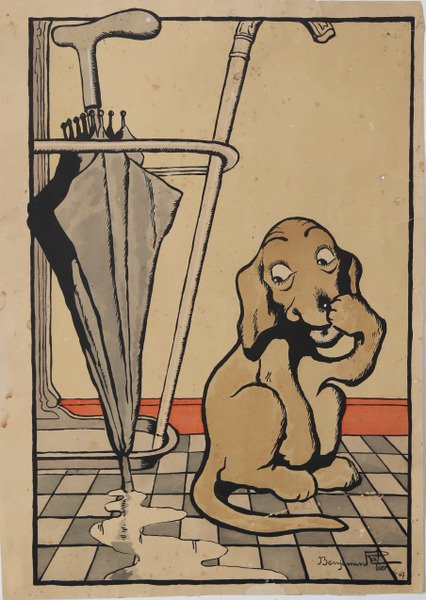
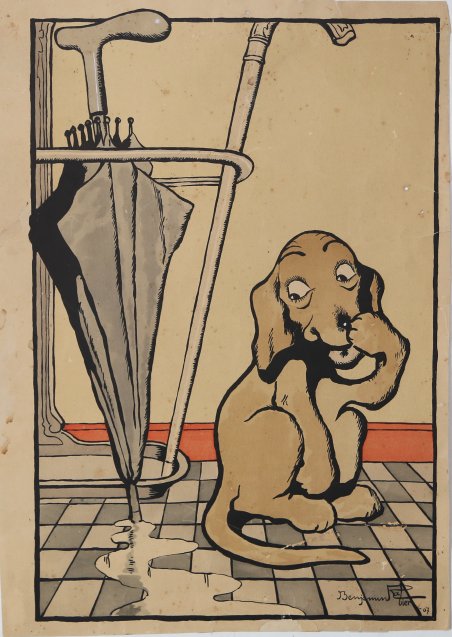
Zut ! On va encore dire que c'est moi!
Mode de Paiement
- PayPal
- Carte bancaire
- Virement bancaire
- Pubblica amministrazione
- Carta del Docente
Détails
- Année
- 1907
- Format
- 340 X 500
- Graveurs
- RABIER Benjamin
Description
Litografia, stampata a colori. Buona prova su pergamena forte. Diversi strappi, uno dei quali penetra leggermente nel soggetto in basso. Piccole pieghe, nel complesso in buone condizioni. Benjamin Rabier (La Roche Sur Yon, 30 dicembre 1864 – Parigi, 10 ottobre 1939) è stato un fumettista francese ricordato come uno dei maestri del fumetto francese, creatore della Linea chiara e un pioniere dell'animazione. Si trasferì con la sua famiglia a Parigi all'età di 5 anni. Partecipò da adolescente ad alcuni concorsi di disegno, vincendo due volte il primo premio, nel 1879 e nel 1880, ma iniziò a lavorare come contabile. Grazie a Caran d'Ache, suo compagno di reggimento, pubblica nel 1895 "L'album drolatique" iniziando una intensa produzione di tavole umoristiche e illustrazioni per molti editorie pubblicando su riviste come La Chronique Amusante e Le Gil Blas Illustré, Le journal amusant, Revue Mame, Gil Blas illustré, Le Pêle-Mêle, Le Rire e L'assiette au beurre. Divenne noto in Inghilterra e negli Stati Uniti dove disegnò per Scraps, Pictorial Comic Life e Puck. Si trasferì nel 1894 nella regione di Ségur divenendo collaboratore regolare del quotidiano Le Rire, dove riscosse un certo successo; disegnò anche per le riviste L'Assiette au Beurre e Le Chat Noir, La Jeunesse Illustrée e Les Belles Images. Nel 1898 produsse il libro "Tintin Lutin" che fu fonte d'ispirazione nel 1929 per Hergé per il nome del suo personaggio. All'inizio del secolo era un artista affermato che pubblicava su numerose testate. Iniziò a produrre altri album e illustrò le storie di La Fontaine. Ha anche scritto spettacoli teatrali e illustrazioni di libri. Verso il 1906 si concentra sulla produzione di illustrazioni per libri per l'infanzia, privilegiando sempre le storie di animali. Si dedicò all'animazione nel 1916 e ha anche lavorato nel campo della pubblicità. Ad esempio, ha sviluppato il logo di mucca del marchio di formaggi La Vache Qui Rit. Nel 1923 ha creato Gédéon, un'oca protagonista di una serie di storie che realizzò fino alla fine della sua vita e che venne pubblicata in una serie di sedici volumi dal 1923 al 1939. Nel 1936, tornò a lavorare per editori britannici, illustrando diversi libri. Zut! On va encore dire que c?est moi! 1907. Lithograph, printed in colors. Good proof on strong vellum. Several tears, one of which penetrates slightly into the subject on the left, consolidated on the back with adhesive. Good margins. ' Benjamin Rabier (La Roche Sur Yon, December 30, 1864 - Paris, October 10, 1939) was a French cartoonist remembered as one of the masters of French comics, creator of the Light Line and a pioneer of animation. He moved with his family to Paris at the age of 5 years. He participated as a teenager in some drawing competitions, winning first prize twice, in 1879 and 1880, but began working as an accountant. Thanks to Caran d'Ache, his regimental companion, he published in 1895 "L'album drolatique" starting an intense production of humorous plates and illustrations for many publishers publishing in magazines such as La Chronique Amusante and Le Gil Blas Illustré, Le journal amusant, Revue Mame, Gil Blas illustré, Le Pêle-Mêle, Le Rire and L'assiette au beurre. He became known in England and the United States where he drew for Scraps, Pictorial Comic Life and Puck. He moved in 1894 in the region of Ségur becoming a regular contributor to the newspaper Le Rire, where he had some success, also drew for magazines L'Assiette au Beurre and Le Chat Noir, La Jeunesse Illustrée and Les Belles Images. In 1898 he produced the book "Tintin Lutin" which was a source of inspiration in 1929 for Hergé for the name of his character. By the turn of the century he was an established artist publishing in numerous publications. He began producing more albums and illustrated La Fontaine stories. He also wrote plays and book illustrations. Around 1906 he concentrated on producing illustrations for children's books, always favoring animal stories. He turned to animation in 1916 and also worked in advertising. For example, he developed the cow logo for the cheese brand La Vache Qui Rit. In 1923, he created Gédéon, a goose that was the protagonist of a series of stories that he created until the end of his life and that was published in a series of sixteen volumes from 1923 to 1939. In 1936, he returned to work for British publishers, illustrating several books. Cfr.
