Directorium chori ad vsum sacrosanctae Basilicae Vaticanae, & aliarum Cathedralium, & collegiatarum ecclesiarum collectum opera Ioannis Guidetti Bononiensis, eiusdem Vaticanae Basilicae clerici beneficiati, et sanctissimi d.n. Gregorii XIII capellani. Romae, Apud Robertum Granjon Parisien
Directorium chori ad vsum sacrosanctae Basilicae Vaticanae, & aliarum Cathedralium, & collegiatarum ecclesiarum collectum opera Ioannis Guidetti Bononiensis, eiusdem Vaticanae Basilicae clerici beneficiati, et sanctissimi d.n. Gregorii XIII capellani. Romae, Apud Robertum Granjon Parisien | Libri antichi e moderni | GUIDETTI, Giovanni Domenico (1532-1592)

Directorium chori ad vsum sacrosanctae Basilicae Vaticanae, & aliarum Cathedralium, & collegiatarum ecclesiarum collectum opera Ioannis Guidetti Bononiensis, eiusdem Vaticanae Basilicae clerici beneficiati, et sanctissimi d.n. Gregorii XIII capellani. Romae, Apud Robertum Granjon Parisien
Directorium chori ad vsum sacrosanctae Basilicae Vaticanae, & aliarum Cathedralium, & collegiatarum ecclesiarum collectum opera Ioannis Guidetti Bononiensis, eiusdem Vaticanae Basilicae clerici beneficiati, et sanctissimi d.n. Gregorii XIII capellani. Romae, Apud Robertum Granjon Parisien | Libri antichi e moderni | GUIDETTI, Giovanni Domenico (1532-1592)
Metodi di Pagamento
- PayPal
- Carta di Credito
- Bonifico Bancario
- Pubblica amministrazione
- Carta del Docente
Dettagli
- Anno di pubblicazione
- 1582
- Luogo di stampa
- Roma
- Autore
- GUIDETTI, Giovanni Domenico (1532-1592)
- Editori
- Robert Granjon
- Soggetto
- Quattro-Cinquecento
- Stato di conservazione
- Buono
- Lingue
- Italiano
- Legatura
- Rilegato
- Condizioni
- Usato
Descrizione
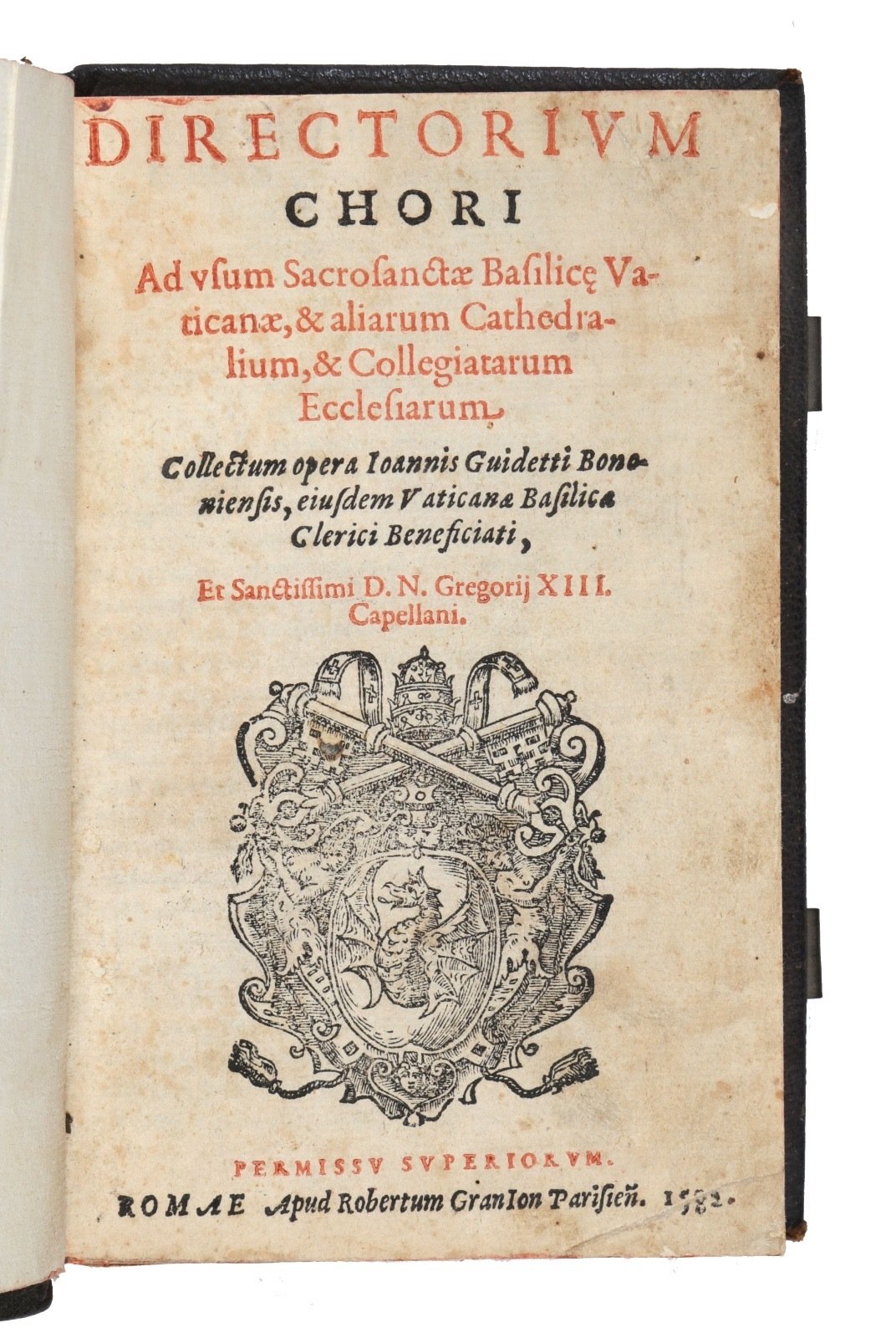
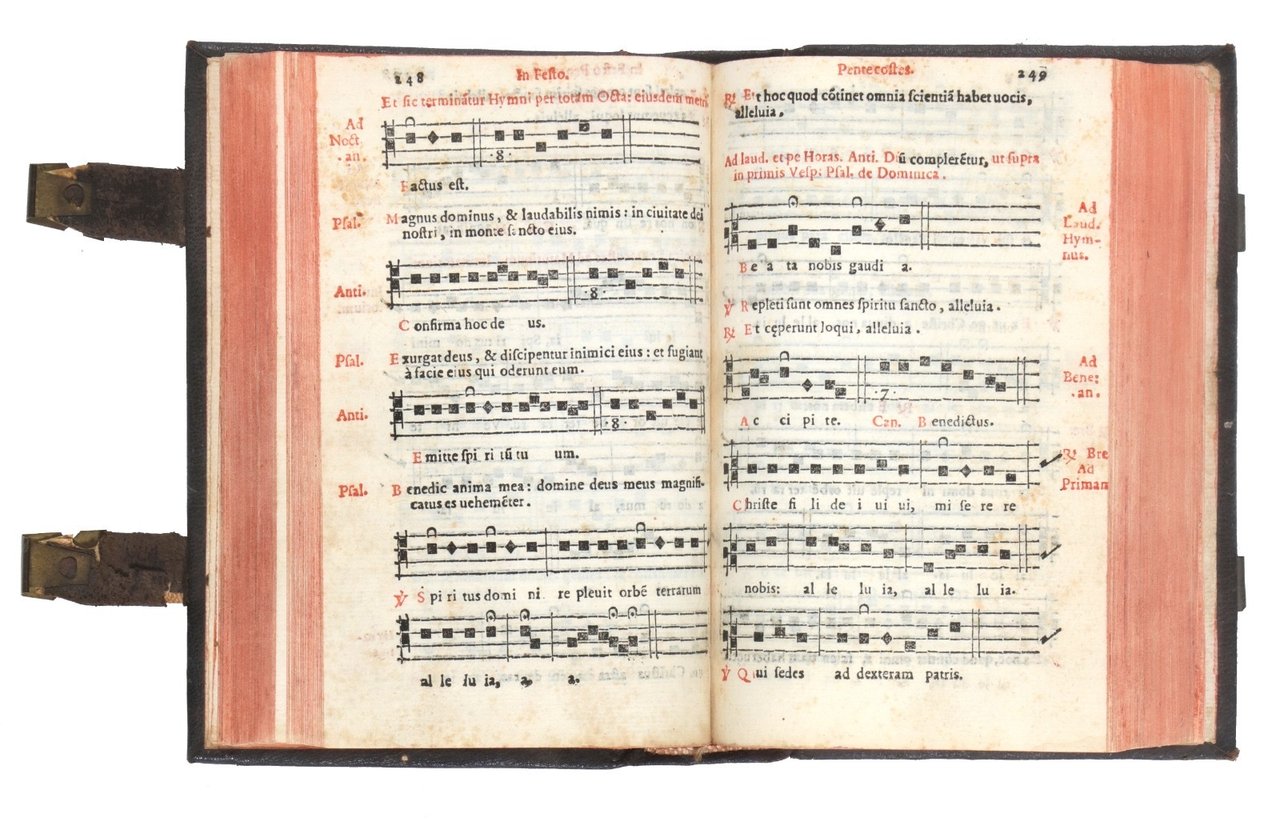
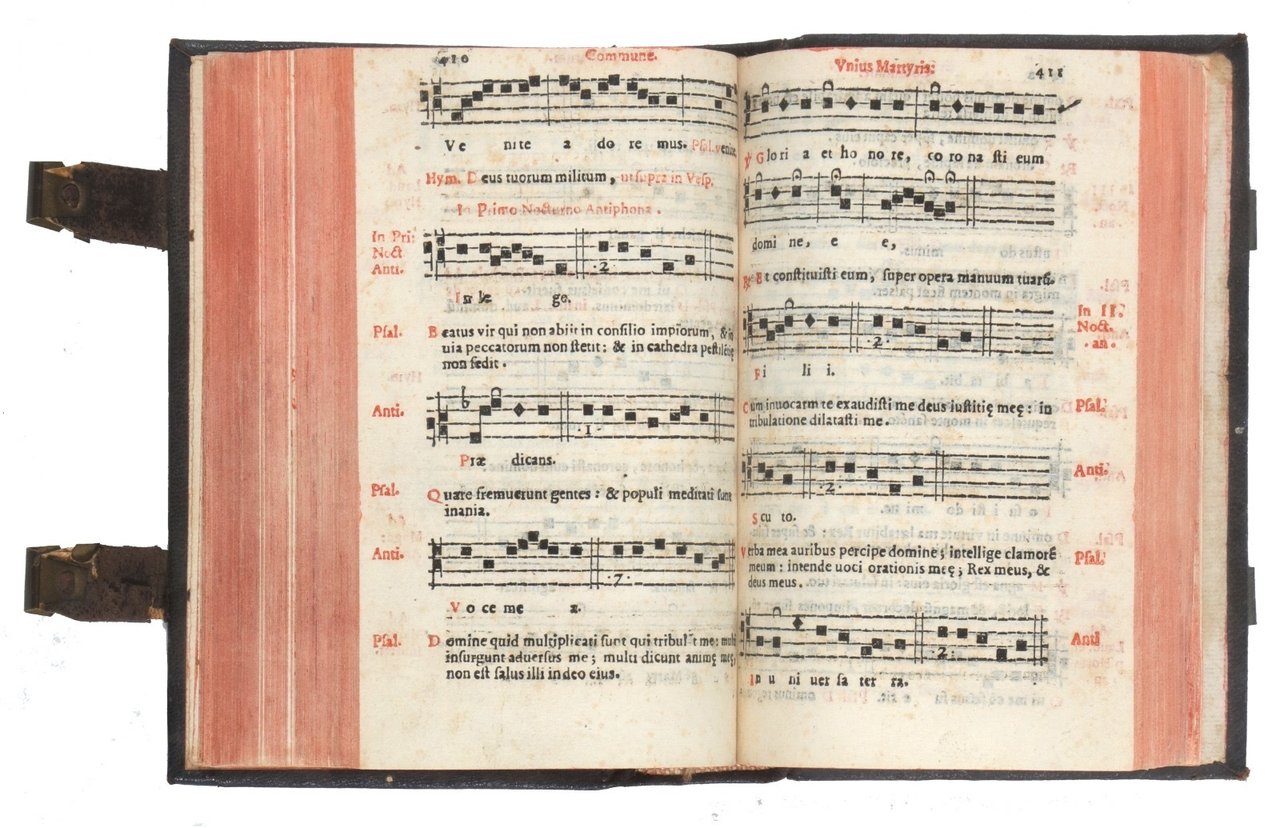
8vo (157x98 mm). [16], 1-479, [1 blank], 480-573, [2 blank] pp. Collation: A-Z8 AA-OO8. Leaf HH8v is a blank. The final blank leaf OO8 is missing. Woodcut arms of Pope Gregory XIII on the title page. Printed in red and black throughout, mainly type-set music on 4-line staves. Later blind-tooled dark leather with clasps, red edges. Margin cut short occasionally slightly affecting the headlines and printed marginalia, small restorations to title-page verso, some foxing and staining.
Rare first edition, dedicated to Pope Gregory XIII. All sixteenth-century editions of Guidetti's manual on liturgical chant (the book was reprinted in 1589 and 1591, then again in 1604, 1615, 1619, 1624, 1641, 1665, 1730, and 1737) are rare on the market.
“This is one of the most important books for the history of church music” (Lathrop Harper, 1970). Between 1575 and 1581 Guidetti collaborated to a great extent with his teacher Giovanni Pierluigi da Palestrina and Annibale Zoilo to the revision of liturgical music (gradual and antiphonary), with the aim to revive Gregorian singing in its pristine integrity and to free it from the additions and melodic alterations arbitrarily added over the years by cantors. To Guidetti was assigned “the final revision and completion of all portions requiring it” (The New Grove Dictionary of music and musicians, 2001, X, p. 520). The reformed gradual and the antiphonary were published at Venice in 1580.
Two years later, in 1582, Guidetti published his major work, the Directorium chori, on the direction of the choir and on how the various chants were to be conducted according to the uses of the pope's chapel. With this very innovative work Guidetti provided a rhythmically differentiated notation, better suited to represent the respective durational values of the notes of the chant, of which he defined the exact execution without having to employ an excessive number of symbols: “the brevis (square), worth a tempus; the semibrevis (lozenge), worth half a tempus; the brevis sub semicirculo (under a half circle), that is one and a half time; another brevis sub semicirculo, but that ‘intra semicirculum habet punctum' (i.e., the crowded brevis, we would say), which is worth two times; finally the group of linked brevis and semibrevis (‘Brevis et semibrevis simul coniunctae sub eodem semicirculo') in which the vowel is repeated, but the precise mensural value of the two notes involved is not explained. Despite the enormous popularity of Guidetti's manual, it seems that neither the semi-circle nor the crowns over the notes were ever adopted by others. Nevertheless, we observe Guidetti's attempts to capture actual mensural practice through the use of a variety of notational symbols. In any case, the Directorium chori was a highly successful book” (cf. M. Gozzi, Liturgical music and liturgical experience in early modern Italy, in: “Listening to Early Modern Catholicism: Perspectives from Musicology”, D.V. Filippi & M. Noone, eds., Leiden-Boston, 2017, pp. 74-76).
The enthusiastic reception of this first edition is proved by the 1589 reprinting and by all subsequent editions. The Directorium is the most authoritative manual of this kind published after the Council of Trent. The rhythmic and vocal simplification it proposes made it an indispensable work of consultation for all cantors.
“Of the chant books issued during the Catholic Reformation, Giovanni Guidetti's Directorum chori (1582) is of special importance in relation to the history of chant notation. In modern scholarship, Guidetti's system of notation is famous for its unique note forms; it also recommends most parts of accentus (prayers, Epistles, Gospels etc.) to be chanted on a single pitch – recto tono. Through this system of notation, Guidetti applies the basic rules of ancient prosody to plainchant” (Hyun-Ah Kim, Humanism and the Reform of Sacred Music in Early Modern England, e.book, 2013).
This is one of the few books printed by Robert Granjon at Rome. Robert