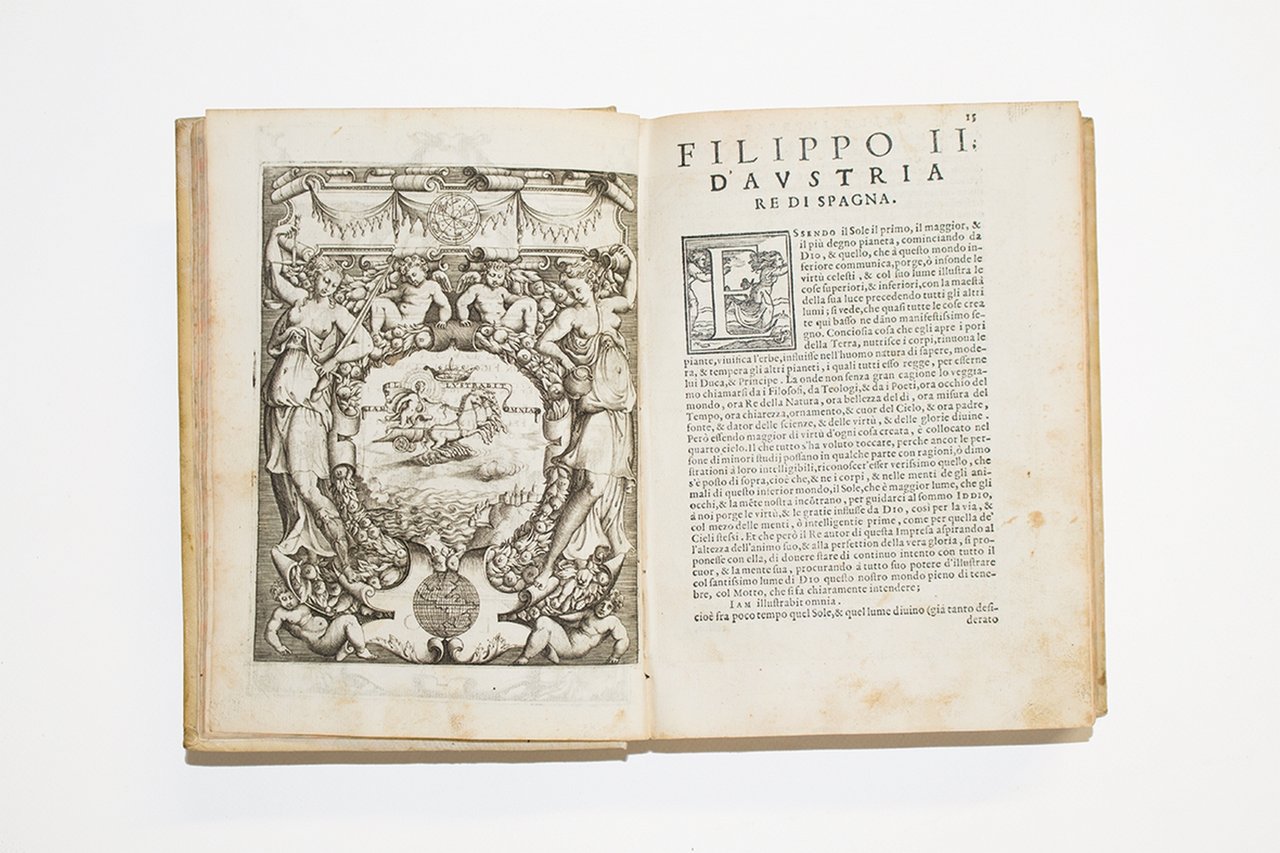
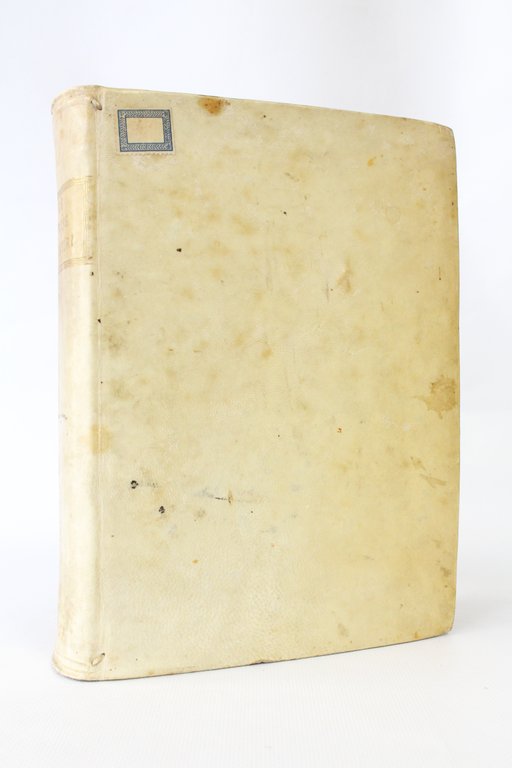
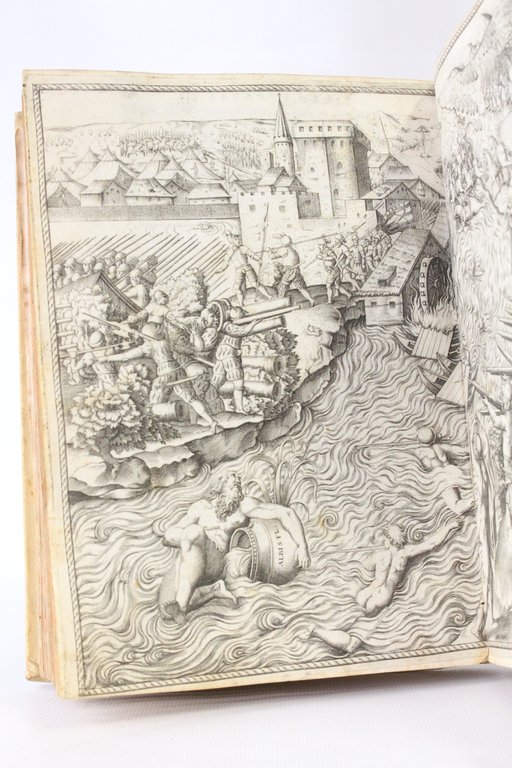
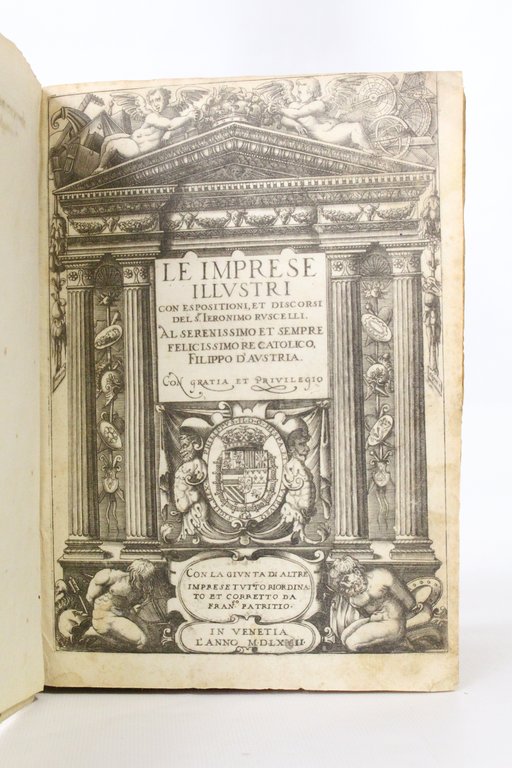
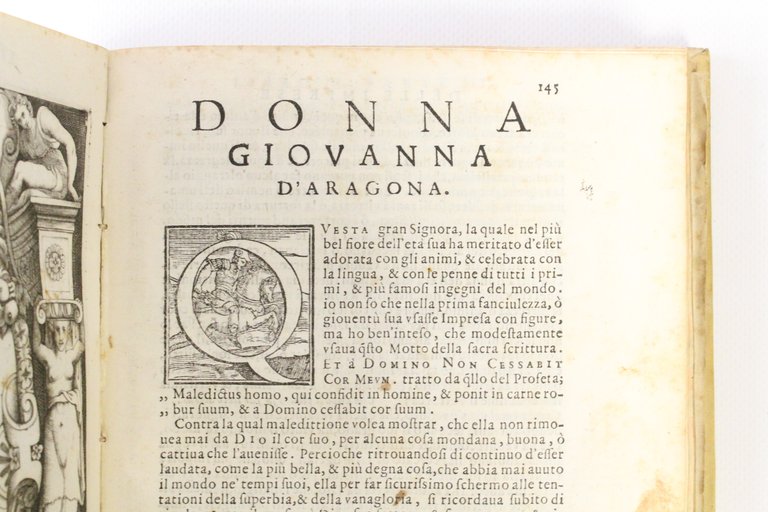
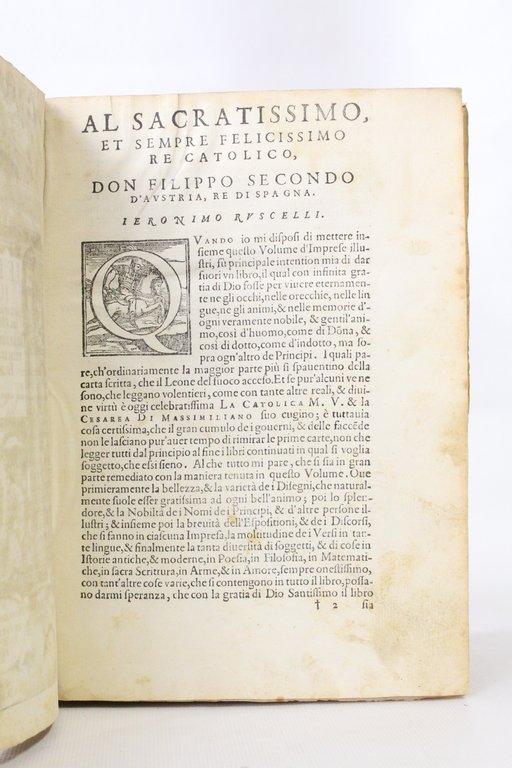
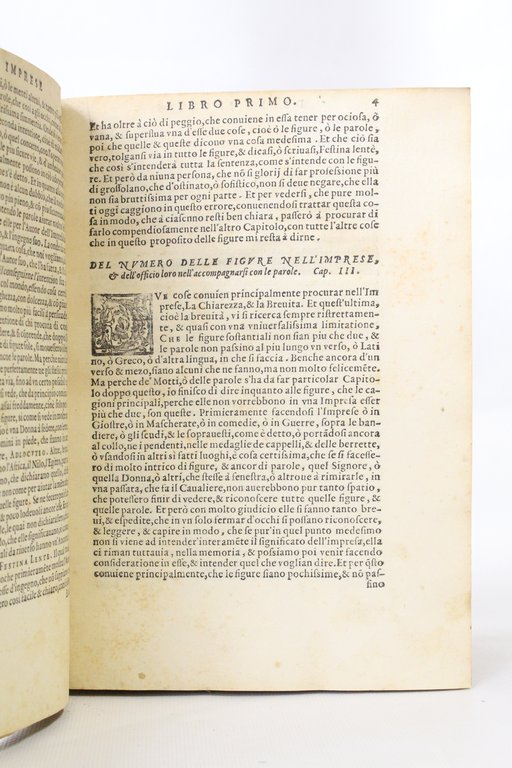
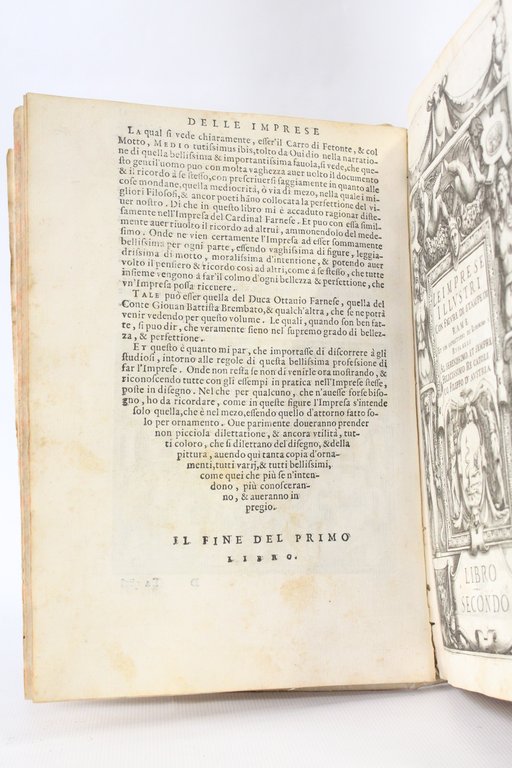
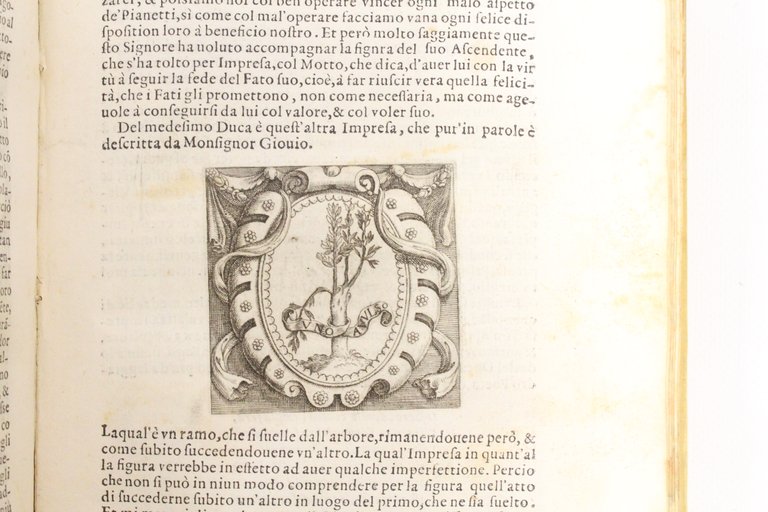
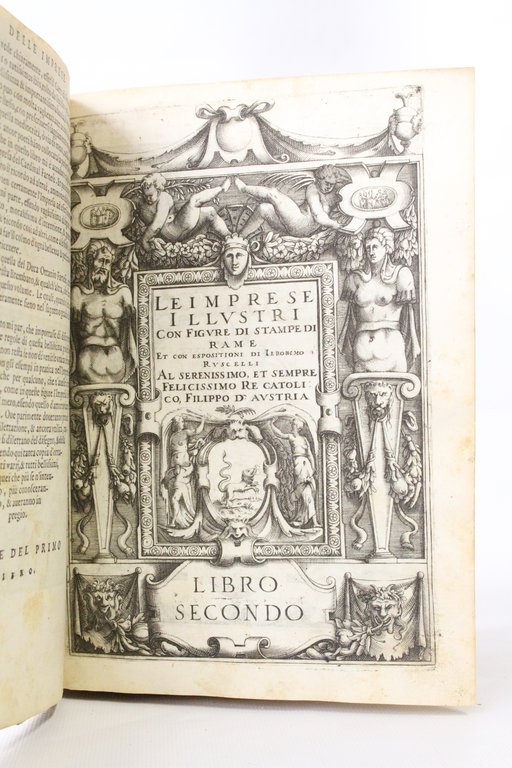
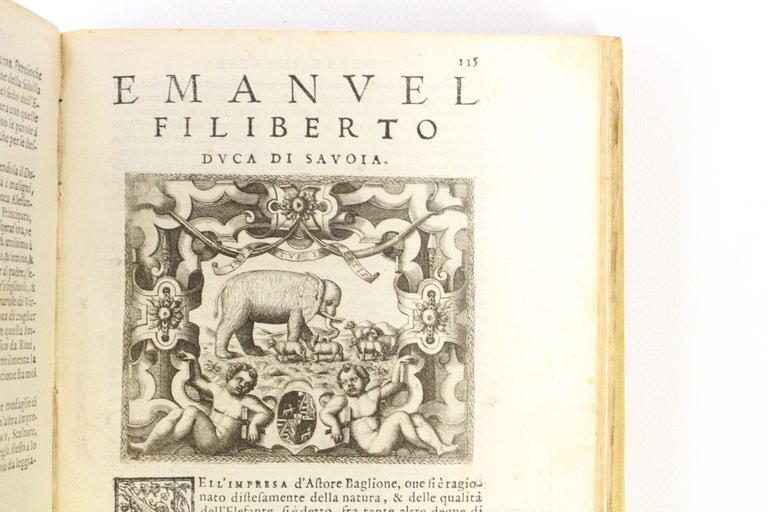
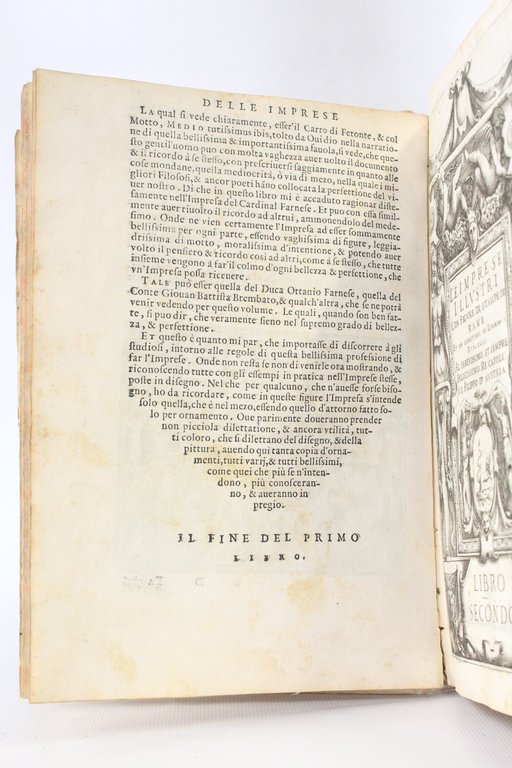
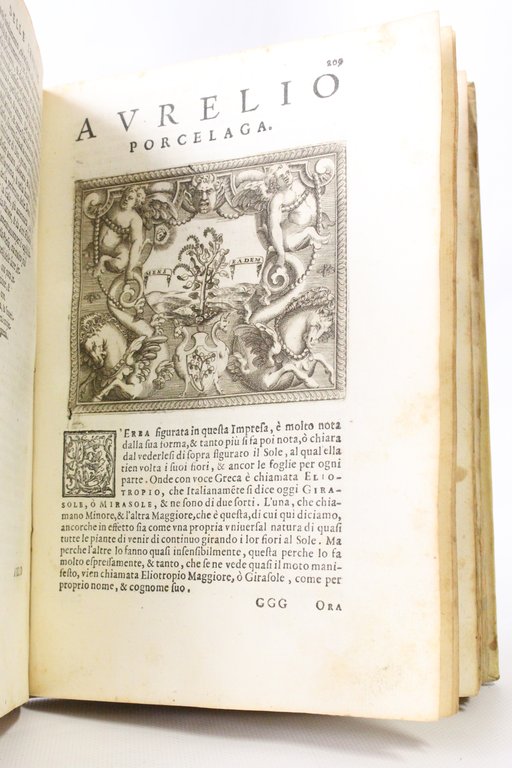
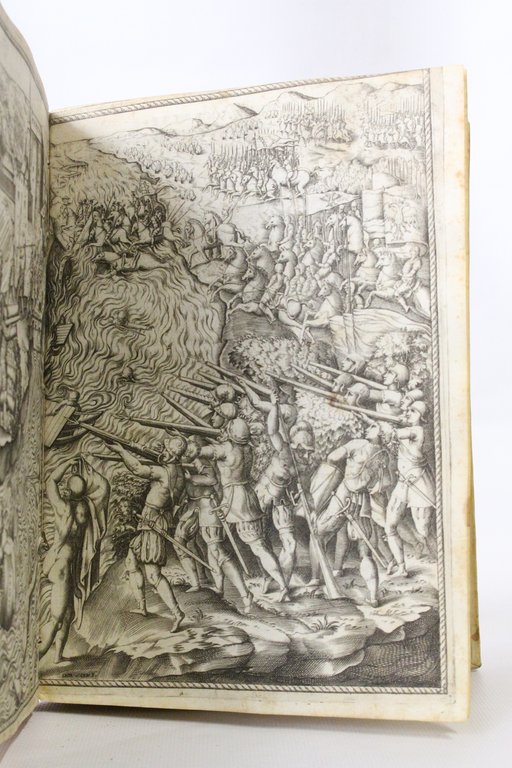
Comin da Trino di Monteferrato | Venezia [Venice] 1572 | 16.50 x 22.50 cm | 3 parties reliées en un volume | Le Imprese Illustri : con Espositioni et Discorsi del S.or Ieronimo Ruscelli Comin da Trino di Monteferrato, Venezia 1572, in-4 (16,5 x 22,5 cm), (8) 191 pp. (20) 193-288 pp., 3 parts bound in one volume, later full parchment Second edition, the first one was published in Venice in 1566. The work is illustrated with a portrait of the author and 128 engravings of which 17 plates engraved by Nicolò Nelli et Gaspare Oselli in addition to a double page engraving by Domenico Zenoi, representing the battle of Mühlberg. Each of the three parts contents an engraved title page representing a sophisticated structure, the first bearing the coat of arms of Philip II of Spain. Later binding in full parchment, gilt title in a triple gilt frame, a little label from the library pasted on the top left-hand side of the first board, sprinkled edges. The leaf HH2 was mistakenly numbered HH3. Scattered foxing. The book is a foundation in the research of heraldry, Le Imprese Illustri represents an exceptional encounter between an uncommon field of study impresa (heraldic badge) and the amour, lifted by a boom of printing techniques, of illustrated books. Divided in several books, the work opens with a theoretical approach for the study of impresa with the aim of demarcating this form of heraldry, very close to emblem, which is characterized by the combination of figure (the body) and motto (the soul). Ruscelli here refines his work in Le Discours, which he had written in 1556, upon the new edition of the first work which traits exclusively the impresa, la Ragionamento di Mons. Paolo Giovio sopra I motti e I disegni d'arme e amore che comunemente chiamiamo Impresse Guide by the intrinsic visual dimension of the subject of study, the author nevertheless distinguishes himself from his predecessor by an abundance of illustrations, notably of plates engravings. They are exceptional for their quality, which support the analytic approach of his study. The central double page, featuring the battle of Mühlberg, is a work by Domenico Zenoni, then one of the most active engravers in Venice, who was particularly known for his representation of contemporary events. Through the impresa of the princes, of whom a majority were still alive at the time of the composition of the work, Ruscelli's book, draws up a real political map of Europe in the middle of 16th century. Moreover, the representations of the two most powerful royal families of the time, the Habsburg and the Valois, the remarkable presence of the impresa of the ottoman sultan Suleiman the Magnificent, reflects the influence of the princes and the capacity of the impresa to overcome borders. The first author to highlight this connection, Ruscelli gives an important place to feminine imprese, revealing the influence women leaders acquired in the second half of the 16th century like Catherine de' Medici. An art situated between literature and pictorial work, l'impresa is, according to Ruscelli, a know how in which women excel, shown by their status and their engagement in the literary activities of the period “si vede che tuttavia le Donne vengono facendo cosi gloriasa concorrenza a gli uomini che per quasi commune consentimento di loro stessi, esse se ne trovino di gran lunga superiori.” Each impresa being the mirror of its prince, they become the demonstration of the inseparable link between the social rank and the intellectual culture during the Renaissance. They highlight the qualities and the noble values which the prince wishes to show to the world, the present becoming the future. In the same way, Ruscelli places his volume in posterity, with dedicated epistle, so that he lives “eternally in the eyes, the ears, on the lips, in the soul and the memoirs of all the men and women of high spirit and true nobles, whether they be wise or ignorant, but above all the princes.” The work pioneered b

 Scopri come utilizzare
 Scopri come utilizzare