Questo sito usa cookie di analytics per raccogliere dati in forma aggregata e cookie di terze parti per migliorare l'esperienza utente.
Leggi l'Informativa Cookie Policy completa.

Sei in possesso di una Carta del Docente o di un Buono 18App? Scopri come usarli su Maremagnum!

Libri antichi e moderni

Brickhill Paul

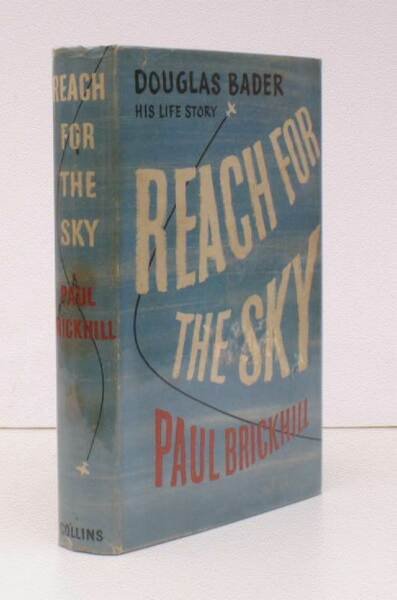
Reach for the Sky. The Story of Douglas Bader. BRIGHT, CLEAN COPY IN DUSTWRAPPER

Collins, 1954

75,90 €

Island Books

(Devon, Regno Unito)

Parla con il Libraio

Metodi di Pagamento

Dettagli

Anno di pubblicazione
1954
Autore
Brickhill Paul
Editori
Collins
Soggetto
aviation, ww2, wwii, raf, royal air force, pow, bader, douglas bader, fighter command, paul brickhill, colditz
Lingue
Inglese

Descrizione

8vo., First Edition, with frontispiece and 24 plates on 12, tiny signature on front free endpaper; navy cloth, backstrip lettered in gilt, a very good, bright, clean copy in price-clipped dustwrapper, the latter lightly age-soiled and rubbed at extremities. Written by Paul Brickhill (already celebrated as the author of another RAF classic 'The Dam Busters', 1951), 'Reach for the Sky' remains the best account of the leg-less Battle of Britain hero. It is the basis of Lewis Gilbert's hugely successful feature film (1954) starring Kenneth More in what was arguably his finest role. One of the legendary figures of the Royal Air Force, Douglas Bader was from the outset an outstanding athlete. As a cadet at Cranwell he gained his 'blues' for cricket, rugby, hockey and boxing. He represented the RAF at both cricket and rugby and would probably have been capped for England but for the accident that changed his life and created a legend. In 1931 a near-fatal air crash left him leg-less. Knowing that no man with such a handicap had ever walked without a stick he nevertheless found his way back to fitness playing tennis, golf and many others sports. He even flew again, until the authorities determined that a pilot without legs could not fly and discharged him from the service. With the outbreak of War he fought to be readmitted, not merely to a desk job, but back to the cockpit. Finally he was given command of a flight which quickly increased to five squadrons as the RAF realised that he was not only an outstanding pilot but an inspired leader of men and a fighter tactician almost of genius. Even as a POW of the Germans his spirit was such that his captors were forced at one stage to remove his artificial limbs to prevent the chance of him escaping. Enser, p.375.
Logo Maremagnum it