Henri Ciriani Architecture 1960-2000
Henri Ciriani Architecture 1960-2000 | Libri antichi e moderni | Mauro Galantino
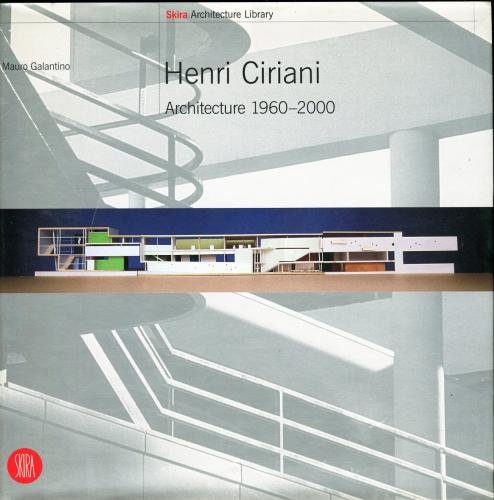
Henri Ciriani Architecture 1960-2000
Henri Ciriani Architecture 1960-2000 | Libri antichi e moderni | Mauro Galantino
Metodi di Pagamento
- PayPal
- Carta di Credito
- Bonifico Bancario
- Pubblica amministrazione
- Carta del Docente
Dettagli
- Anno di pubblicazione
- 2000
- ISBN
- 9788881187027
- Luogo di stampa
- Milano
- Autore
- Mauro Galantino
- Pagine
- 240
- Volumi
- 1
- Collana
- Biblioteca di Architettura Skira
- Editori
- Skira
- Formato
- 21x21x2
- Edizione
- Prima Edizione 2000
- Descrizione
- sovracc. ill. colori
- Descrizione
- brossura con sovracc ill.
- Sovracoperta
- True
- Stato di conservazione
- Nuovo
- Lingue
- Inglese
- Legatura
- Brossura
- Copia autografata
- False
- Print on demand
- False
- Condizioni
- Nuovo
- Prima edizione
- True
Descrizione
(Biblioteca di Architettura Skira).
Indice
Light as principle - Franco Purini
From the plane to the 'pièce urbaine' The wholesome topology-typology clash
Proving the vitality of Modernity, three epiphanies and an epilogue
Housing, primacy of morphology, horizontal extensions, vertical extensions, from foundation
'pièce' to completion 'pièce'
From control of continuity to the collective building
Chronology of designs
Bibliography
Henri Edouard Ciriani was born in Peru in 1936 and received his training in architecture in Lima. After graduating at a very early age, he worked with the Instituto Nacional de la Vivienda, a goverment town planning organisation, executing several large-size projects. In the early sixties at Ventanilla, Matute and San Felipe, the democratic Peruvian government created a real laboratory for territorial experimentation, based on themes and methods belonging to the modern movement's building conceptions. In these early executions Ciriani already began concentrating on the elaboration of complexity from simple architectural elements, often connected with traditional components of the home, taken apart and put back together in a contemporary organism.
From then on, roads, public space, the typological complexity and social quality of architecture remain a system the author would never give up, refining his building research towards an increasingly intentional spatial quality of organisms, to be consciously filtered into a rich plasticity of the building.
After an extended briefing tour through Europe in the mid-sixties, he moved to Paris, worked with the Gornis studio, then was associated with the architect Borja Huidobro and the landscape designer Michel Corajoud until the mid-seventies. Those were the days of the great competitions for the 'villes nouvelles', where Ciriani worked in association with the A.U.A. and, occasionally, with Ricardo Bofill. The designs for Dunkirk, l'Isle d'Abeau and Evry drafted between 1971 and 1975 were an essential passage for his territorial research, maturing an ever-closer connection between urban form and architectural form.
Ciriani opened his own studio in 1975, working on public housing programmes, completing a theoretic reflection on the intermediary scale between plan and project that he would call the 'little utopia of the urbanpièce, the fragment having a dimension allowing to study road layout together with the type and its tectonic development.
Noisy II, the Cour d'Angle and the nonexecuted Chambéry design are the most significant undertakings of that period. Taking an active part in the international debate in countless competitions, Ciriani, while reflecting on the housing fabric made a substantial contribution to the theme of collective building, where his critical research on the spatiality of the modern legacy appears with greater visibility. The nursery schools at St. Denis and Torcy and the museums of Péronne and Arles express an ever greater care in defining the decomposition of the building, to make it adhere to its contextual problems without relinquishing its typological specificity. The defining of the 'tyical-atypical' concept with which Ciriani articulates the parts of the building, between 'typical' elements that still belong to function and 'atypical' ones that can be plastically connected with context, remains an important methodological approach for defining a trend of architectural composition freed from the analogical legacy.
Note alle condizioni del volume
Nessuna. (T-CA)
Autore/i Mauro Galantino
Editore Skira Luogo Milano
Anno 2000 Pagine 240
Dimensioni 21x21x2 (cm) Illustrazioni ill. a colori e b/n n.t. - colors and b/w ills
Legatura brossura con sovracc ill. - paperback with dustjacket Conservazione Nuovo - New
Lingua Inglese - English text Peso 900 (gr)
ISBN 8881187027 EAN-13 9788881187027