Il mostruosissimo mostro. Di Giovanni de' Rinaldi, diviso in due Trattati, nel primo de' quali di ragiona del significato de' Colori, nel secondo si tratta dell'herbe, & Fiori
Il mostruosissimo mostro. Di Giovanni de' Rinaldi, diviso in due Trattati, nel primo de' quali di ragiona del significato de' Colori, nel secondo si tratta dell'herbe, & Fiori | Libri antichi e moderni | RINALDI, Giovanni (fl. 2nd half of the 16th cent.)

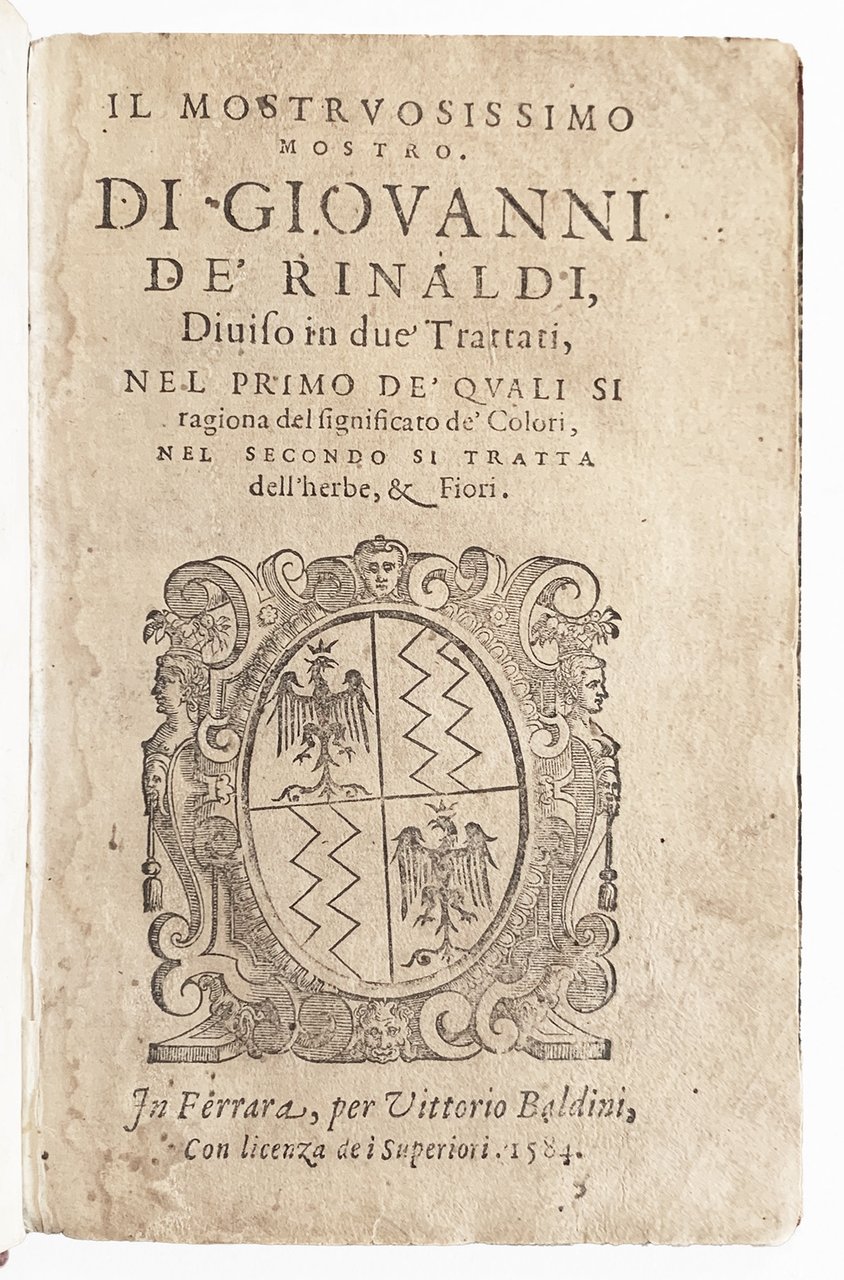


Il mostruosissimo mostro. Di Giovanni de' Rinaldi, diviso in due Trattati, nel primo de' quali di ragiona del significato de' Colori, nel secondo si tratta dell'herbe, & Fiori
Il mostruosissimo mostro. Di Giovanni de' Rinaldi, diviso in due Trattati, nel primo de' quali di ragiona del significato de' Colori, nel secondo si tratta dell'herbe, & Fiori | Libri antichi e moderni | RINALDI, Giovanni (fl. 2nd half of the 16th cent.)
Metodi di Pagamento
- PayPal
- Carta di Credito
- Bonifico Bancario
- Pubblica amministrazione
- Carta del Docente
Dettagli
- Anno di pubblicazione
- 1584
- Luogo di stampa
- Ferrara
- Autore
- RINALDI, Giovanni (fl. 2nd half of the 16th cent.)
- Editori
- Vittorio Baldini
- Soggetto
- Quattro-Cinquecento
- Stato di conservazione
- Mediocre
- Lingue
- Italiano
- Legatura
- Rilegato
- Condizioni
- Usato
Descrizione
8vo (150x95 mm). 128 pp. Collation: A-H8. Several errors in pagination. On the title page woodcut arms of the dedicatee, Livia Thiene. Woodcut initials, head- and tail-pieces. Roman and italic types. 19th-century half calf gilt (slightly worn and rubbed). Bookplate “Bequest of Kenneth K. Mackenzie October 1934”. Embossed stamp on p. 71. Title page soiled and browned with a dampstain along the gutter, some occasional foxing and light browning.
Rare first edition (first issue with the pagination errors in quire E not corrected). The dedication to Livia Thiene is signed by the author from Ferrara, on 30 June 1584. The work was reprinted in Ferrara in 1588, in Venice in 1592, 1599, 1602, 1611, and 1626, in Pavia in 1593 under a different title (Il Vago et diletteuole giardino), in Brescia in 1599 and 1619, and more recently in Lavis in 2018.
The work is divided into two parts. The first part explores the meaning of all colors, drawing extensively on different sources and examples. The second part, on the other hand, is a sort of lexicon of everything that can be given as a gift, with each entry referencing its symbolic value - from flowers and herbs to hair, from the unicorn to the snail, from the lute to licorice, and so on.
“Giovanni de' Rinaldi's Il Mostruosissimo mostro is a sort of summary of the earlier treatises on colors, like those by Fulvio Pellegrino Morato, Antonio Telesio, Simone Porzio, Sicillo, Lodovico Dolce, and Luca Contile, and it has the merit of illustrating what it says about the symbolism of colors with passages from modern authors, frequently citing Ariosto. Rinaldi flattered himself that his work would be well-received by readers, offering them the means to ‘make clear to their dear and beloved women the joys, the sorrows, the sighs, and the unbearable passions that they suffer in following and loving them' (l. 2b). The discussion is preceded by a Sonetto dei Colori similar to that of Morato. The first part of Rinaldi's work proceeds by illustrating the sonnet line by line, drawing on many classical examples, as previous treatise writers had done, but also with abundant references to vernacular poets, especially Petrarch, Ariosto, and Tasso; and there is certainly no shortage of curious and extravagant observations. The second part of his treatise is an alphabetical dictionary of everything that can be given as a gift, featuring the most bizarre and strange symbolic interpretations” (cf. A. Salza, Imprese e divise d'arme e d'amore nell' “Orlando Furioso” con notizia di alcuni trattati del ‘500 sui colori, in: “Giornale storico della letteratura italiana”, 38, 1901, pp. 327-328).
Edit 16, CNCE30123; USTC, 852609.