Abramo e Isacco
Abramo e Isacco | Stampe | TESTA detto "Il Lucchesino" Pietro
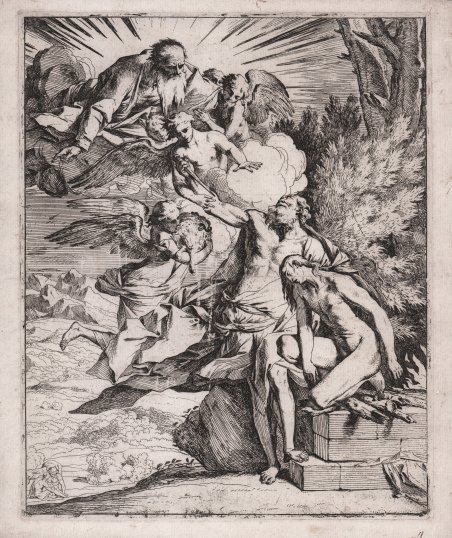
Abramo e Isacco
Abramo e Isacco | Stampe | TESTA detto "Il Lucchesino" Pietro
Metodi di Pagamento
- PayPal
- Carta di Credito
- Bonifico Bancario
- Pubblica amministrazione
- Carta del Docente
Dettagli
- Anno di pubblicazione
- 1640
- Formato
- 235 X 290
- Incisori
- TESTA detto "Il Lucchesino" Pietro
Descrizione
Il sacrificio di Isacco, con un angelo che trattiene la mano di Abramo. Acquaforte, 1640-42 circa, priva di firma e indicazioni editoriali. “Harris and Brigstocke place this etching in the 1630s, whereas Bellini considers it to belong to Testa's last years, or between 1645 and 1650, relating it to the series of the story of the Prodigal Son. The delineation of the landscape is far more delicate here, however, and the etched line of the fluttering draperies and the contours more finely modulated. In these respects, the print is closer to The Adoration of the Magi, even though the angels are no longer the infants that Testa had favored up to this point. They correspond instead in their age and appearance to the adolescent Isaac seen here on the altar and resemble, for example, those in drawings for The Holy Family with Saint Anne and Angels and in the painting of The Presentation of the Virgin in the Temple. As in The Adoration of the Magi and the painting An Allegory of the Massacre of the Innocents, Testa represents a second episode in the landscape, although here the relationship is not sequential. According to the account in Genesis 22: 1-14, Abraham left behind with the ass the men who had accompanied him as he went to the mountain to sacrifice Isaac. Testa emphasizes the mystery of God's intervention by showing these men with the ass seated unaware in the sunshine lower down the hillside as one angel stays Abraham's arm and another brings the sacrificial ram. Meijer and Van Tuyll have observed that Testa's invention may be connected to the terracotta relief of the same subject by Alessandro Algardi, probably from the late 1630s (now in the Seattle Art Museum). There are many differences between the two, and the motif of the angel grasping the sword is not unique to Algardi's invention, but the proportions and appearance of Testa's figure of Abraham may well indicate his knowledge of the relief. Testa may also have known Domenichino's painting of this subject (now in the Museo del Prado, Madrid, and possibly sent to Spain in 1636), in which the angel also removes the dagger from Abraham's hand and a brilliant landscape is similarly juxtaposed to the shady trees behind Abraham, whose features likewise resemble those portrayed by Testa. The uncontrolled open biting close to the edges of the plate, especially near the lower border, the vertical white spaces where the horizontal etched lines are broken near the angel with the ram, and the accidentally inked scratches appear in all impressions of this print. Despite his careful preparation of the invention through detailed studies, Testa was clearly not especially concerned about the thorough polishing and cleaning of the plate. The flaring in the dark shadows around Isaac's groin and in the head of the angel bearing the ram suggests that the ground was not hard enough to withstand the bite where many lines were worked close together” (cf. Elizabeth Cropper, Pietro Testa, pp. 145-149). Magnifica prova, ricca di toni, impressa su carta vergata coeva con filigrana “giglio su monti nel doppio cerchio”, con margini di circa un centimetro, in ottimo stato di conservazione. Bibliografia Bartsch, Le Peintre graveur (XX.215.2); Cropper, Pietro Testa, Prints and Drawings (71.I); Bellini, Pietro Testa, n. 26. The sacrifice of Isaac, with an angel staying Abraham's hand. Etching, circa 1640-42, unsigned. “Harris and Brigstocke place this etching in the 1630s, whereas Bellini considers it to belong to Testa's last years, or between 1645 and 1650, relating it to the series of the story of the Prodigal Son. The delineation of the landscape is far more delicate here, however, and the etched line of the fluttering draperies and the contours more finely modulated. In these respects, the print is closer to The Adoration of the Magi, even though the angels are no longer the infants that Testa had favored up to this point. They correspond instead in their age and appearance to the adolescent Isaac seen here on the altar and resemble, for example, those in drawings for The Holy Family with Saint Anne and Angels and in the painting of The Presentation of the Virgin in the Temple. As in The Adoration of the Magi and the painting An Allegory of the Massacre of the Innocents, Testa represents a second episode in the landscape, although here the relationship is not sequential. According to the account in Genesis 22: 1-14, Abraham left behind with the ass the men who had accompanied him as he went to the mountain to sacrifice Isaac. Testa emphasizes the mystery of God's intervention by showing these men with the ass seated unaware in the sunshine lower down the hillside as one angel stays Abraham's arm and another brings the sacrificial ram. Meijer and Van Tuyll have observed that Testa's invention may be connected to the terracotta relief of the same subject by Alessandro Algardi, probably from the late 1630s (now in the Seattle Art Museum). There are many differences between the two, and the motif of the angel grasping the sword is not unique to Algardi's invention, but the proportions and appearance of Testa's figure of Abraham may well indicate his knowledge of the relief. Testa may also have known Domenichino's painting of this subject (now in the Museo del Prado, Madrid, and possibly sent to Spain in 1636), in which the angel also removes the dagger from Abraham's hand and a brilliant landscape is similarly juxtaposed to the shady trees behind Abraham, whose features likewise resemble those portrayed by Testa. The uncontrolled open biting close to the edges of the plate, especially near the lower border, the vertical white spaces where the horizontal etched lines are broken near the angel with the ram, and the accidentally inked scratches appear in all impressions of this print. Despite his careful preparation of the invention through detailed studies, Testa was clearly not especially concerned about the thorough polishing and cleaning of the plate. The flaring in the dark shadows around Isaac's groin and in the head of the angel bearing the ram suggests that the ground was not hard enough to withstand the bite where many lines were worked close together” (cf. Elizabeth Cropper, Pietro Testa, pp. 145-149). A fine impression printed on contemporary laid paper with “double encircled flur-de-lys over mountains” watermark, with margins, very good conditions. Bibliografia Bartsch, Le Peintre graveur (XX.215.2); Cropper, Pietro Testa, Prints and Drawings (71.I); Bellini, Pietro Testa, n. 26. Cfr.