Adorazione dei pastori
Adorazione dei pastori | Stampe | CHAPERON Nicolas
Adorazione dei pastori
Adorazione dei pastori | Stampe | CHAPERON Nicolas
Metodi di Pagamento
- PayPal
- Carta di Credito
- Bonifico Bancario
- Pubblica amministrazione
- Carta del Docente
Dettagli
- Anno di pubblicazione
- 1649
- Formato
- 385 X 205
- Incisori
- CHAPERON Nicolas
- Descrizione
- TIB, 4725.105
Descrizione
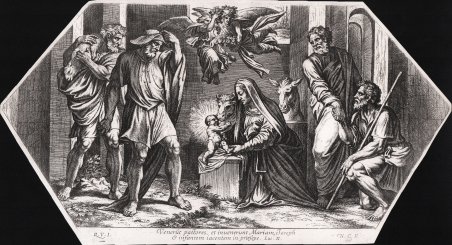
Venerut pastores, et invenerunt Mariam, Joseph e infantem iacentem in praesepe. Acquaforte, da un soggetto di Raffaello. Della serie Sacrae Historiae Acta a Raphael Urbin in Vaticanis Xystis ad Picturae Miraculum Expressa. La serie "Sacrae Historiae Acta a Raphael Urbin in Vaticanis Xystis ad Picturae Miraculum Expressa" riproduce la sequenza completa degli affreschi realizzati da Raffaello Sanzio nelle Logge Vaticane. Si compone di 54 tavole: una dedica a Raffaello, un frontespizio con un testo dedicatorio a Renard e cinquantadue tavole che riproducono gli affreschi di Raffaello. La dedica e il frontespizio non sono numerati, mentre le tavole che riproducono gli affreschi sono numerate da 1 a 52. La serie fu incisa da Nicolas Chaperon e pubblicata a Roma nel 1649. Il ciclo di affreschi della Logge, noto anche come Bibbia di Raffaello, è stato ampiamente riprodotto nel corso del XVII secolo: Badalocchio e Lanfranco nel 1605/06, Aloisi Galanini nel 1613, Borgianni nel 1615, Villamena nel 1626, Aquila e Fantetti nel 1675. Tra i migliori allievi di Simon Vouet, Nicolas Chaperon si trasferì a Roma nel 1642 e si affiancò allo stile classicista di Nicolas Poussin. Fu proprio quest'ultimo pittore che, tramite l'incarico ricevuto dal re di Francia, gli commissionò le 54 lastre incise raffiguranti le più famose pitture di Raffaello. Se ne conoscono 4 stati presentati con due frontespizi (come da tradizione quindi 52 riproducenti i dipinti e due frontespizi): il più raro presenta nel frontespizio le parole Ille ego sum Raphael e la seconda tavola senza la dedica, il secondo ha la dedica e l'aggiunta cum Privilegio Regis, il terzo con l'aggiunta nel cippo presente nel frontespizio Lutetiae Parisiorum e con l'excudit del Mariette, infine il quarto ritoccato e pubblicato tra Sei e Settecento. Ogni tavola è doppiamente firmata, R.V.I. ovvero Raphael Urbinas Invenit e N.C.F. equivalente di Nicolas Chaperon Fecit. Le tavole sono fin dalla data della loro esecuzione considerate le più fedeli agli affreschi e le più vicine al gusto classico in voga in quegli anni tra Roma e Parigi. Acquaforte impressa su carta vergata coeva, rifilata al rame o con sottile margine, in ottimo stato di conservazione. Bibliografia Robert-Dumesnil 1835-71, Le Peintre-Graveur Français (VI.216.1); Laveyssière, Jacquot and Kazerouni, 'Nicolas Chaperon', 1999, pp.159-171. Venerut pastores, et invenerunt Mariam, Joseph e infantem iacentem in praesepe. Etching, from a subject d Raphael. From the series Sacrae Historiae Acta a Raphael Urbin in Vaticanis Xystis ad Picturae Miraculum Expressa. The series 'Sacrae Historiae Acta a Raphael Urbin in Vaticanis Xystis ad Picturae Miraculum Expressa' reproduces the complete series of frescoes painted by Raphael in the Logge. It consists of 54 plates: a dedication to Raphael, a title-page with a dedicatory text to Renard, and fifty-two plates reproducing Raphael's frescoes. The dedication and the title-page are not numbered, while the plates reproducing the frescos are numbered from 1 to 52. The series was engraved by Nicolas Chaperon and published in Rome in 1649. The series of frescoes in the Logge, also known as Raphael's Bible, has been widely reproduced throughout the 17th century: Badalocchio and Lanfranco in 1605/06, Aloisi Galanini in 1613, Borgianni in 1615, Villamena in 1626, Aquila and Fantetti in 1675. One of Simon Vouet's best pupils, Nicolas Chaperon moved to Rome in 1642 and joined the classicist style of Nicolas Poussin. It was the latter painter who, through the commission he received from the king of France, commissioned from him the 54 engraved plates depicting Raphael's most famous paintings. Four are known to have been presented with two frontispieces (as per tradition therefore 52 reproducing the paintings and two frontispieces): the rarest one presents in the frontispiece the words Ille ego sum Raphael and the second plate without the dedication, the second has the dedication and the addition cum Privilegio Regis, the third with the addition in the cippus present in the frontispiece Lutetiae Parisiorum and with the excudit of Mariette, finally the fourth retouched and published between the seventeenth and eighteenth centuries. Each plate is doubly signed, R.V.I. or Raphael Urbinas Invenit and N.C.F. equivalent of Nicolas Chaperon Fecit. The plates are from the date of their execution considered the most faithful to the frescoes and the closest to the classical taste in vogue in those years between Rome and Paris. Etching impressed on contemporary laid paper, trimmed to copper or thin margin, in very good condition. Bibliografia Robert-Dumesnil 1835-71, Le Peintre-Graveur Français (VI.216.1); Laveyssière, Jacquot and Kazerouni, 'Nicolas Chaperon', 1999, pp.159-171. Cfr.